WARNING: POTENTIAL SPOILERS AHEAD FOR EVERY SEASON OF ELITE.
One of the most moving moments during Left Coast Crime came during Raquel V. Reyes’ acceptance speech for Best Humorous Mystery for Mango, Mambo, and Murder. Raquel spoke very eloquently about her love for the crime fiction genre, and why it was so important for her to write a Latina sleuth heroine in her series: “Representation matters,” she emphasized, her voice breaking a little bit. This naturally got me to thinking about representation and its importance. It reminded me of the weird little boy in Chicago (and later, in the suburbs and on the plains of Kansas) who believed he was so weird, unnatural, and anything but normal; and how those rare appearances of gay men in fiction–scattered here and there in paperbacks–meant so much to me and made me feel, even if just for a moment, that I wasn’t strange and weird and an outsider. There were people like me out there somewhere, and maybe, just maybe, someday I’d find them and my community and feel like, finally, I belonged somewhere.
I was thinking about this very thing as Paul and I binged our way through Season 5 of our favorite show, Elité, on Netflix recently (the new season dropped while I was in Albuquerque).
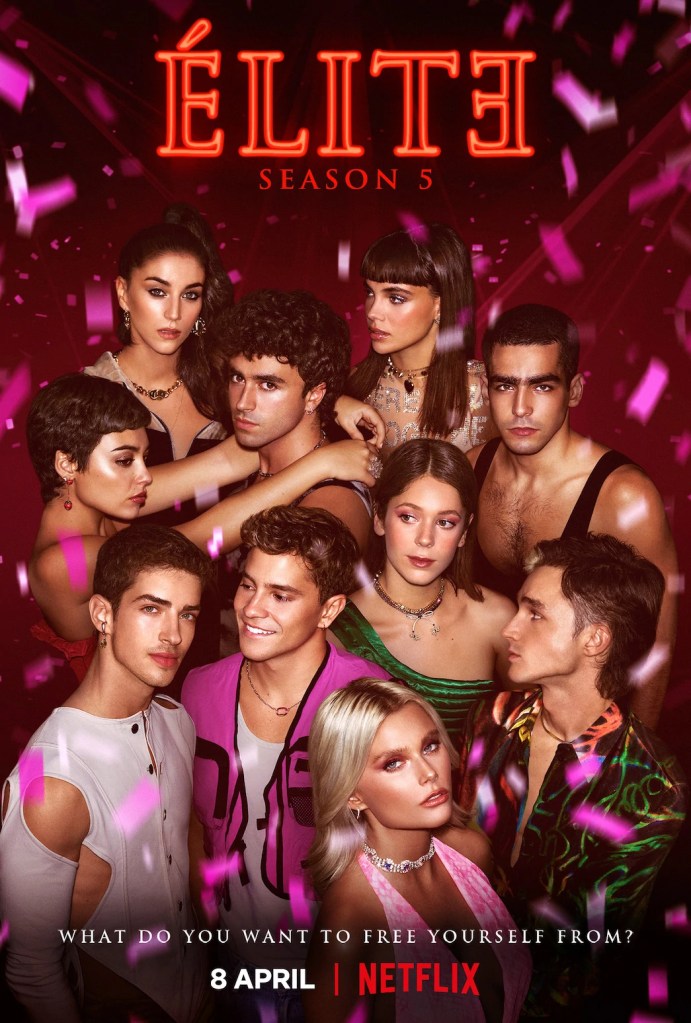
I don’t remember how, when, or why Paul and I started watching Elité, but I am so glad we did. I know it was pre-pandemic, because I do remember both of us being concerned about when the fourth season would drop and whether it would be delayed because of the pandemic. But regardless of when we started watching, this Spanish-language Gossip Girl type show (far, far superior to Gossip Girl, sorry, stans, don’t @ me) really captured our imaginations and we became full fledged addicts. (The best way to describe the show is as a terrific hybrid of Gossip Girl and How to Get Away with Murder, yet better than both). I think part of it was the great cast–everyone was not only gorgeous, but they were remarkably talented as well, and the writing/plotting/story construction was superb; take note, American television series. I also greatly enjoyed the Ander/Omar romance, which began with both deeply closeted and meeting guys on hook-up apps, which is how they met. They began building a relationship, coming out to friends and family–it didn’t go well with Omar’s Palestinian parents–and their romance was given equal weight to that of their straight cast members; I don’t recall many shows where that happens. It was handled very well, and they literally became one of the show’s “super couples”, to borrow a daytime soap term. Fans loved them, and their romance was handled so beautifully that I was impressed, all the way from the terrors of the closet to fears about acceptance to actually coming out and developing a romance, with all the drama and upheavals young straight couples usually have to deal with. Omar and Ander were no different from any other romantic couple on the show; their story was just as important as the others, and there was never any sense of “oh they’re just pandering because we’ll always watch something with gay representation on it.”
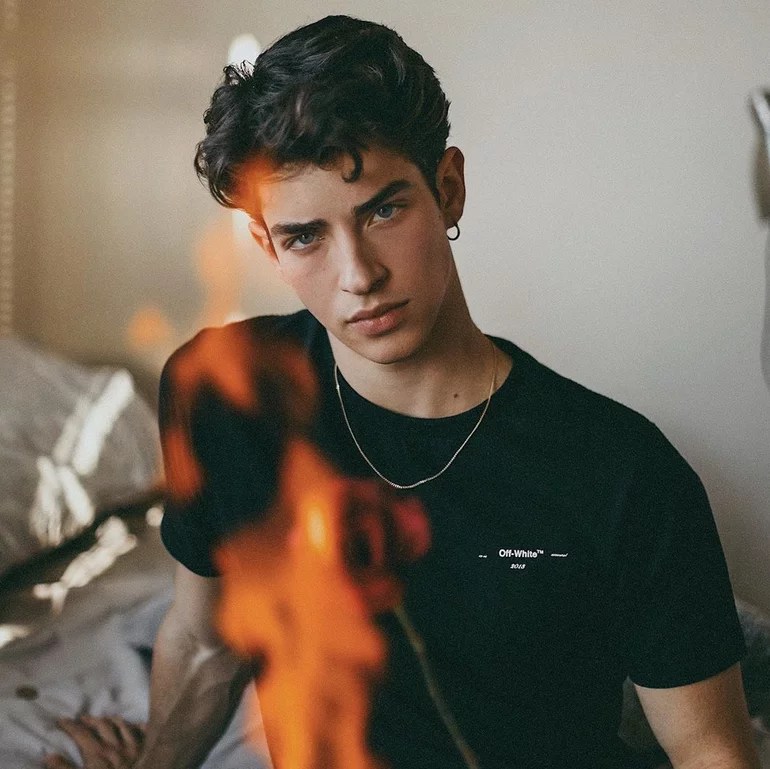
And it wasn’t just Omar and Ander, either. Polo and Carla were in a long-term relationship since they were children; deeply in love and yet somehow bored with each other, both found themselves attracted to sexy new student Cristian; and that progressed from Polo watching Cristian and Carla together to joining them! Polo’s sexuality became a bit more murky than it was at the beginning. Is he bisexual, pan, or are they all three polyamorous? Carla and Polo end up breaking up and Cristian left the show after a tragic accident; but the intricacies and intrigues from their long-term relationship continued to play out and affect their storylines as well as others along the way. A lesbian romance was introduced into season 4, as well as a new villainous gay character, whose entire purpose was simply to be rebellious against his father and try to come between Omar and Ander. Played by the strikingly beautiful Manu Rios, I liked the idea of a manipulative gay villain (think Erica Kane as a gay man), but hoped they would flesh him out more. I felt Manu Rios was more talented than the material they were giving him, and hoped that in Season 5 we’d get to know him better.
(There are many other reasons I love the show–the other characters are also incredibly well developed, and their behavior fits their characters as they’ve developed along the way; no one ever acts in a way that doesn’t feel realistic simply to suit a story-line, something else American show runners should pay attention to.)
Season 5 literally dropped the Friday night I was in Albuquerque, and as soon as I got back to New Orleans, Paul and I started watching, and binged the entire season in like two nights. Season 4 wasn’t as good as the first three seasons (the bar was set high, to be fair), but it was also a transitional season; at least half of the cast graduated at the end of season three and thus left the show–which I thought was probably a good thing, despite losing some absolute favorite characters from those earlier seasons. Season 4 transitioned the story as the show added new cast members to replace those who’d left; so we didn’t enjoy it as much as we could have (more original cast members departed at the end of season 4) and so I was worried that Season 5 wouldn’t be as good, either…but I am delighted to report I was totally wrong on that score. -With Season 5, the show is back at the incredibly high level/standard it set for itself in those first three seasons, and while it is very hard to compare the one season with the interconnected stories of those first three, I don’t know. Season 5 might just be my favorite.
And of course, now that we’ve seen Season 5, the stage has been set for a very strong new, sixth season, and I literally cannot wait.
But the primary strength of this most-recent season comes from the further development of the character of Patrick, played by the stunningly beautiful young actor Manu Rios, through a truly terrific storyline that let us see sides of Patrick we’ve not seen before.
I mean, look at that stunning face.
The body isn’t too shabby, either.


Patrick joined the cast of characters, as I mentioned, in season 4. The openly gay character was primarily brought in as an agent of chaos: self-absorbed, narcissistic and rebelling against his strict father (the new principal), his role in season 4 was primarily to cause drama and disruption between the long-running gay romance storyline between Omar and Ander (again, and it can’t be said enough, how lovely was the Omar/Ander storyline, where a gay couple in a soapy show got the kind of story usually reserved for opposite sex teen couples?), so he was kind of a villain character–striking out angrily whenever he was hurt but inevitably causing more trouble for himself than for others, but the role was played with such sensitivity and style by Manu Rios that we as viewers couldn’t hate him the way we should have, the way we wanted to; since he was really “the other guy” and causing trouble between the already fraught Ander/Omar relationship we were all rooting for. Patrick was really nothing more than the latest obstacle to their happily ever after; but when Ander also left the show after season four, I wondered if Patrick and Omar would pick back up–it didn’t seem likely, but they were the gay characters, so…
And even I didn’t fully appreciate how talented Manu Rios was during season four–but that changed in a matter of moments in Season 5. I mean, I could see he was beautiful–anyone with eyes can see that–but could he turn what was essentially a one-note character into someone who seemed perfectly real to the viewers?
The answer was yes yes a thousand times yes.
You see, there’s a new student at Las Encinas in season 5, who catches Patrick’s eye on his first day: Ivan Carvalho, played by André Lamoglia.
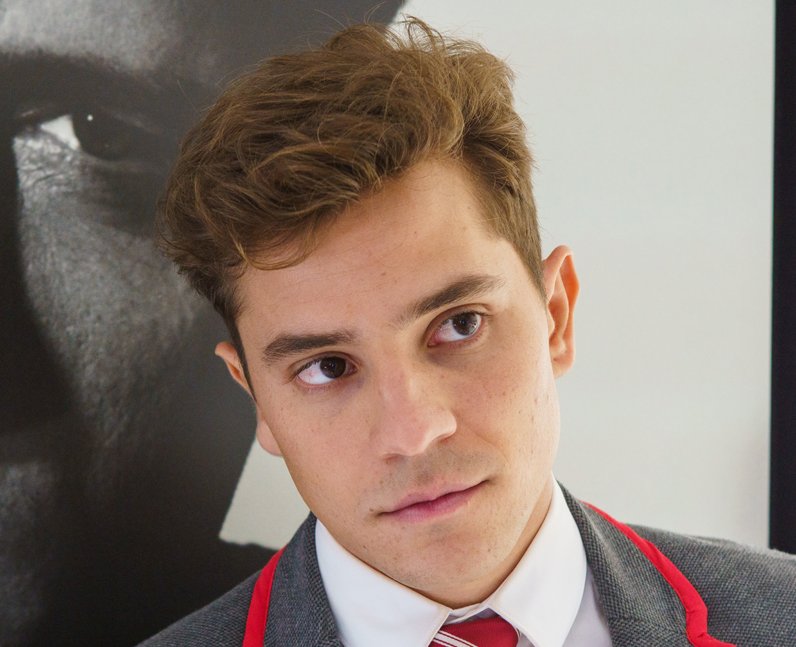
This picture doesn’t do him justice in the least, either. He’s beautiful. And the way his face lights up when he smiles–utterly irresistible. (Lamoglia is also a remarkably good actor.) His father is a world-famous soccer player, Cruz Catalho, and there’s no sign or mention of Ivan’s mother. But Cruz lives the good life of the hard-partying rich superstar, often telling his uptight son–who’s moved around the world following his father’s career, unable to make lasting friends or set down roots anywhere as a result–to loosen up. Ivan just wants a normal life–with Cruz always telling him to relax and enjoy the great life Cruz is able to provide for him.
And the character is so kind and loving and understanding…it’s easy to see why Patrick would not only be attracted to him for his looks but drawn to him as a person. He sees Patrick in a way no one else ever has before. It’s impossible not to root for them to fall in love with each other.

Ivan first comes to Patrick’s attention when he is looking for directions to the high school locker room–which, at the time, didn’t strike me as odd but now looking back, it kind of does; he was in his gym clothes and in need of a shower, but I SUPPOSE that it’s entirely possible he could have gotten turned around–new school and all, I guess. Immediately interested and attracted to this handsome stranger, Patrick not only gives him directions but offers to take him there “since I was on my way there anyway.” They talk as they shower–but Ivan is onto Patrick; after the shower he points out with a smile, “you just wanted to shower with me to see me naked” he teases, pointing out Patrick’s arousal. As I mentioned, Ivan is breathtakingly gorgeous. When he smiles, you can’t do anything but melt. And yet, the two boys have undeniable chemistry.
But Ivan is straight. He keeps telling Patrick this, over and over again, but…

We actually first meet Ivan as he is getting ready for school, climbing over the passed out bodies in the living room to see if his father will drive him to school. Instead, Cruz winds up hugging the toilet and telling Ivan to take the car. During his first initial meeting with Patrick, Ivan definitely points out that he isn’t gay, but he’s not put off by Patrick’s sexuality, either. They can be friends–but that’s all it’s going to be. He knows Patrick is attracted to him, and he’s a bit of a tease; sending mixed signals that confuse and anger Patrick.

This, too, is an old trope of a story, and I was really not overly thrilled with it; it’s clichéd and one of the tired old reasons the homophobes trot out whenever they want to deny us our rightful place in society and culture: we want to convert everyone.
Because it’s just that easy.
But at the same time, Patrick’s desperate crush on his new straight best friend isn’t played as exploitative. There’s more there than just him being a cocktease, really; Ivan clearly cares very deeply for Patrick, and their friendship means a lot to him. He cares, and this is a new experience for Patrick; he isn’t used to anyone genuinely caring for him. He’s a disappointment to his father, he loves his sisters but those relationships are very tense, and he really just wants to be loved. So the fact that he has found someone who genuinely loves him is confusing; he loves being loved, but he is also strongly attracted to Ivan, in love with him (at one point Ivan teases him, “you’ve fallen for me”) and isn’t sure how to react or behave or what. Ivan is attracted also to Patrick’s sister Ari–and the heartbreak when Patrick sees them together is completely believable; and it’s all done in his incredibly expressive face. After seeing Ivan and Ari having sex on a boat on the lake…heartbroken Patrick goes back to the dock and sits there, hating himself and hating his life. While he’s sitting there, Ivan’s father Cruz comes out there–they’ve already had a couple of run ins already, and Patrick is on to the fact that Cruz isn’t as straight as he acts–and as Cruz comforts Patrick–they begin to kiss!
Did. Not. See. That. Coming.
At the time, I was rather impressed with the writing, frankly. What better set-up for drama than having Patrick, in love with Ivan, wind up in a relationship with Ivan’s dad? (Yes, aware of the creepiness of an adult man sleeping with a high school student; yet I still thought it make an interesting story.) But the writers are even more clever than that.
Patrick winds up comforting Ivan after his brief little fling on the water with Ari–who no longer wants to even speak to him–and the two boys go back to the Carvalho household. Cruz isn’t happy with this–he has his own developing feelings for Patrick, so he acts homophobic, but privately he invites Patrick to join him later after Ivan falls asleep. Later, when Patrick cleans up before bed and walks into Ivan’s room, he sees Ivan watching porn and they come oh-so-close again to something physical happening…but Ivan pulls aways again. Frustrated and hurt AGAIN, Patrick goes to the guest room. While watching porn on his phone and masturbating, he gets a text from Cruz asking is Ivan asleep yet? Hating himself but hurt AND horny, Patrick gets up to go join Cruz–but when he walks out of the guest room Ivan is there in the hallway.
IVAN: I can’t sleep.
PATRICK: Count sheep.
IVAN: No, no, I want you to come back to my room with me.
PATRICK: You need to stop. I am going to get really angry with you.
IVAN: I can’t stop thinking that…what if…because of prejudice or fear or something…what if I am missing out on something amazing…with someone amazing…who makes me feel amazing.
PATRICK: Stop.
Ivan then tries to kiss Patrick, but awkwardly. Patrick pushes him away, and Ivan apologizes. “I’m sorry, I’m just really nervous but I want this.”
The look on Patrick’s face literally made me tear up as he said, “No, let me.” And then they kiss. When Patrick pulls away he says, “Are you okay?”
Ivan smiles and just nods, and the two boys go back to Ivan’s room.
What followed was the most amazing slightly longer than five minutes gay sex scene I’ve ever seen outside of gay porn. But it wasn’t raunchy (it’s definitely not gay porn); it was sensual and beautiful and erotic; an expression of love between two young men who’ve never been really in love before. It wasn’t all candlelight and roses; it was Ivan’s first time (at one point, he’s doing oral on Patrick for the first time, and Patrick stops him–“watch the teeth!” I defy anyone to find a gay man who has never said that or had that said to him once in his life. ) and while i know rimming scenes have become more commonplace on cable shows, I’ve never seen two males do it as realistically as it was done here. Patrick allows Ivan to top him, and even that was realistic, honest, authentic. The entire thing was beautifully shot and scored (EDIT: the song playing in the background is Brian Eno’s “By the River,” which is beautiful and perfect for this scene), and the acting was fucking fantastic (the pun was deliberate). I literally got tears in my eyes.

There were three more episodes in the season after this–with ups and downs and more pain and heartache for the two–but it all comes together in the incredible season finale, which again left me in tears.
This entire season could have simply focused on Patrick and Ivan’s story, and I would have been happy. But the other storylines of the season–which didn’t seem all that great in the first half–coalesced in the second half of the season, with twists and surprises and suspense; this show is fantastic at surprise twists that make you gasp.
But this story…wow. How much of a difference would it have made in my life to have seen something like this play out on a television series when I was a teenager? Even in my early twenties? Both young actors are fantastic. The acting is stellar, and I have to admit it’s one of the few times I’ve seen a gay storyline play out like this where I was absolutely 100% convinced they were in love with each other, was rooting for them, wanted them to end up together against all the odds.
Manu Rios and André Lamoglia steal the fifth season right out from under the rest of the cast–which is no small feat, as Elité’s biggest strength has always been its incredibly talented cast.
I loved this show already, but I love it all the more now. I have no idea what they are going to do with Ivan and Patrick for the next season; but whatever it is, I am here for it…and so are the rest of the fans of the show around the world. (Yes, I did a deep dive the other day on-line; Patrick and Ivan and their story are the breakout stars of season 5…as they should be.)
I would seriously write Patrick/Ivan fanfic.
Bravo, Elité and Netflix, and thank you.

 Queer and Loathing in America