Paperback Writer

John Copenhaver, one of queer crime’s latest (and brightest) stars recently (you should read his books, frankly; I am looking forward to his latest, Hall of Mirrors) wrote a brilliant essay on the concept of writing complex queer characters, and the artistic need to push beyond ‘gay is good’ messaging and not worrying about the question of role models which you can read by clicking here. I highly recommend it–it’s well thought, reasoned, and stylishly written, and the kind of thing I wish I could write.

But reading this essay made me think about my own work, the pressures I’ve had–either real or imagined–about representation and addressing social issues through the framework of queer people and characters, and made me think about the work I do from not only a creative view (which is how i always view my work) but from a cultural, political, and societal perspective. That’s not something I’ve ever really consciously done (“oh, let’s make this political“) but one thing I’ve never done is worry about how straight people might react to my work…primarily because it isn’t really for them that I write my books in the first place. If my work offends straight people that isn’t my problem, nor is their whining about how queer people see and perceive them…and it’s not like there aren’t millions of books designed as comfort reads for cishet white people. I’ve also never understood taking offense at a book. I’ve read plenty of books whose point of view I’ve neither understood nor care to; and I tend to not read anything that I think is going to either offend me or be antithetical to everything I read–I tend to avoid Westerns, international spy thrillers, and war novels, and mostly for the same reason I tend to avoid most cishet white male authors. Your work isn’t written for me, and I can’t imagine westerns to be not problematic1–likewise, I’m not interested in reading about toxic male he-men that are racist rah-rah-rah books to make white men feel better about themselves (you know who you are) and so I avoid covers that pretty much spell out to me what the contents are going to be–women who exist only to be beautiful sex toys, any gay characters are offensive stereotypes and usually die, and so on and so forth; I love my country in spite of its flaws, and that love is strong enough to bear critiques on our nation and the people who run it, so I don’t need to read fiction designed to make me thump my chest and scream AMERICA LOVE IT OR LEAVE IT at anyone who dares critique the country and its domestic and foreign policies.

If cishet white people enjoy my work, fine. If they don’t, well, as I said it isn’t intended for them in the first place.

first author photo

When I first dreamed of being a writer, it never occurred to me to write about gay characters or themes. I was a child, for one, and for another that child was terrified that anyone might figure out that I wasn’t one of the “normies”, and what I actually was inside was something they’d all view with contempt. When I was a kid I wanted to write a kids’ series, like Nancy Drew or the Hardy Boys, and even came up with multiple different ones that I wanted to write, and came up with a rather lengthy list of titles for the books (which I still have, because I’d still like to try this at some point before I die), and gradually moved on to wanting to write other styles of books as I got older and began reading more. My addictions to soaps, both daytime and nighttime, during the late 1970s thru the early 1990’s, had me looking at writing more about towns and large casts of characters, and I always wrote a murder mystery into my ideas for these Peyton Place type novels I wanted to write; I also wanted to write Gothic suspense novels, and Stephen King had me also wanted to write mainstream horror novels…and later on, I moved into wanting to write horror/suspense/crime novels for young people.

It wasn’t until I met Paul, and I found gay bookstores, that I realized I could write gay stories and themes and characters, and I decided I wanted to write gay crime novels, set in New Orleans, and so that’s what I set out to do, starting a novel called The Body in the Bayou, which I had already thought up as a series about a straight Houston private eye–so I made the main character gay and moved it to New Orleans. I threw out the first ten chapters within two weeks of moving here, and started over again.

Promo photo for my old training business

And then I found myself in the conundrum John talks about in his essay so brilliantly; is it okay to have queer characters be the bad guy? Do we have to write all of our stories and novels from a thematic viewpoint that ‘gay is good’? Do we as creators have a responsibility to the community to only present queer people as heroic, or can they be flawed or even bad?
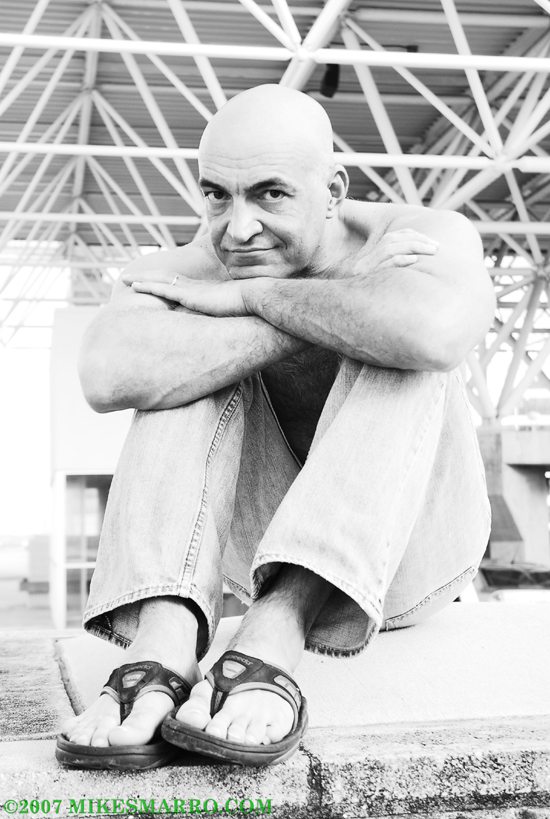
Author photo from 2007

I’ve talked about this before–how the idea for the case in Murder in the Rue Dauphine came to me, and I also worried about how the book would be received because I was explicitly creating a case and a world where not all queer people were good people. It was inspired by a gay man who came to New Orleans, got involved in the non-profit world here, threw a bunch of money around, and then disappeared overnight as his house of cards was about to collapse, stealing a shit ton of money and owing everyone a lot of money. That was when I realized how we always are welcoming to other queer people and we can sometimes overlook red flags and warning signs because you’re working with another queer person. We tend to give other queer people the benefit of the doubt and more chances than we would a straight person…and I wanted to explore that in fiction. Shining heroes without feet of clay also aren’t fun or interesting to write about, either.

Gay isn’t always good.
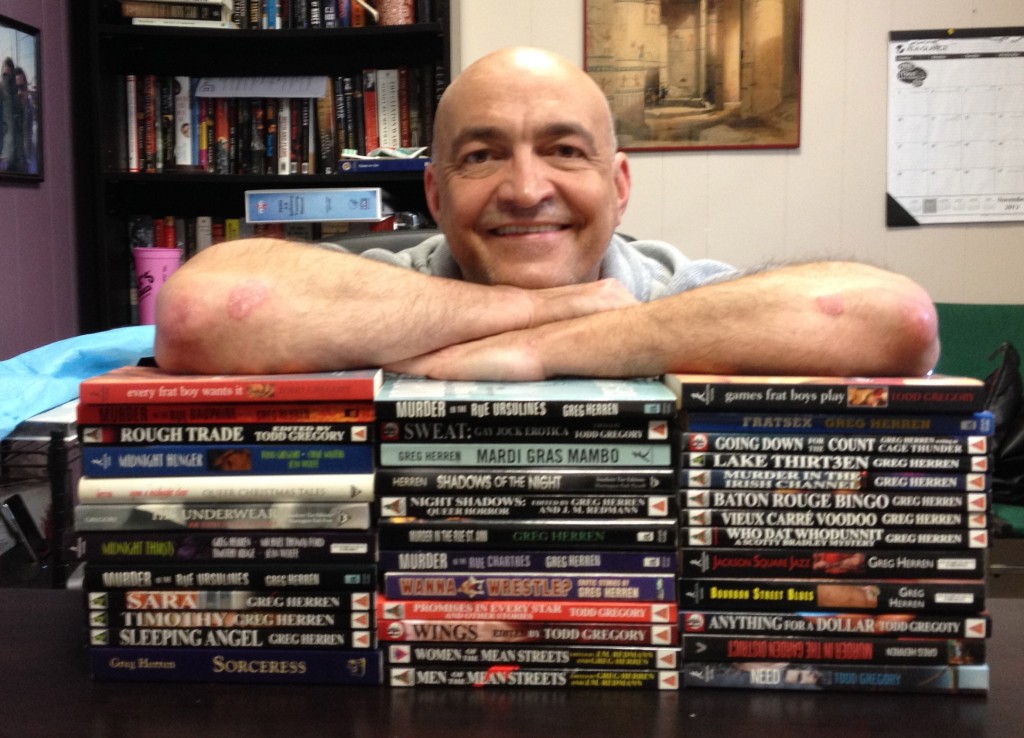
Most recent author photo, and I definitely need a new one.

And we aren’t doing our readers any services by creating “perfect” characters, either. Neither Chanse nor Scotty is perfect (although Scotty’s definitely an idealized person, I have to admit, but he does have flaws and blind spots) and the main characters in my stand alones are often messy, sloppy people who need to get out of their own way sometimes. Those are the kinds of characters I like to read about–because they are human.

I also find gay criminality enjoyable to read. James Robert Baker’s books were like being slapped in the face; full of gay anger and revenge and bitterness about the homophobic world in which we all exist–but Baker’s messy characters are active; they want revenge on the world and by God they are going to get it. The Ripley books by Patricia Highsmith are magnificent. Christopher Bollen’s A Beautiful Crime was terrific with its messy gay characters perpetrating a fraud.

I think we relate to and enjoy messy criminal queers because they are so relatable to us. There’s no worse feeling than powerlessness, the inability to control your own destiny and life, and always wondering …is it because I’m gay? I’ve gotten angry about this any number of times during my life, and I have always wondered somewhat would this happen to a straight man? and the answer is always no.

But do read John’s article. It’s very well done and thought provoking, and I’m going to let it simmer in my head for a while longer.

  1. Westerns would be a good discussion for another time, actually.
    ↩︎
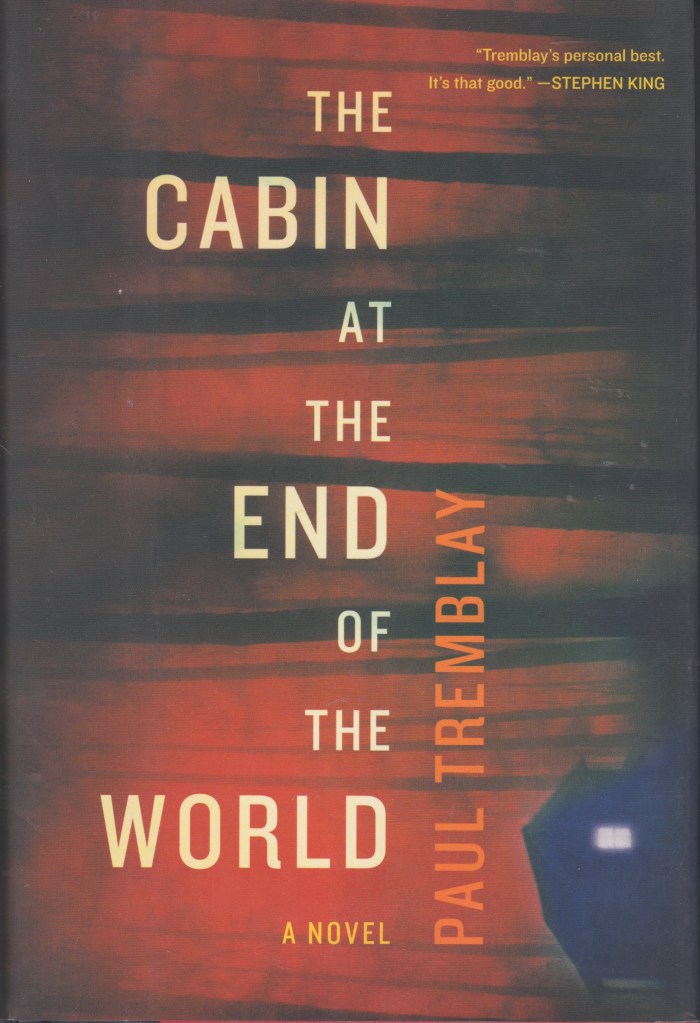
End Game

I’m really becoming a huge fan of Paul Tremblay.

I’ve always enjoyed horror, ever since I was a kid; I used to love watching Creature Features on WGN in Chicago, and getting scared–sometimes having nightmares. But the supernatural has always interested me, as well as horror; in the 1980’s and even into the early 1990’s I saw myself as becoming a horror writer rather than a crime writer. And while I’ve written some “scary” stories and novels, I don’t know that I could classify them as horror– I think Sara and Sorceress are probably the closest I’ve ever come to writing horror; maybe even Lake Thirteen would count (it certainly bears my favorite cover of all my novels). But I see myself as more of a fan of horror than a writer of it; as I’ve said many times, I tend to write more about human monsters than supernatural ones. I had heard great things about Paul Tremblay before I started reading his actual work; my friend Megan in particular is a big fan of his, and based on her recommendation I started reading A Head Full of Ghosts, but it didn’t really strike my fancy that first time, and so I put it aside and moved onto something else. I did pick it up again later, and then, of course, I couldn’t put it down.

After finishing The Coyotes of Carthage, I was looking through the TBR piles, pulled out a book or two before putting them back, and then finally decided to read a second Tremblay, The Cabin at the End of the World.

It was a most excellent choice.

The girl with the dark hair walks down the wooden front stairs and lowers herself into the yellowing lagoon of ankle-high grass. A warm breeze ripples through the blades, leaves and crab-like petals of clover flowers. She studies the front yard, watching for the twitchy, mechanical motion and frantic jumps of grasshoppers. The glass jar cradled against her chest smells faintly of grape jelly and is sticky on the inside. She unscrews the aerated lid.

Wen promised Daddy Andrew she would release the grasshoppers before they got cooked inside the homemade terrarium. The grasshoppes will be okay because she’ll make sure to keep the jar out of direct sunlight. She worries, though,, that they could hurt themselves by jumping into the sharp edges of the lid’s punched-in holes. She’ll catch smaller grasshoppers, ones that don’t jump as high or as powerfully, and because of their compact size there will be more leg-stretching room inside the jar. She will talk to the grasshoppers in a low, soothing voice, and hopefully they will be less likely to panic and mash themselves against the dangerous metal stalactites. Satisfied with her updated plan, she pulls up a fistful of grass, roots and all, leaving a pockmark in the front yard’s sea of green and yellow. She carefully deposits and arranges the grass in the jar, then wipes her hans on her gray Wonder Woman T-shirt.

Ironically, in my earlier paragraphs I talked about writing crime because I want my monsters to be human; ironically, the monsters in Paul Tremblay’s latest, sublime entry into the horror genre could easily be considered a crime thriller as well because his monsters are all too human, and this set-up is just as terrifying as any supernatural horror novel I’ve ever read. Being out in the country has never really appealed to me very much (ironically, my current work-in-progress is set out in the country) precisely because it’s no safer out in the country than it is in the city; at least in the city someone will hear your screams or cries for help. The very isolation of the country is part of its terror for me; in no less part because country people always smugly assert (and reassure themselves) that crime and murder are MUCH more likely to happen in the big, bad, dangerous city.

Sidebar: I still think there’s a terrific essay to be written about the proliferation of rural horror/crime novels in the 1970’s, directly tied to the inherent racism of white flight from integrated schools and neighborhoods to the suburbs and the country, and perhaps someday I will have the confidence to write the essay based on that abstract theme.

Tremblay has set his terrifying tale in a small cabin on a lake in upstate New Hampshire, close to the Canadian border, where our heroes–a married gay couple (Andrew and Eric) are spending a ‘back-to-nature’ vacation with their adopted child, Wen. The story is told in the present tense (always creepier in horror, seeing the action unfold as it happens rather than in the much safer past tense–it’s happening as opposed to it’s already happened) and the point of view shifts between the two dads and their young daughter. Wen is out on the lawn catching grasshoppers and naming them when a big man appears suddenly out of the woods, friendly and nice, he tries to win her over but ultimately fails, sending her running inside to warn her daddies that they are no longer alone in their rustic cabin–with no cell service and no wi-fi (which, ironically, was part of the cabin’s original appeal–to unplug; that appeal will righteously bite the in their ass now that a Dionysian influence has arrived in their idyllic world).

The big man, Leonard, isn’t alone; he has three friends with him, all wearing similar button-down shirts in different colors and jeans: Redmond, kind of an asshole every-straight-man; Sabrina, a nurse; and Adriane, who is older. As the three family members barricade themselves into the cabin, the four seemingly normal visitors let them know they are there to present them with a horrible, horrific choice: they have seen, in visions and dreams, that the apocalypse is nigh, but have been shown the cabin and the small family, and told that if one of them will voluntarily sacrifice himself, the end of the world will be stopped.

This is, of course, every parent’s worst nightmare: a threat to not only their family but to their child, and Tremblay does an amazing job of letting us, the readers, get to know all three of the family members, developing them into complicated, realistic characters with backstories and levels and layers; I also applaud him for writing about a same-sex family and making the characters absolutely real. (This is how you do it, people; read the book and take notes). Wen is completely believable as a little girl; the family bond and love is absolutely real; and that makes the horror even more horrible, more horrifying, more of a gut-punch…as we go through every step of the process with them, all over the course of less than twenty-four hours, as their lives are irrevocably altered and changed, as they refuse to believe the story of their visitors, but slowly but surely the wonder begins to creep in…what if this is absolutely real and they are indeed messengers from God?

I will leave it to the horror academics to discuss the symbols and symbolism threaded throughout the story–but I have to bring up the colors of the shirts the visitors are wearing, and the fact there are four of them: representing the four horsemen of the apocalypse along with their warnings of doom. The questions of faith, of existing as gay in a heterosexist society, of family and love–all of these are beautifully explored and written about, and the building of tension and suspense is unparalleled; it’s really hard to put the book down and walk away from the story without finding out how it all ends–will they make the sacrifice, or will the world end? Are the visitors right–and how will anyone ever know if they were, because the world not ending doesn’t prove anything if the sacrifice occurs.

Or are they just insane?

I highly recommend this book, and cannot wait to read more Tremblay.