Small Town

I’m never really certain how to describe where I’m from; because it isn’t simple. I was born in Alabama, which is where my people are from (which is what we say in Alabama), but we moved to Chicago when I was two. We lived in the city until I was ten, which is when we moved out to the suburbs. I was fourteen when we moved to Kansas, and nineteen when I followed my parents to California. Since California, I’ve lived in: Houston, Tampa, Houston, Tampa, Minneapolis, New Orleans, DC, and then back to New Orleans once and for all. So, saying I grew up in Kansas isn’t quite accurate, nor is I grew up in Chicago. I graduated from high school in Kansas, so there is that. I consider New Orleans home; I’ve certainly lived here longer than I have anywhere else in my life, but in a sense, I am kind of ‘homeless’ in that regard. I’ve always pretty much considered wherever my parents live to be home, even though now they live somewhere I’ve never actually lived–so I lazily say I’m going home to see my parents, even though their current home has never really been my home; I guess in that sense that wherever my parents are is home because my parents define, for me, where that indescribable, undefinable place that I call home would be. I also think of Alabama as home, too; though I haven’t lived there in fifty-five years and I have no memory of ever living there.

Does that make sense?

New Orleans is home for me now; Alabama is where I’m from, but I also consider anywhere my parents live to also be home.

Is it any wonder I am barely clinging to my sanity with my fingernails?

And yes, I lived in a very small town in Kansas: I believe the population of Americus was 932 when I lived there (that number is stuck in my head, so it came from somewhere), and moving there, even from a suburb of Chicago, was a bit of culture shock for me. (Not nearly as big as the shock must have been for my parents, moving from a mostly country existence in a remote part of Alabama to Chicago when they were twenty with two toddlers.) The streets didn’t have names or numbers; and at the main intersection in town there was a blinking red light hovering over the center, suspended on wire that waved and swayed in the wind. There was a gas station and a tiny little food place called the Katy Drive-in; what was now the Americus Road that you took to “go to town” (the county seat, Emporia, about eight miles away) used to be the Katy Railroad Line, long gone and almost completely forgotten. We caught the bus at the grade school, which had been the high school until its conversion when the old grade school was condemned by the fire marshall; people in town were still bitter about the loss of the town’s high school and the students being absorbed into the consolidated high school, about sixteen miles from town: Northern Heights High School, about a mile east of yet another small town named Allen. Northern Heights’s student body was an amalgamation of farm kids and kids from five towns: Americus, Bushong, Allen, Admire, and Miller, each of which used to have it’s own grade and high school.

It was strange for me, but being the new kid  had added benefits to it; no one knew, at my new school, that at my previous school I was picked on and sort of mocked and belittled and made fun of; had gay slurs sneered at me in the hallways since the seventh grade, sometimes cornered by a group of boys who got their jollies by mocking me and making me worry about physical violence. By the time some of the kids at my new school realized that I was different not only because I was new and from the big city but because I was harboring the deep secret that I was gay it was the second semester of my senior year and I only had a few months to endure slurs and mocking laughter, of finding Greg Herren sucks cock written in magic marker on my locker or on the desk I usually sat in during a class.

Kansas has been on my mind a lot lately; Constant Reader will no doubt remember that several months ago I had dinner with a classmate, passing through town on his way to a long bike ride along the Natchez Trace. That dinner reminded me of things I hadn’t thought about in years; the smell of corn fields after the rain, the brooding heat, how you could see a thunderstorm coming from miles away across the flat terrain, and the long drive to school. The WIP is set in a town based on Emporia; Sara was set in a high school based on the one I attended. Laura, my main character in Sorceress, was from Kansas and had gone to the Sara high school until her parents’ death, which is the impetus that ended with her in the California mountains. My story “Promises in Every Star” is set at an imaginary high school reunion in Kansas, where my main character returns for the first time in years.

I do have a lot of fond memories of my high school years in Kansas; I don’t want to make it seem as though I don’t. But the passing of time and the malignant spread of nostalgia through my brain hasn’t yet succeeded in dulling the bad memories either, or painting over them with a golden, rosy sheen.

But I also wouldn’t be who I am now were it not for that time, so I can’t be bitter or angry about the bad; you can’t have the good that came from then without having to accept the bad. And there was a lot of good, really, a lot of fun and laughter. Even were I not a gay kid terrified of what would happen if anyone knew–although more knew than I was aware back then–being from the city would have made me different anyway; as would being a creative type who loved to read and aspired to be a writer.

I would have been different anyway; the main issue of almost all of my life experiences before I finally came to terms with who I am, my difference, was always predicated in my mind on my sexuality; it took a long time for me to realize that my difference wasn’t just the gay thing because the gay thing overrode everything else.

Heavy thoughts for a Sunday morning.

And you will be pleased to know, Constant Reader, that I have returned to the Short Story Project. Next up is “Nemesia’s Garden” by Mariano Alonso, from Cemetery Dance, Issue 79, edited by Richard Chizmar:

Why is it that the secrets we don’t like to talk about during our lives are the same secrets we don’t want to take to the grave with us?

The day before dying on a hospital bed after a long battle with cancer, my mother told me a story that happened the year before I went off to college. The story was as strange as the time she chose to share it.

For many years, my mother worked as a cleaning lady in several private residences on Manhattan’s Upper East Side and Upper West Side. She was an illegal immigrant with basic education and poor English-language skills; for this reason she was in no position to negotiate with her wealthy patrons for a fair wage that, at least, was always in cash and tax-free.

This is a creepy ass story about two twisted, elderly sisters–one disabled, the other cruel–which is more than a little reminiscent of What Ever Happened to Baby Jane in style and theme and tone, but I greatly enjoyed reading it. It’s told from the perspective of their cleaning woman, an illegal immigrant who is telling the story to her son, as you can tell above, when she is dying, because she can’t go to her grave with the creepy tale on her conscience.

And now, back to the spice mines.

14792bc77e5759abf69f4950ef00ffaa

Nobody Told Me

Friday, and a Holiday Weekend Eve. Huzzah! I am going to get so much done this weekend, Constant Reader, you have no idea. Huzzah! Huzzah!

One thing I did notice this week–and this is really funny–is that when I was posting my book covers and book blurbs on Tumblr this week ((you can follow me here) I saw that in one of my former y/a’s, I’d used a name that I am again using in my WIP; obviously, that’s going to have to change! I also realized I was going to need to reread that book (Sara, in case you were wondering) to make sure I’m not pillaging other names from it, either. This happens, you see, because of manuscripts I wrote in my twenties and early thirties, and names I used in those books that I have re-used in rewrites of them or in new books. I also always would come up with character names for short story or book ideas; and so those names are already lodged in my head and when I need a new character name they boil up in my subconscious. So, now I have to rename this girl…and hopefully, I won’t have to rename anyone else.

(This hilariously happened another time, with two male names: Chris Moore and Eric Matthews. I originally came up with those names in the 1980’s when I was making notes on a fraternity murder mystery–great idea I should revisit–and then, when I was writing Every Frat Boy Wants It, I used those character names. In another irony, they were both from a small town in the California mountains, Woodbridge. When I was revising and rewriting and finishing Sleeping Angel, set in a small town in the California mountains named Woodbridge, I used those character names again and didn’t realize what I had done….which sort of makes Every Frat Boy Wants It kind of a sequel to Sleeping Angel. My work always somehow winds up connected in some way…)

I’ve been reading a lot of short stories lately; in fact, I’ve read about six over the last two days! How cool is that? I discovered that I had a collection of all Ross McDonald’s Lew Archer stories, The Archer Files, and dug into that last night while I was waiting for Paul to come home. I also can’t stop reading Troubled Daughters Twisted Wives by Sarah Weinman, and also read another couple of Laura Lippman’s stories in her collection Hardly Knew Her. There was a discussion recently on social media about short stories, and how the market has been slowly imploding over the last twenty years or so…it was interesting, and it also made me curious. I generally don’t read a lot of short stories–hence the Short Story Project–and yet, whenever I do read short stories I enjoy the hell out of them. You should always read the kind of things you like to write, and perhaps the reason I have so much trouble writing short stories is because I don’t read them very often (yes, yes, I edit anthologies, but that’s an entirely different thing–but maybe because I’ve done so many anthologies is part of the reason why I don’t read short stories in my free time? Hmmmm, something to ponder there), and frankly, reading these amazing short stories since the Short Story Project started has been kind of inspirational for me. So, the Short Story Project is working. Huzzah!

One of the last two stories I read in the Weinman anthology were “Lavender Lady” by Barbara Callahan; the story was originally published in Ellery Queen’s Mystery Magazine in September 1976 and was nominated for an Edgar Award for Best Short Story:

It was always the same request wherever I played. College audiences, park audiences, concert-hall audiences–they listened and waited. Would I play it in the beginning of a set? Would I wait till the end of a performance? When would I play Lavender Lady?

Once I tried to trick them into forgetting that song. I sang four new songs, good songs with intricate chords and compelling lyrics. They listened politely as if each work were merely the flip side of the song they really wanted to hear.

That night I left the stage without playing it. I went straight to my dressing room and put my guitar in the closet. I heard them chanting “Lavender Lady, Lavender Lady.” The chant began as a joyful summons which I hoped would drift into silence like a nursery rhyme a child tires of repeating. It didn’t. The chant became an ugly command accompanied by stamping feet. I fled to safety.

Mick Jagger famously said he’d rather be dead than singing “Satisfaction” when he was forty-five; that comment came back to bite him in the ass as he was singing it when he was in his sixties. I often wonder about that; how tired musicians must become of playing songs that are trademarks; the monotony of singing the same songs day after day, year after year. Imagine how many times Judy Garland sang “Over the Rainbow,” or Cher has sung “Gypsies Tramps and Thieves,” Madonna “Like a Virgin,” and so forth. How do you manage to do it without it becoming rote, routine, dull and boring?

But what makes this story so strong is that our main character’s signature tune, “Lavender Lady,” has a dark history. The song is beautiful and beloved, but the story behind it, the story that inspired the heroine to write it, is twisted and nasty. She was born into a wealthy family, neglected by everyone, and was kidnapped by her nanny…who was the Lavender Lady. That is the story behind the song, and so you can imagine how anguishing it is for her to sing it, over and over again, to have it be the signature tune that audiences expect for you to perform, come to hear; reliving that awful memory every time you play the first chord and sing the first note.

Terrific story!

The other was written by the amazing Vera Caspary, who also wrote the classic novel Laura, which of course was made into an even more well-known classic film. This story, called “Sugar and Spice,” which is the story of a very twisted relationship between two cousins.

I have never known a murderer, a murder victim, not anyone involved in a murder case. I admit that I am a snob, but to my mind crime is sordid and inevitably associated with gangsters, frustrated choir singers in dusty suburban towns, and starving old ladies supposed to have hidden vast fortunes in the bedsprings. I once remarked to a friend that people of our set were not in the homicide set, and three weeks later heard that her brother-in-law had been arrested as a suspect in the shooting of his rich uncle. It was proved, however, that this was a hunting accident and the brother-in-law exonerated. But it gave me quite a jolt.

Jolt number two came when Mike Jordan, sitting on my patio on a Sunday afternoon, told me a story which proved that well-bred, middle-class girls can commit a murder as calmly as I can knit a sock, and with fewer lumps in the finished product. Mike had arrived that morning for an eleven o’clock breakfast, and after the briefest greeting had sat silent until the bells of San Miguel started tolling twelve.

As I mentioned, “Sugar and Spice” tells the story of two cousins; Nancy and Phyllis. Nancy’s father was the richest man in their small town, and so therefore Nancy was rather spoiled and had a privileged upbringing, was used to getting her own way. Phyllis’ father walked out on her and her mother, and so her mother was forced to give piano lessons to support them. Everyone in town felt sorry for them; as they were quite poor. Nancy was overweight, ungainly and unattractive; Phyllis was kind of effortlessly beautiful, and their grandmother preferred Phyllis, constantly insulting Nancy and putting the two girls at odds with each. Mike Jordan, as mentioned above, is telling the story of the two cousins, and the murder of actor  Gilbert Jones, to his hostess, Lissa. As he gets to know both girls and they get older, the twisted relationship between the two girls becomes even more entangled and bitter and twisted, as they tend to keep falling in love with the same man. The story is fantastic, absolutely fantastic, and a master class in how to build suspense in a short story. Wow. Amazing.

And now, back to the spice mines.
539f6f8b18bbb_-_guy-without-his-shirt-1004-large-new

She Bop

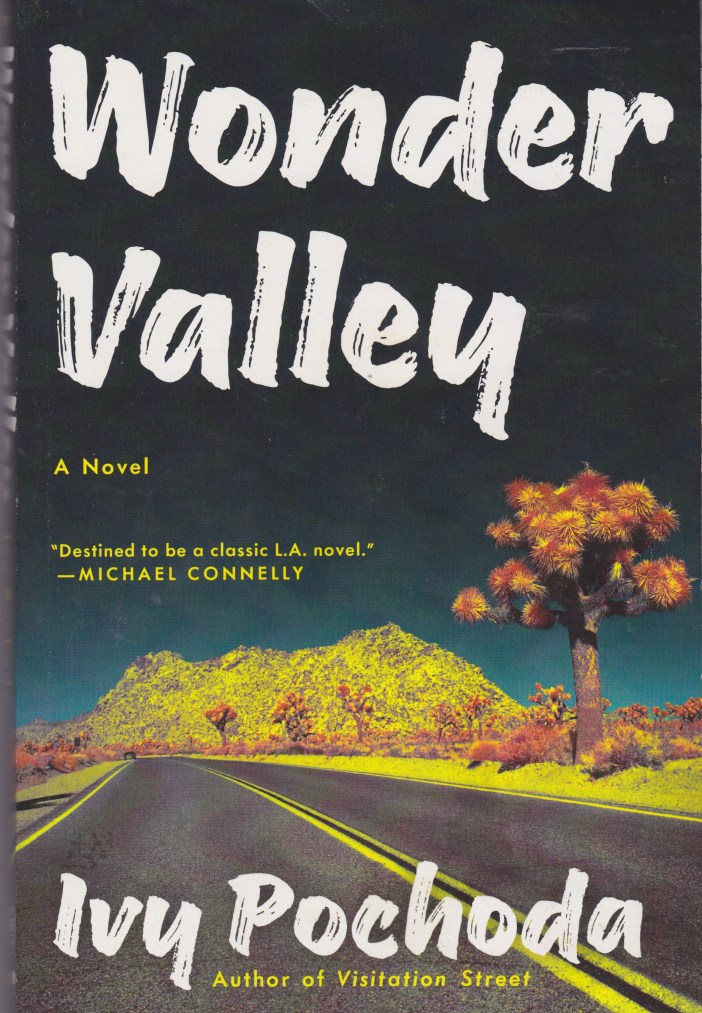
Well, the brake light thing was nothing serious; merely an internal computer malfunction of some sort, so the internal computer had to be reset, which took longer than I would have liked, but I love my dealership and I love my car, and sitting there gave me the opportunity to finish reading the amazing Ivy Pochoda novel, Wonder Valley.

Scan

He is almost beautiful–running with the San Gabriels over one shoulder, the rise of the Hollywood Freeway over the other. He is shirtless, the hint of swimmer’s muscle rippling below his tanned skin, his arms pumping in a one-two rhythm in sync with the beat of his feet. There is a chance you envy him.

Seven a.m. and traffic is already jammed through downtown, ground to a standstill as cars attempt to cross five lanes, moving in increments so small their progress is nearly invisible. They merge in jerks and starts from the Pasadena Freeway onto the Hollywood or the Santa Ana. But he is flowing freely, reverse commuting through the stalled vehicles.

The drivers watch from behind their steering wheels, distracted from toggling between radio stations, fixing their makeup in the rearview, talking to friends back east for whom the day is fully formed. They left home early, hoping to avoid the bumper to bumper, the inevitable slowdown of their mornings. They’ve mastered their mathematical calculations–the distance x rate x time of the trip to work. Yet they are stuck. In this city of drivers, he is a rebuke.

When I was watching the Joan Didion documentary, I was stuck by something that was said about Ms. Didion’s work; that she wrote beautiful sentences about terrible things. It was a terrific quote, and as I was currently savoring Ms. Pochoda’s stunningly brilliant novel, particularly apt: because that is what Wonder Valley is;  beautiful writing about terrible things.

The prose is spare, like James M. Cain’s and Megan Abbott’s; each word chosen with care for its evocative power with an economy of writing that it so much more difficult to do than being overly florid. The novel is complexly structured as well; bouncing around in time between something awful that happened in 2006 and how the ripples from that event are affecting 2010, the current day. She juggles timelines and points of view effortlessly, and changes the rhythm of her words accordingly so that each point of view has a distinctive voice and view point; you can tell by tone and sentence structure what point of view you are seeing the story from without having to know the character.

That is some seriously mad skill.

There were parts of this novel that reminded me of my favorite James M, Cain novel (Serenade); and having been to Palm Springs and that area, she captures the bleak beauty of the desolation of that sun-blasted arid area. Her characters are fully formed, damaged, lost, trying to cope with issues of guilt and damage with varying degrees of success and failure, yet these deeply flawed people are heroic in their simplicity, their desire to move on and affect change in their lives they are somehow powerless to achieve; the shadows of guilt are too long and have consequence. They are so brilliantly drawn and developed that you want them to succeed; whether it’s Britt’s struggle with her own self-destruction; Ren’s attempts to move past a crime he committed when he was twelve; James’ being trapped in a life not of his own design because of a mistake; Blake’s dark desire for vengeance. Their lives cross and intersect on a Los Angeles traffic jam. This is a difficult style of story to pull off; dating back to The Bridge of San Luis Rey by Thornton Wilder; which was a Pulitzer Prize award winning novel about a group of people who died in a bridge collapse, and how their interrelated lives all brought them together on the bridge that fateful day. The lazy way to do this kind of story is, of course, the Arthur Hailey formula (Airport, Hotel), but the way Pochoda has done it is worthy of Wilder, maybe even surpasses his own novel which created the trope. She also explores class in how each of the characters have dealt with their own guilt–and only Ren was actually punished by the system, of course; people of color are always punished by our system, while the wealthy white lawyer, the daughter of privilege, even the white son of the cult leader live in prisons of their own mind and guilt–and even those mental prisons are colored by their own levels of privilege.

It’s not an easy read, but it is a book to be read and savored and cherished.

I’d not read her first novel, Visitation Street, but it’s definitely moved closed to the top of the pile. I would be very surprised if Wonder Valley doesn’t make Best of lists and award shortlists. It’s simply extraordinary writing and story-telling.