Cat’s in the Cradle

The death of Agnes Nixon this past week saddened me, and spurred me to write two blog posts about her greatest, and most famous, creations; All My Children and One Life to Live. I watched both shows, along with General Hospital, off and on for over thirty years; I only stopped watching soaps when I needed the time I spent watching them to write–a decision I’ve never really regretted all that much. But I watched, over the years, many different soaps at one time or another: The Edge of Night, Dark Shadows, Love of Life, Search for Tomorrow, As the World Turns, Guiding Light, The Young and the Restless, Another World, Days of Our Lives, The Bold and the Beautiful, Capitol, Love is a Many Splendored Thing–it’s really quite staggering. And at night, I remember watching Peyton Place with my mom as a kid–although I don’t really remember much of it–and later, I was a huge Dynasty fan. I did watch Dallas, Knots Landing, and Falcon Crest during the 80’s night time soap heyday; I also watched others that didn’t last very long, like Emerald Point NAS, Flamingo Road, Paper Dolls, and Bare Essence.

It’s pretty safe to say I am a fan of the serial/continuing story format. When I was in college, I managed to get into a graduate level English course despite being an undergraduate because I was able to write a paper that was good enough to get me in; it was on Popular Culture in the 20th Century, and attendance wasn’t required–always a plus for me–and there were no tests; you only had to write a lengthy paper on some aspect of popular culture in the 20th century for your grade. I chose to write about soaps; the paper, which would wind up being 120 or so typewritten pages long, was title “How Changes in Daytime Drama Storylines Have Reflected Changes in American Culture and Society Since the 1950’s.”

God, how I wish I still had a copy of that paper.

I really wanted to work for the soaps in the 1980’s; my ambition switched from being a mystery and/or horror writer to being a soap writer. I still think it would be a lot of fun, even if there are very few soaps left to work for. But writing that paper required me to do a lot of research into the soaps and their histories; I’ve never minded doing research if it was a subject I was interested in. So, I kind of became a mini-expert in the soaps, and their histories, and there were a lot of interesting trends. It was interesting how moralistic the soaps were–something that hadn’t changed from their early days; back when there was a Motion Picture Code and a Comic Books Code, and censors for television (do they still have censors?); in which someone who did something bad always had to be found out and punished. (An interesting aside: one of the bad things that characters could do, and be forgiven/rehabilitated for and not necessarily punished for, was rape. But that’s a subject for another time–but I want to go on record to say that characters who had long runs on soaps, and in fact became very popular, at one time were rapists: Luke on General Hospital, Mickey on Days of Our Lives, John on As the World Turns, Roger on Guiding Light, Todd on One Life to Live; far too many for it to be a one-off, and enough to make it a trend. Even in prime time, on Dynasty Adam raped Kirby and was never prosecuted; she later agreed to marry her rapist.)

I even wrote, as a joke, a soap parody when I was in college, with my friends as characters. I called it The Young and the Pointless, and it was primarily for my amusement, and that of my friends. Basically, I looked at my friends and asked myself the question, if you were a character on a soap, what kind of character would you be?  I came up with the storylines myself; borrowing liberally from the storylines I’d learned so much about writing the paper, and ironically, my friends couldn’t get enough of it. They really became invested in the story; one even told me “My character wouldn’t say this.” Every day they would ask “have you written any new episodes?” It finally became over-bloated, because people who weren’t in it originally wanted to be, and I tried to be accomodating, and I cancelled it at long last midway through the third “season”. But it was a valuable learning experience for me, in that I learned that 1. I could write stories that interested people and made them want to keep reading; 2. I learned valuable lessons in creating characters and writing dialogue; and 3. I learned how to plot out a story. It was more like the classic parody SOAP than a real soap opera, but it was so much fun to write. I still have the originals somewhere–I’d always intended to type it up and make copies for the friends who were characters in it. Alas, some of them have died in the years since–a rather sobering thought–but The Young and the Pointless lives on in my files.

Yesterday LSU won, beating Missouri 42-7 at Tiger Stadium; their first win under interim head coach Ed Orgeron. LSU looked terrific; the defense played incredibly well, and the offense misfired a couple of times, but over all looked terrific. Unfortunately, it’s hard to tell if that was because they’ve come together as a team and are playing up to their potential, or if Missouri just isn’t particularly good; but LSU looked much sharper against Missouri than they did a few weeks ago against Jacksonville State. Their schedule now turns into Murderer’s Row, with games against Florida, Arkansas, Alabama, Ole Miss, and Texas A&M, so we shall see.

I wound up not being as productive yesterday as I’d intended; I did a lot of laundry and did some cleaning, but not all the cleaning I’d wanted to do. I also didn’t do any writing; I wound up getting sucked into watching some games on television (the last five minutes of the Georgia-Tennessee game was amazing; it reminded me of the last three minutes of the 2009 Georgia-LSU game, where LSU went ahead 12-7, only to fall behind with forty seconds left 13-12, but scored with less than twenty seconds left to pull off the win 20-14). Amazing.

I also spent some time opening Antonia Fraser’s Mary Queen of Scots and reading random sections yesterday; I originally read the book when I was eleven. The Queen of Scots has always interested me, and also, she was one of that ‘monstrous regiment of women’ who held power in the sixteenth century–when, as I’ve mentioned before, more women were in positions of power throughout Europe than any time prior or since. I also read some of Barbara Tuchman’s essays in Practicing History, and again, thought about how much I would love to write a book about the sixteenth century.

God, how I love history.

And now, I need to make up for the work I didn’t get done yesterday, so it’s off to the spice mines I go.

Here’s a hunk for you to enjoy:

img_1103


Tie a Yellow Ribbon Round The Old Oak Tree

Good morning and Happy Saturday, Constant Reader! This is my first full free weekend since Labor Day–no Decadence outreach, no LSU tickets, no Bouchercon, no AIDS Walk. Paul’s off at tennis, despite having an abscessed tooth extracted this past week, and the house is silent–I don’t know where Scooter is, having vanished after getting fed and a his morning handful of ‘you’re a very spoiled kitty here have some treats.’ I am doing laundry and will most likely clean today, but I also intend on working on short stories today. I came across an interesting submissions call the other day that I have an unfinished story that would be perfect for, so I am going to try to finish the story that I was asked for, edit two more, and finish writing that one–and maybe even work on the fratboy porn novel. I have to head out to Walgreen’s at some point, but other than that I don’t even have to leave the house this weekend unless I want to. I may go do some cardio later, but I may leave that up in the air as well.

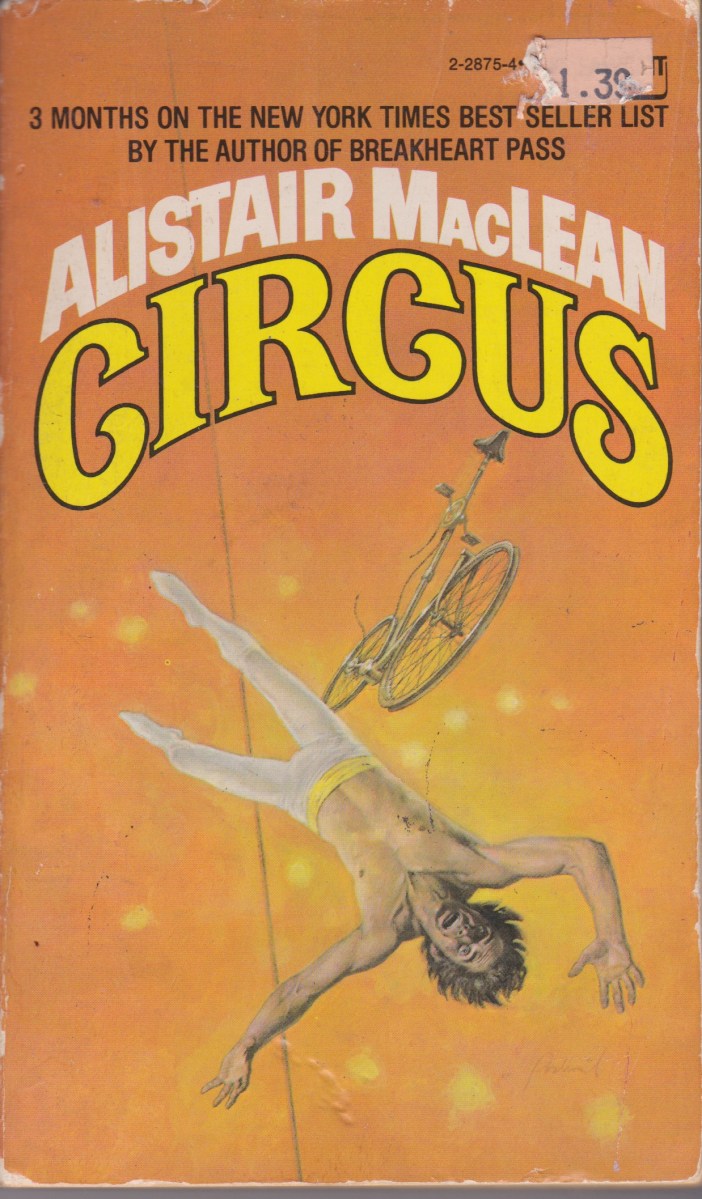
I am reading several books at the moment–some nonfiction; The Proud Tower and Practicing History: Collected Essays by Barbara Tuchman, in addition to The Tigress of Fiori, which is still on my nightstand, and I am now reading Puppet on a Chain by Alistair MacLean; someone had mentioned him recently on Facebook, and I remembered enjoying his work in the 1970’s and 1980’s, and also that I had never finished reading all of his books. Someone had mentioned Puppet on a Chain as a favorite, and it was one I hadn’t read, so it was off to eBay I went to get a bunch of his work. The first book of his I read was Circus–the young gay boy couldn’t help but be drawn to the cover design of a ripped muscular bare-chested man in white tights falling from a high wire. That may have been my first bare torso book cover purchase….hmmmm.


circus
Can’t imagine why that caught my eye, can you?

It’s also, I find, very interesting to read thriller writers from the past, to see how much the genre has changed. Obviously, back then the big enemy was Communism and the Soviets; World War II was also recent enough so Nazis weren’t out of the question, either. I also bought some Helen MacInnes novels I hadn’t read while I was there; I look forward to making my way through that stack of books at some point when I have time.

Ha ha ha ha! I even typed that with a straight face.

So, that’s my day; finishing “Lightning Bugs in a Jar” and “The Scent of Lilacs in the Rain,” editing “The Weight of a Feather” and “Death and the Handmaidens”, cleaning, watching college football, and listening to my new download of Fleetwood Mac’s remastered, deluxe version of the vastly underrated Mirage album, which I am really enjoying. I’d forgotten how much I really liked the album, and the early versions of the songs are, in some cases, better than the version that was eventually released on the album–Christine McVie’s early version of “Hold Me” is less lick, and without those interesting harmonies overdubbed (which I do like, don’t get me wrong), you can see how the song could actually be performed live; and the early version of Stevie Nicks’ “That’s Alright” (one of my favorite songs of hers) is actually much more country; I’ve always thought Stevie should record an album of country songs.

I also may start editing and correcting Bourbon Street Blues, so that ebook can finally get going. It’s been way too long since people have been able to get it anywhere other than ebay and from used bookstores.

Okay, off to mine spice! Have a lovely day, everyone!


Angie Baby

Agnes Nixon died yesterday. For those of you who don’t know who she was, she created the long-running soaps One Life to Live and All My Children, among others, and worked on numerous others as well. She created two of the greatest female characters in television history–Victoria Lord on One Life to Live and Erica Kane on All My Children, both of whom made daytime legends of the actresses who played them, Erika Slezak and Susan Lucci.

I loved soaps, and it wasn’t until the late 1990’s that I stopped watching them because i needed the time to write. When I was a kid, both of my parents worked so during the summers a lady down the street watched my sister and I during the day–and she was an avid fan of General Hospital, One Life to Live, and Dark Shadows. My grandmother also worked the evening shift at American Can Company back then, and so she also watched the shows, so on days when she watched us we watched them all together. It was hard sometimes catching up, since we weren’t able to watch them during the school year (other than Dark Shadows, which we could run home from school to catch the last twenty minutes or so of), but watch them we did…and when All My Children debuted, we started watching that one because it was new–we could know everything from the very beginning. The thing that was amazing about All My Children as well, was that it had young characters featured front and center; the romantic lives of teenagers was just as important as that of its older characters. Tara, Phil, Chuck and Erica were all high school students when the show started, and there was something else odd about the adults in Pine Valley, as well. They didn’t just sit around and talk about what was going on with their lives, they also talked about the Vietnam War, protests, and opposing it. The show was actually relevant; while other soaps were insular, where nothing mattered except what was going on in the town as though the rest of the world didn’t exist, the people in Pine Valley were very aware. And both Phil and Chuck–and their families–worried they’d be drafted when they got out of high school.

amcbook

Phil eventually did wind up going to Vietnam, and was reported dead there.

The show was incredibly popular with young people–all of my friends watched it, and as the years passed, the show continued its commitment to young love. Pine Valley also had something else that most other soaps didn’t have–people of color. In the early 1980’s, there were two parallel star-crossed love stories featuring teens–Greg and Jenny, who were white, and Jesse and Angie, who were black. Both stories got equal air time, were equally important, and the young actors were incredibly compelling. There was also a teen villainess, Liza Colby, played by Marcy Walker, who was also fantastic.

Greg and Jenny:
imgres

Angie and Jesse:

imgres-1

The despicable Liza:

imgres-2

Kim Delaney, who would go on to prime time success, left the show shortly after she and Greg were finally, after years of heartbreak, obstacles, and separation, married; the show decided not to recast but to kill her off.

It was devastating.

In college, everyone would gather around television sets in the lounges to watch All My Children ; when Jenny flatlined I remember everyone in the lounge gasped in disbelief; some people actually started crying. Years later, I mentioned to a friend “if someone ever tells you they used to watch All My Children , and you ask them when they stopped watching, they will tell you they stopped watching when Jenny died.”

The show did eventually recover from killing off Jenny, but it took a while.

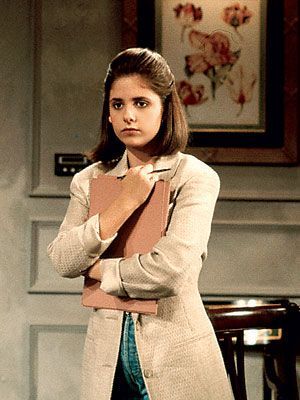
Over the years, the show created incredible characters played by exceptional actors; Sarah Michelle Gellar’s big break came as Kendall on the show; a young actress who not only could hold her own against Susan Lucci but was a villainess you also felt compassion for. She played Kendall, the daughter no one knew Erica had; the product of a rape when she was thirteen that she gave away, and Kendall turned up as a teenager. The scenes between Erica and Kendall, when Erica tried to explain why she could never love her because she would always see Kendall and remember the rape, were incredibly powerful; Sarah Michelle Gellar would win an Emmy for those scenes, and I never understood why Lucci did not. (Lucci, of course, was nominated a billion times and only won once; it became a running joke for Lucci–the irony being she became much more famous for not winning than any of the women who won did; and when she did finally win, it was national news and she was on every magazine cover on the newsstands.)

e55267ed80865a18956f611ddd65fbb8

Kelly Ripa also got her big break on All My Children , as Adam Chandler’s illegitimate daughter Haley.

One of the other things that made the show special was it wasn’t afraid to be funny; it was more than just unrelenting melodrama and sobbing. One moment your heart would be breaking over Donna’s grief over her child dying in a fire and the next you’d be laughing at the antics of Opal Gardner. All My Children never was afraid to be funny. (One of the greatest characters on the show was villainess Janet–“Janet from another planet”–who did horrible things but at the same time was incredibly funny.)

And of course, there was Erica Kane. You can’t talk about All My Children without talking about Erica. When asked once if she would ever leave the show, Susan Lucci replied, “Why would I? Where else would I get to play Scarlett O’Hara every day?” Erica started out as a bitch on the show–a young teen villainess– but in the skillful hands of the perfect actress for the part and a talented writer who showed the character in all of her confusing complexity, Erica became the center of the show, and was always the star. Erica wanted to be loved, but she also wanted to be rich and famous and successful–and didn’t want to get all of those things by marrying a rich man; she wanted to get them herself. And that drive, Erica’s drive, I think, was what made her such a beloved character. She did things the wrong way, she lied and manipulated, but the disaster that was her personal life never stopped her from getting all the things out of life that she wanted–and when her deceptions once again destroyed her personal life, she always wiped away the tears and repeated her mantra: “I can do anything. I’m Erica Kane.”

And of course, Erica had daytime’s first (and one of the few) abortions.

The show always dealt, like it did with abortion and Vietnam, social issues. It had daytime’s first lesbian character, dealt with HIV/AIDS, had a gay character and addressed homophobia, and of course, Erica’s daughter Bianca became daytime’s first main character to be a lesbian…and to have as troubled, dramatic, and fascinating love life as any of the straight characters.

I could probably write an entire book about All My Children . I learned a lot from the show, about writing, how to plot a murder mystery (the show had some of the best murder mysteries on daytime), and how to create a complicated character.

RIP, Ms. Nixon. I’ll talk about One Life to Live tomorrow.

Afternoon Delight

For the first time in maybe a month, I actually had an appointment with Wacky Russian this morning, and you know what? I feel great.I’ve clearly missed the exercise; and I actually feel like I should be going in every morning and doing a bit of stretching and cardio.

Right? Who am I, and what have I done with Gregalicious?

But the rush of endorphins! What a glorious feeling! I actually feel like the lethargy that has engulfed me since prior to Bouchercon has been lifted; the cobwebs in my mind cleared away, and energy, energy, energy. On my walk home from the gym, I actually solved the problem I am having with this stubborn short story I’ve been struggling with for weeks (short stories are ever so much harder for me than novels, really, and yes, I know that means I am completely insane).

And–since we are on a ‘Greg is insane’ run this morning–the problem is I don’t like the title; it doesn’t really fit, and so I have to come up with a better title.

There is great power in names, and I find that I cannot work on anything unless it has a title that I think fits the story; that title might change over the course of writing and rewriting when something better comes to mind, but if it’s not titled, I just can’t write it. I know that doesn’t make any sense, but that also is true about characters. I can’t write about a character unless I know their name.

And this story’s title, while lofty, pretentious and borderline literary (“The Handmaidens of Olympus”) really doesn’t fit the story to me. I’ve played with the title, trying to make that oh-so-pretentious title work in some variation, to no avail. And on the walk home from the gym, I realized that it doesn’t work, it isn’t going to work, and no amount of thinking about it is going to make it work. So, out it goes, and I have to come up with something new.

So, the goal for today is to come up with a new, working title–I have some ideas already–and I suspect the story is going to flow a lot easier for me now.

Weird. I know.


Here’s today’s hunk.

img_1115

On the Dark Side

Someone recently pointed out to me that on my website, I described my Chanse MacLeod series as more nourish, but a hilarious typo—which either no one noticed previously or had but were too polite to mention to me— made the sentence read as the Chanse series is more nourish. Yes, it made me laugh for a few moments before I went in and corrected it, but it also made me start thinking about the sentence itself. Is the Chanse series, in fact, more noir than the Scotty series?


The Chanse series is darker than the Scotty series, and yes, that was a deliberate choice, but calling the Chanse series noir is probably incorrect; what I should have said was the Chanse series was more hardboiled. That would be factually correct. So, what precisely is the difference between hardboiled and noir?


Hardboiled crime fiction is a bit easier to define than noir, and it is possible for a novel or story to be both. Wikipedia says this:


Hardboiled (or hard-boiled) fiction is a literary genre that shares some of its characters and settings with crime fiction (especiallydetective stories). Derived from the romantic tradition which emphasized the emotions of apprehension, awe, horror and terror, hardboiled fiction deviates from that tradition in the detective’s cynical attitude towards those emotions. The attitude is conveyed through the detective’s inner monologue describing to the audience what he is doing and feeling.

The genre’s typical protagonist is a detective who witnesses daily the violence of organized crime that flourished during Prohibition(1920–1933) and its aftermath, while dealing with a legal system that had become as corrupt as the organized crime itself.[1]Rendered cynical by this cycle of violence, the detectives of hardboiled fiction are classic antiheroes. Notable hardboiled detectives include Philip Marlowe, Mike Hammer, Sam Spade, Lew Archer, and The Continental Op.


Interesting that Wikipedia doesn’t define it as a subgenre of crime fiction, but defines it as its own genre, separate but sharing characteristics with crime fiction. It also claims that the notion of hardboiled fiction is limited to a specific time period. I don’t think that’s true; I would go so far as to say that there are many authors who are publishing hardboiled crime fiction today. It’s only my opinion, but I do think one could consider Sue Grafton, Sara Paretsky, Ace Atkins, Reed Farrel Coleman, and many others as practitioners of the form.


Noir, on the other hand, is a more slippery kind of fish to define. Film noir and literary noir, for example, are completely different things; the classic movie is considered film noir, but the novel itself, to me, is hardboiled; Spade is a cynic but he is not a bad guy. When I was asked to write a story for New Orleans Noir, the assignment, as defined by the editor, was to come up with a description for noir and write a story that fit that definition. My definition was the endless nightmare; for me, noir was about an everyday Joe who makes a bad decision—something amoral or immoral, maybe against the law—and that bad decision sets he/she on a path where things get worse, and the only choices presented from that point on sink the character deeper and deeper into the quagmire of an amoral abyss. To that end, I wrote the story “Annunciation Shotgun”.

I never really felt, though, that my definition was adequate; it scratched the surface, but it didn’t go deep enough to truly define noir. Of course, Laura Lippman defined noir on a panel I was on perfectly: dreamers become schemers. As always, the woman who is often the smartest person in the room nailed it, and I have since stolen that as my definition.

I love noir, both the film and literary versions of it. James M. Cain is one of my favorite writers, and I have always wanted to write a noir novel. I have a couple of ideas, and as always, it’s simply a matter of being able to find the time to sit down and actually write one. I want to read more noir writers; modern day genius Megan Abbott is one of our best writers and her novels are extraordinary. The closest I’ve come to a noir with my novels are Timothy and Dark Tide;

I have a couple of other ideas, as I said, that I may explore. I know how both start, but there’s that slight issue of the plot yet to work out. Once I have a better grasp of the plots, I’ll start writing them.

And on that note, it’s back to the spice mines.

The Streak

Laura Lippman always says that one of the most worn-out, tired cliches/tropes of crime fiction is a beautiful woman dies, and a man feels bad.

On our panel at Bouchercon last week, the subject of cultural appropriation came up, and unfortunately, I didn’t get to answer it–which is unfortunate, because my response was going to be, “I appropriate from straight culture all the time. In fact, I used the trope of a beautiful woman dies and a man feels bad in my first novel, only switched it into a beautiful man dies and a man feels bad.”

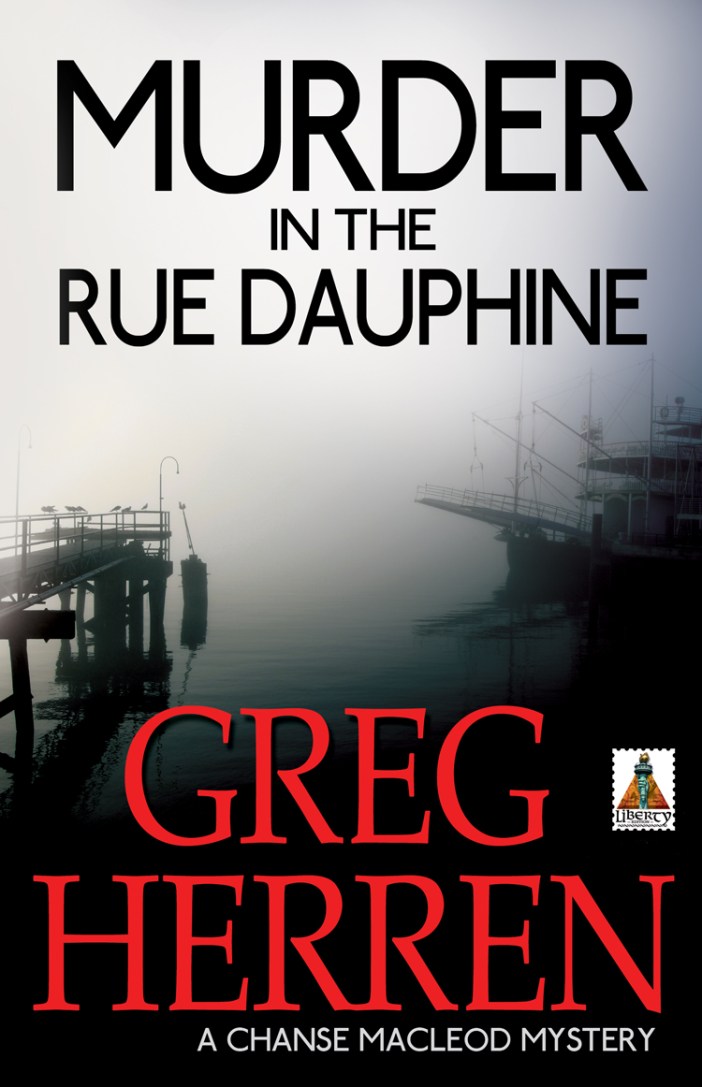
Because really, you can sum up the plot of Murder in the Rue Dauphine that way.

get-attachment-aspxThe funny thing is, I didn’t realize I was subverting, or appropriating, a trope at the time I wrote the book–but I was also trying to write a gay-themed mystery with a gay main character, and so I wound up using one of the tried-and-true crime tropes without even realizing I was doing it.

When I was a senior editor, one of the things I wanted to see was gay novels that flipped the script on straight tropes–where is the gay James Bond? Indiana Jones? Gay romantic suspense? I honestly believed–and still do–that if the books were well-written and the characters well developed,  a gay or lesbian writer could take a trope/cliche from mainstream publishing and breathe fresh life into it. I tried to do this very thing with both Timothy and The Orion Mask, and once I get through these next books I have to write, I am going to try subverting some more writing tropes–like a gay hard-boiled noir, for example; wouldn’t that be fun? I have an idea for two that have been simmering in my head on the back burner for a while: Muscles and Spontaneous Combustion. 

We shall see, I suppose.

And now, I need to get back to the spice mines, otherwise I will never get any of these things done.