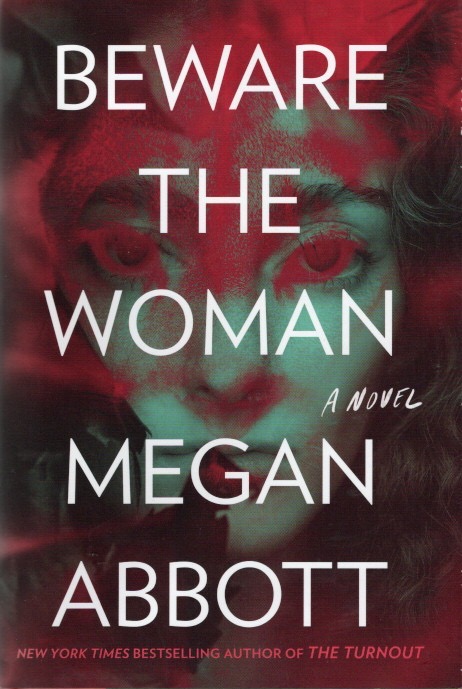
I finished reading the new Megan Abbott novel, Beware the Woman, this morning during a marvelous, raging thunderstorm that filled the gutters and streets of New Orleans with dirty swirling water, cutting the temperature to something bearable for once this summer and cooling the interior of my apartment to the point I needed to put on a sweatshirt and a knit cap on my head. Curled under a blanket with a good book while a thunderstorm rages with a warm cup of coffee on the side table, tendrils of steam rising in curly-cues of white from the creamer-lightened pool of soft brown, is perhaps my happiest of places.
Hell, reading anything new by Megan Abbott is my happiest of places.
My first Megan Abbott novel was Bury Me Deep, which stunned me with its craftsmanship, its voice, its literate choices of words and sentences structures that are short yet lyrical, minimalist strokes painting a broad canvas of human frailty and contradiction, crime and desire that comes from a primal place within, almost inexplicable and unexplainable yet so easily understandable and recognizable. I went on from there to Dare Me and the rest of her all-too-short canon; admiring, loving, respecting and enjoying each book with its magical spell woven by a true master of the literary form, astonishing in its humanity and an exploration of what lengths her characters will go to in order to get the thing (or things) they want, need, desire and hunger for.
Some of the earlier reviews I saw for Beware the Woman painted some parallels between the book and what is perhaps my favorite novel of all time, Rebecca by Daphne du Maurier…which had me intrigued and interested even more than usual.
But more on that later.
“We should go back,” he said suddenly, shaking me out of sleep.
“What?” I whispered, huddled under the thin bedspread at the motor inn, the air conditioner stuck on HI. “What did you say?”
“We should turn around and go back.”
“Go back?” I was trying to see his face in the narrow band of light through the stiff crackling curtains, the gap between every motel curtain ever. “We’re only a few hours away.”
“We should go back and just explain it wasn’t a good time. Not with the baby coming.”
His voice was funny, strained from the AC, the detergent haze of the room.
I propped myself up on my elbows, shaking off the bleary weirdness.
We’d driven all day. In my head, in my chest, we were still driving, the road buzzing beneath us, my feet shaking, cramped, over the gas.
Our main character here is Jacy Ashe, a pregnant wife in her early thirties, married to a neon sign artist, Jed, and working as an elementary school teacher. They are en route when the story opens to the remote upper peninsula of Michigan (primarily known to me from Steve Hamilton’s novels) to visit Jed’s retired doctor father, who lives up there in what used to be the family summer place, with his housekeeper, Mrs. Brandt. This is one of the classic set-ups of one of my favorite subgenres of crime fiction–the Gothic–as well as placing it strongly into another category I love, domestic suspense. This novel has echoes of du Maurier, Phyllis A. Whitney, Dorothy B. Hughes, and Margaret Millar…blended seamlessly together into a classic yet modern novel that updates and reinvigorates both subgenres, bringing them into the modern era and proving they are still just as relevant and important as they have ever been.
(Aside: I do not know where Abbott came up with the name “Jacy,” but it’s one I’ve always liked and wanted to use in my own work since first reading Larry McMurtry’s The Last Picture Show and seeing the Bogdonovich film based on it; I smiled and wondered if that was where Abbott got the unusual name from.)
The Gothic set-up is there, and I can also see the slight echoes from Rebecca: the brooding remote house in the country where tragedy has occurred in the past; the mysterious housekeeper who doesn’t seem to like our heroine very much; the slow-burn of slow revelations of secrets from the past; and the creeping paranoia and potential gaslighting of Jacy…often explained away as her pregnancy hormones or a reaction to the medications after she has a pregnancy complication. One of the strengths of Gothics, for me, is that question of paranoia vs. reality; the gaslighting that is always a hallmark of a Gothic novel. After all, what reason could either Jacy’s father-in-law or husband have for wanting to drive her mad and risking her baby’s health and well-being? She feels her husband slipping away from her and no one seems to believe her…this is probably one of the best depictions of a paranoid pregnant woman in literature since at least Rosemary’s Baby.
Someone once said the Gothic and domestic suspense novels were “women’s noir,” because the danger to them always arose from them being women and doing women’s things; a reaction to the terror of getting married and placing (until very recently) all of your agency into the hands of your husband–and what if you chose poorly?
Abbott takes the best elements of noir and combines them with the foundations of domestic suspense and Gothic to explore what it is like to be a woman, how it is to be a woman, and the trap of societal and cultural expectations for women.
And there’s a reason why the cops always look at the husband first when a woman is killed.
This is a brilliant novel, with many layers to unpack and unravel through its deceptively simple voice and brevity of language. Megan Abbott is a sorceress, a Scheherazade of crime fiction to whom you simply cannot stop listening. Read it, cherish it, love it.
 Queer and Loathing in America