Many years ago, at a Bouchercon in the far distant past, I was lucky enough to be assigned to a panel with several strangers. It was Raleigh, and I don’t remember what the panel was about–other than none of us on the panel actually wrote what the topic was about–but it ably helmed by Katrina Niidas Holm. That was the weekend where I was lucky enough to meet both her and her husband, Chris. Also on the panel were Liz Milliron, Lou Berney, and Lori Roy. I always intend to read my co-panelist’s work before panels, so I can talk to them intelligently about their books–but it’s not near as pressing as it is when I moderate, and this was one of those years where I was busy and simply didn’t have the time. The panel was marvelous. I had the best time, and I loved everyone on the panel. I have since gone on to read their work and have become a besotted fan of all three of them, really.
My first Lori Roy novel was Bent Road, which won her (deservedly) the Edgar for Best First Novel. I absolutely loved it, and made sure I got the next two as well. (At the Edgars following the Raleigh Bouchercon, both Lou and Lori won Edgars; her second, also making her one of the few authors to win Edgars for Best First and Best Novel.) I’ve read everything she’s published since then, but have never gotten to the second novel (an Edgar Best Novel finalist) or Let Me Die in His Footsteps, her second nomination for Best Novel and her second Edgar win. I don’t remember why I decided to finally read Let Me Die in His Footsteps, but I am very glad I did.
It’s really quite marvelous.
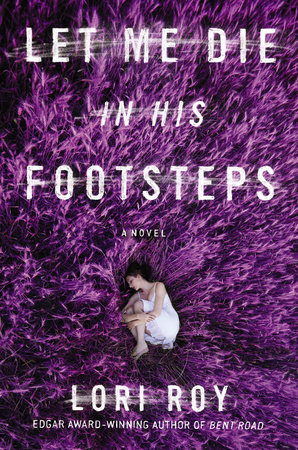
Annie Holleran hears him before she sees him. Even over the drone of the cicadas, she knows it’s Ryce Fulkerson, and he’s pedaling this way. That’s his bike, all right, creaking and whining. He’ll have turned off the main road and will be standing straight up as he uses all his weight, bobbing side to side, to pump those pedals and force that bike up and over the hill. In a few moments, he’ll reach the top where the ground levels out, and that front tire of his will be wobbling and groaning and drawing a crooked line in the soft, dry dirt.
They‘re singing in the trees again today, those cicadas. A week ago, they clawed their way out of the ground, seventeen years’ worth of them, and now their skins hang from the oaks, hardened husks with tiny claws and tiny, round heads. One critter calls out to another and then another until their pulsing songs made Annie press both hands over her ears, tuck her head between her knees, and cry out for them to stop. Stop it now. All these many days, there’s been something in the air, a spark, a crackle, something that’s felt a terrible lot like trouble coming, and it’s much like the weight of those cicadas, thousands upon thousands of them crying out to one another.
Annie has known all morning Ryce would be coming. It’s why she’s been sitting on this step and waiting on him for near an hour. She oftentimes knows a thing is coming before it has come. It’s part of the curse–or blessing, if Grandma is to be believed–of having the know-how.
Let Me Die in His Footsteps is set in rural Kentucky, with a dual timeline–the present in the book is 1952; the past is 1936. Both timelines feature two sisters, one normal and the other with the “know-how.” In the present, Annie is the sister with the know-how while her sister Caroline is normal and pretty and sweet and pretty much beloved. The 1936 section focuses on Caroline’s mother, Sarah, and her sister with the know-how, Juna. It is soon made clear in the present day that something terrible happened back in 1936, something whose repercussions are still being felt to this present day of 1952. Annie isn’t Caroline’s sister, but rather her cousin; Sarah is Caroline’s mother while Juna was Annie’s. Juna also had a bad reputation around the county, having played a pivotal role in the 1936 tragedy. The book opens with Annie reaching her ascension; the halfway mark between sixteen and seventeen, when she is supposed to look down into a well at midnight, where she will see the face of the man she is going to marry. Annie sneaks out of the house late at night to go next door and peer down into the Baine family well; there’s trouble and tension between the two neighboring families…dating back to 1936. All the Baine sons are long gone; the only one left is old Mrs. Baine, who sits out on her porch with a shotgun in case of her worthless sons try to come home. Caroline follows Annie and sees someone in the well; Annie sees no one. But after the look into the well, they discovered Mrs. Baine’s dead body in the yard…and all the secrets and lies from 1936 start to not only unravel but impact 1952.
We’re never really sure what the “know-how” is, or if it’s just an old wives’ tale, a superstition. The rural south in both 1936 and 1952 were dramatically different than modern times; the rural areas weren’t as exposed to television or films or the newspapers, really and the old ways still held sway. I can remember being told about someone with the sight that everyone was supposed to stay away from in rural Alabama when I was a kid; those kinds of superstitions and beliefs still exist in some of these more backward rural areas. But one thing I truly appreciate about Roy–who often writes about poor rural Southern people–is that her writing isn’t what I call “poverty porn”; her characters are very real and this just happens to be their situation. The Hollerans have a lavender farm, having eschewed tobacco in the recent past after Grandpa Holleran died from lung cancer. Lavender infuses the novel almost from the very first page. I love the smell of lavender, although I would imagine fields and drying houses filled with it might be a lot. The story plays out in a slow burn, terrific build to the end, and all kinds of secrets from the past must be dealt with in order for the present-day characters to get on with their lives.
Roy is such a good writer that it almost takes my breath away. She uses a distant third person point of view, one in which we don’t really get inside her character’s heads that much, so the reader has a kind of distant remove from the characters, but it really works. Her work reminds me of Faulkner without the racism, and of other great Southern writers. Her novels are very smart, with a lot of depth and emotional honesty that resonates with the reader, compelling us to keep reading.
Highly recommended; Let Me Die in His Footsteps clearly deserved to win the Edgar for Best Novel.
Hopefully there will be a new Lori Roy soon, because all I have left of her canon is her second novel, Until She Comes Home, which was also an Edgar finalist.
 Queer and Loathing in America