I wasn’t sure I was going to write here today when I first got up; I overslept, for one, and then was thinking more along the lines of just getting under my blanket in my easy chair and spending the entire day reading and ignoring everything going on in the world outside my bubble–where I suspect I’ll be spending an awful lot of time either for the next four years…or for the rest of my life. It’s thirty degrees here at the moment, and now we’re apparently expecting anywhere from three to six inches of snow (!!!!!) over the next few days, including sleet. It could get really bad here with the snow and ice and cold, and now they are saying we might have to stay home for two to three days! There’s been no word from work, of course–so I will have to get up at six tomorrow morning anyway to find out if they’ve closed the office or not. I love my job I love my job I love my job.1
Yesterday was pretty unremarkable, really. I ran out to make groceries and while it was sunny and nice, whenever the wind blew it felt miserably cold, the kind that goes right through you to the bone. That’s the kind of cold we get here, a wet cold, and that’s why I hate the cold weather here so much (when I can’t just stay cozy and warm at home and underneath blankets); it feels so much colder than it actually gets here. I really do have to write a snow-day Scotty book, don’t I? We watched a terrible thriller called Project Power, primarily because it starred Joseph Gordon-Levitt, whom I love, and it was both set and filmed here. It was entertaining enough (as with anything filmed in New Orleans, the geography was hysterically funny–how does one ride a bike from the West Bank to uptown and then to Jazzland in New Orleans East?), but then we moved on to The Jetty, a crime drama about a cold case and a connection to a current one starring Jenna Coleman that is actually quite excellent, and examines age of consent v. maturity, which is stunningly well done. Highly recommended; we have one episode left which we will probably get to later on today and then we’ll start another.
I’ve pretty much blown off everything this weekend for the most part, and have little productivity to show for it, which means that today I need to try to get as caught up as possible before Paul gets up and comes down to join me in the living room this afternoon. I still need to write up my thoughts on Ode to Billy Joe, I have several things I need to be writing, and need to be done, so I think I won’t be turning on the television this morning or this afternoon and instead parking in either my chair to read or at my desk to be writing. When I finish this I am going to go read, and then most likely to shower and get back to work here at my desk,
I was very pleased to see that Jayden Daniels and the Commanders (sounds like a 60’s vocal band, doesn’t it?) won their playoff game (my condolences, Detroit Lions fans) and what a mark he’s making in the NFL! I told Paul yesterday, “ten years ago if someone would have told us that two of the greatest NFL quarterbacks of all time would be LSU graduates and Heisman Trophy winners, we would have laughed in their face.” It’s true. During the Les Miles era the LSU offense often sputtered and misfired, with talent being wasted on both sides of the ball; the defense was great but the offense could never be depended upon. Since Joe Burrow arrived in 2018, that has changed completely and flip-flopped; now we have a defense we can’t count on, but an impressive offense. I think LSU is going to be very good next year, and might be one of the few bright spots of the year in this household, for sure.
I am really enjoying Farrah Rochon’s Bemused, which will be fun to write about when I finish reading. I think Hercules is one of the more underrated Disney animated films, and my favorite part of the movie was the muses (and I live in the neighborhood of the muses, too)–so this book is absolutely perfect for me. I always loved ancient Greece when I was a child, and was an even bigger fan of the mythology. (Funny how it’s always Greek myths rather than the Roman versions, even as we call him Hercules–which is the Latin; in the Greek it’s Heracles.) I’ve also always wanted to write about a Greek myth, revised and updated and modernized, or even not; I’ve always wanted to tell the story of the Trojan War from the perspective of Cassandra on the walls of Troy as her city burned. I love Madeline Miller’s reinterpretation of myth in The Song of Achilles and Circe, but she does it so well I can’t imagine being anything other than a very pale carbon imitation. (Does anyone remember carbon paper? Is it even used or made anymore?)
But if I don’t buckle down and start writing, I don’t know that I can actually go ahead and call myself a writer anymore.
And on that note, I am going to make another cup of coffee and head into the living room with Bemused. Have a lovely Martin Luther King Jr holiday, everyone, and I’ll give a snow report update tomorrow morning, either from here on a remote day or from the office.
Okay, to be fair, I just checked my email and they will decide this afternoon whether we’ll be working “remotely” or not tomorrow. My apologies to upper management. ↩︎
Brrrr. It’s in the forties this morning (AIEEEE!!!!) and the temperature will hold steady for the day, and won’t stop dropping until about bedtime tonight, when it will drop some more and the wind chill will start falling. I should sleep super-well tonight, and am glad I don’t have to go to work until Tuesday (if then)–and the winter storm watch has gone into effect already. I need to go make another grocery run today–there were things I forgot (of course) yesterday, and I was hoping to make it to the gym later as well. My shoulder feels odd this morning, which isn’t the great, and I am wondering about resting it for another day and potentially going tomorrow? Or am I just being incredibly lazy? That could also be the case, am I looking for yet another excuse to not go to the gym? I don’t think so. I think I’m going to finish writing this, spend some time with Bemused (which is delightful) and maybe go run that errand quickly and get it out of the way, and just go to the gym later on in the afternoon, after I’ve gotten some cleaning and writing done? Who knows? It would probably be easiest to do the gym and then go to the store and get it all done at one time (me trying to be efficient as always, but I don’t need to conserve my time anymore, either; I just have to not waste time anymore.
We watched Carry-on last night, which was fun, despite the plot being full of holes. Jason Bateman continues to be the best Bateman; he brought a very creepy intensity with his very calmness to the role, and of course Taron Edgerton is adorable and charismatic and always very fun to watch. I won’t get into whether the story would work in the real world or not–action adventure suspense movies don’t really give two shits about realism anymore–and the reason for that is I haven’t worked in an airport for nigh-on thirty years (groan) now, and things most likely are very different from when I worked there; 9/11 changed airports forever, and I was a pre-9/11 airline employee who was very glad to be out of the industry when 9/11 did happen. I mean, it was entertaining enough to hold our interest for two hours–I did keep checking the Commanders/Lions score, though, because I love Jayden Daniels (one of only two quarterbacks for LSU in the last decade to beat Alabama), and love how much Commanders fans are falling for That Kid Jayden the way LSU fans did)–but it was entertaining enough. We also watched a Swedish show called The Breakthrough yesterday–a crime story–but it wasn’t that interesting and was actually kind of dull; Paul kept dozing off and I kept turning to my iPad, so that was a waste of time. Do not recommend.
I woke up earlier than usual–around seven thirty this morning–but it’s fine; I’ve been sleeping too late and need to get back into the habit of getting up early, and now I have my entire morning to get things done around here. My coffee is going down very nicely, too, I might add, and I do need to eat something so I can take my meds this morning. It’s also sunny out with no clouds in the sky, so it’s beautiful out if cold. It was gorgeous yesterday, to be honest; I didn’t wear a jacket as I ran yesterday’s errands and it was lovely–after the morning rain, of course. The wind is supposed to start picking up soon–gusts of up to thirty miles per hour, which makes it feel ten degrees colder outside than it actually is (wind chill!) so will definitely be needing a coat when I go outside today. I do feel warm and relaxed and comfortable here in the house, which means I’ll feel super cozy when I get into my chair to read this morning. I do feel contented this morning, despite the looming deadlines and the messy house. I’m not sure why that is, this morning being the last good day this country will be having for a very long time, but there it is. I’ve been trying to avoid thinking of the joke of a shitshow this country is going to be effective tomorrow, but it does seem that Americans are finally waking up to the fact that we are not, in fact, the greatest country in the world and it’s kind of eye-opening to see that socialist countries have a much better quality of life than we do with all our so-called “freedoms.” American exceptionalism is a very heady drug and more addicting (and dangerous) than heroin–because if you think you are already living in the greatest country in history, why does it need to be improved? That mindset has already been pushed on us by the worst abusers–the wealthy class–so they can continue to rob us blind and they take everything away from us, and we should be grateful they let us even have the minimal amount of crumbs.
I didn’t write very much yesterday–I was mentally fatigued from the week–and so I decided to just let my mind relax and be free, and of course I came up with a fantastic idea for a book as well as solved the issue with “Festival of the Redeemer,” so that should make finishing that a lot easier, and am most pleased about that; the title of the new idea is Diabolical, and I love that one-word title, which seems to be the direction I am going with non-series titles. (I also got to see potential covers for Hurricane Season Hustle yesterday, and I cannot wait to share the final one with y’all, as it’s pretty cool and a new favorite cover for me. Woo-hoo! Now to write the damned thing, you know?
And on that note, I am heading into the spice mines. Have a lovely last day before the fall of the country, okay? I will try to do the same.
Work at home Friday! Isn’t that exciting? It is for me, especially since I don’t have to put in many hours, which is good because I don’t have much to do, other than some paperwork and quality assurance and studying up on a new testing technology we will be piloting at work. I am going to go to the gym later and run some errands. I suspect we will be watching LSU Gymnastics in the evening, before moving on to a new show or a movie. We do live large here in the Lost Apartment, don’t we? It’s also not very cold this morning–granted, I’ve moved the needle a bit over the last few weeks about what is cold and what is not; I’ve also stopped fighting dressing properly for the cold (layers, always layers) out of that refusal to accept the fact that New Orleans gets uncomfortably cold for me time to time; that mentality of I live in New Orleans so I shouldn’t have to wear layers and I won’t, which was the kind of stubborn stupidity that I am trying to overcome in every aspect of my life.
I slept very well last night, but wasn’t exhausted when I got home from work, either–which was great. I cleaned the kitchen (leaving the dishes for today) and it was very nice to get up this morning and walk into a kitchen with clean counters and everything put away. Now that I’m getting better rest and exercise, I seem to have snapped out of the years-long cloud I’ve been under since the pandemic began FIVE years ago. The 2020’s haven’t been the best decade over all, have they? But the nice thing is my optimism is back; I believe in my ability to write again, and I am working out regularly again. I may even be willing to let more of the outside world into my peaceful little bubble here, but I am glad I disengaged from toxicity and from toxic people and a toxic community that embraces and will excuse away every last bit of its toxicity because “oh no we might upset the bigots! Can’t you be the bigger person?” My days of being the bigger person are history, collecting dust in the archives as I write this. I ain’t startin’ none, but as Paul says, “He never starts it, but he will finish it and I feel sorry for you.” I have no qualms with going low; I’ve always thought “going high” was a miscalculation in the first place, much as I love Michelle Obama, and I love that she’s not going to the ceremony ending decency for at least another four years. You don’t fight bullies with moral superiority because they don’t care about that shit. They never have. The party of “family values” who weaponized their “values” to scold everyone and scare people into voting for them, who said Bill Clinton’s adultery showed he didn’t have the moral character to be president, have foisted the only divorced presidents on the country to its great detriment each time. They also gave us our only president convicted of crimes in court. So, miss me with your moral superiority, trash–you have none.1
I did work on the book a little bit yesterday, and I am not happy with this chapter as it is written. It might be okay, and it might be because I am having some trouble with it–but I have to get out of “try to save as much of what you’ve already written” and start slashing and cutting and revising judiciously. But I feel very good about the book itself and where it’s going and what I am going to be able to say with it. I have so much to do this weekend! (Sparky really wants my desk chair to sleep in. He jumps up onto the desk and chirps and head butts me a few times. I try to put him in my lap or on my shoulders–nope, don’t want that. He jumped down to the floor just now and is staring at me, using his cat mental powers to will me out of the chair so he can sleep in it. He’s so cute.) But if I stay focused and relax, I should be able to get everything done that I want to get done this weekend as well as get some rest and relaxation. Monday is a holiday, and we may be getting snow by the end of the long weekend. The city will completely shut down if it does; they tend to close roads here when it snows and gets icy because we don’t have the infrastructure to deal with that here, which means if the office is closed, we’ll have to work from home or something; they’re never going to let us get paid and not work unless legally required to.
Capitalism at its finest.
But yes, I feel good this morning. Which is lovely. I think the day will turn out well for me, all things considered. I do want to do some chores around here today, get those dishes out of the way, run my errands and go to the gym, work on my book and do some reading. I do need to make a to-do list (I started making one yesterday but got interrupted and never finished). I am hoping for a terrific weekend, and to get a lot done–but if I don’t, I don’t. There is an extra day to this weekend, after all. Tuesday morning I will have to get up early to find out if the office is closed, and if it is, I probably won’t go back to bed.
And on that note, I am going to go do the dishes and get to work. Have a great Friday, Constant Reader, and remember to make sure you’re taking time to give your brain a break from the horrors that are to come. And I’ll be back in the morning, most likely.
All I ever have to do when confronted with their attempts to be morally superior, I always reply, “and where were you during the HIV/AIDS pandemic?” That shuts them the fuck up every time. ↩︎
Thursday, last day in the office blog and while I am looking forward to the three-day weekend, I am dreading Monday–for obvious reasons–and will instead try to get shit done while taking the occasional moment to study Civil Rights some more, maybe even read my current nonfiction tome, White Too Long, about how Christianity and white supremacy have been intertwined for so long. But the week thus far has been a good one, and productive; almost like returning to the gym kicked something else into gear physically. I’ve not been physically tired (stiff, yes) or sore much since going back, and I’ve been feeling more energetic and empowered, too. I’m sleeping better, too–rarely waking up during the night or opening my eyes before Sparky gets into the bed with me right around when it’s time for me to get up. I don’t know if its the endorphins awakening everything up again, but I am more than happy to take it; I’ve certainly missed the joy of endorphin highs. I also got some amazing work done on the book last night, and that also felt good. I am doing the things that give me pleasure again, and turns out that makes me happier and more fulfilled and I enjoy my life more than just endure it.
Go fucking figure. No notes, highly recommend.
I really can be remarkably ignorant sometimes.
But the book is, as I said, coming along swimmingly. I’m starting to get into a rhythm, and I’m starting to hear Scotty’s voice again. I need to buckle down and focus harder on getting the book done–not going to be easy with Carnival on the horizon–but I’ve handled these kinds of situations before (a deadline right after Carnival) and I think as my writing muscles stretch and flex and rebuild and wake up again, hopefully I’ll be able to get back into my high productivity gear again. I know I want to start reading Bemused, maybe even as early as tonight, and spend some time with it this weekend as well.
I am also petty enough to enjoy seeing that Dollar General Anita Bryant, aka Carrie Underwood, is still getting dragged for the piece of excrement that she is. Really funny how some (straight white) people think we need to unify behind white supremacy is a serious tell, y’all. I never forgive bullies and I will never forgive Anita Bryant or her modern day iteration, either. I will never forgive people who think I should “rise above” being a target of hatred, bigotry, and prejudice and join hands with my oppressors. You want to be a doormat for the patriarchy, that’s fine–just know I will never forget or forgive, and I will point and laugh and mock for the rest of my life.
Choices.
It rained all day and all night, and it doesn’t feel that cold this morning–maybe I’m getting used to weather in the forties? AIEEEE! But we have nasty weather (as does everyone else) coming next week. It’ll be a little colder–in the thirties, but the wind chill factor will make it feel like single digits… which could bring us…gulp…snow. SNOWPOCALYPSE!!! I really do have to write about a murder on the day of a snowstorm in New Orleans. Obviously, the city freaks out and shuts down almost completely. I imagine I will have to go into work regardless–we rarely close–but a snow day could be fun, too. It’s going to be horribly cold everywhere on Tuesday, as hell is apparently freezing over. Not very subtle there, Mother Nature, but oh so apropos. Looks like the Senate Republicans are going to knuckle under and do what their Fuhrer demands to approve his terrible cabinet picks–never ever bet on Republicans having a spine or a love for country over party–so, yeah. The future’s so bleak I imagine a terminator is going to be arriving from the future at any moment.
Oddly enough, despite that horrible long dark tunnel the country is entering on Monday, I’m also getting excited about writing my next book, which has me champing to get this one written. I feel confident again, and it’s nice to think hey this is good rather than all of this is garbage why do you even bother? I love having creative thoughts and ideas running through my head all the time again. Researching pop culture and the news from the early 1970s has been fun and interesting, and has brought back a lot of memories. It’s amazing what you’ve forgotten about completely but with a reminder, will have a rush of other memories associated with that one. There were so many magazines in the 1970s, about everything. One of my teens is a car nut rebuilding the engine in a junked car since he can’t afford to buy a new or used one, and he basically wants to work on cars when he grows up, despite his parents’ wanting him to go to college, and oh my God how many car/hot rod magazines existed? How many magazines about the music industry? There were so many magazines you could actually have a comfortable freelance writing career, and when Playboy used to pay $5000 for a short story. Five thousand dollars for a short story. I’d weep with joy to get that kind of payday for a short story.
And on that note, I am heading into the spice mines. Have a lovely Thursday, and I may be back later. One never can be sure.
Sorry, bud, if you’re serving me my morning coffee you need skimpier shorts.
Wednesday Pay the Bills Day blog! And it’s also the middle of the week, and the three day weekend looms large. I don’t feel tired or groggy this morning, which is odd, but hey–what can I say? I slept well and feel good. The coffee is also good this morning, and I had the last piece of king cake this morning (yes, it’s all gone already and no, I didn’t have more than three smallish pieces); I’ll pick one up on the way home from work tonight, as I have to make some groceries to get us through until the weekend. I can’t wait for next week, when miraculously all prices will suddenly drop by at least 75% and gas will be back to a dollar. Woo-hoo, life-changing! As if. The presidential troll has already walked that lie back, as he is walking all of his campaign lies back, and things will just be worse, and of course, it’ll be the fault of Democrats somehow, despite the Right controlling all three branches of government and are going to overplay their hand (they always do)–but they will not give up power voluntarily so we’re looking at violence in the next election (should there be one) as the republic continues to limp on and try to recover from the latest Republican attempt to turn the entire country into Alabama. (And I say that as someone from Alabama–although Mississippi, Arkansas, and Tennessee would work just as well.) I mean, if you want to get a sense of what one-party Republican rule looks like, pick a fucking red state and see how it’s doing on every scale of quality-of-life metrics. Funny how regularly blue states aren’t on government welfare, isn’t it? So why would a view of politics and government clearly doesn’t work on a state level work on a national one?
Oh yes, Black and Brown people. You can never go wrong boiling everything right-wing to bigotry and prejudice of some sort. People will always vote against their best interests if you consistently tell them they are oppressed and play to their most basic instincts–it’s not YOUR fault, it’s Black/Brown/gay/trans people’s fault! THEY’RE TAKING AWAY YOUR BIRTHRIGHT!
Ironically, the “party of personal responsibility” loves to blame everyone else for their utter and complete failures.
The Internet continued to roil yesterday over the latest publishing scandal, and it’s even more amazing how many people “just had that vibe about him” and “everyone at his publisher knew not to leave female interns around him” and so on–to me, the latter goes to show how people in power covered for their cash cow, and while I know it’s generally not smart to take shots at big name people who are generally beloved, some of this anger should be directed at the institutions that covered for him and allowed him to get away with it for so long? There’s absolutely nothing wrong with trusting someone who has been kind or generous or supportive of you; I tend to not ask people who are that way with me whether or not they have problematic behaviors or values or beliefs; no one does. When you get a good impression of someone you tend to not look for reasons to not like them. Abusers are generally masters at gaslighting, and sadly, you can’t tell by looking at someone that they are a predatory abusers with a trail of victims in their wake. I also don’t feel like the gaslit people an abuser fooled need to publicly made statements or so forth to distance themselves. I get that the natural instinct is to make sure no one thinks you sympathize with them, or are a collaborator or are complicit, but I also don’t think it’s necessary, either. I also get that it’s hard when your hero takes a fall–which is why I think hero-worshipping is usually a mistake. People are fallible; that design flaw is baked in. You’re always going to be disappointed when someone you’ve given your money and your affections to do something that is against your values and system. But…no one’s values or beliefs are going to perfectly align with yours, and sadly, art doesn’t discriminate–people who do bad things can create amazing (and influential) art. Can you enjoy the art after (or already) you know the artist is a problem? I think that’s up to you. Caravaggio was deeply problematic, but his gorgeous art has lasted for centuries. And granted, someone who’s been dead for centuries is a bit different than a rapist who is still alive. Personally, having the works of a problematic current day artist in my house makes me a bit uncomfortable, but your mileage may vary.
This recent public rending of garments and gnashing of teeth in the wake of the latest “good guy turns out to be predator” publishing news seems funny (in the weird/strange meaning way, not haha funny) to me. For one, I’ve never completely trusted men who claim to be feminists; maybe it’s because I learned feminism from lesbians, but I refuse to identify as a feminist–as a male, I can’t truly be a feminist because I will never completely understand or appreciate the experiences of being a woman. I call myself a feminist sympathizer–please note I don’t say “ally” for the simple reason that I grew up in a society and culture of toxic masculinity, and no matter how much I think I’ve recalibrated that out of my system, every once in a while I’ll have a thought, immediately followed by man, it’s so hard to break that programming, isn’t it? I’m not sure why people feel guilty simply because they knew a predator and thought he was nice. The reasons predators succeed for as long as they do is because their carefully constructed persona is camouflage for the darkness within. Last spring someone I knew in the crime community1–well enough that I not only had his email address but I also had his cell number stored in my phone (if I have your cell number saved in my phone, I consider you a friend and have let you inside a bit). Was I surprised when he was arrested and charged with possession of (an incredible amount of) child pornography? Absolutely. Had I ever seen any sign of such a possibility at any time in any of my interactions with him over the last fifteen or so years? No. I didn’t berate myself for not seeing it sooner, or not having my primordial instincts triggered by his badness. There weren’t many, if any, kids around at writers’ conferences and award ceremonies and other professional environments where I ran into him. Granted, he also wasn’t a hero of mine, either. But…Stephen King’s support of J. K. Rowling was disappointing, and I don’t read him anymore. I didn’t get upset about it, nor did I mind donating all my copies of his books to the library sale. I didn’t know him personally; we met once and had a lovely, if brief, conversation. I don’t know if I have an equivalence for Neil Gaiman in my life?
But it does make me think that I am right to be so guarded with straight white men.
Which reminds me of another book I’ve wanted to write. Sigh.
And on that note, I am heading into the spice mines. Have a lovely day, Constant Reader!
An anthology I was in with him is being reissued with his story removed in a week or so; more to come on that. ↩︎
Tuesday morning, and I hope all is well with you, Constant Reader. I slept deeply and well, didn’t want to get under the weight of the blankets, but did and now I am waking up. I just had a piece of King cake (the on I bought Sunday has mysteriously been almost completely eaten since yesterday morning) with my coffee this morning. It’s forty degrees again this morning, only getting into the mid-fifties later. I did pick up my copy of Bemused (and a few other books, Disclaimer plus two non-fiction tomes, one about Appalachia and another about the Satanic panic and the Go Ask Alice literary fraud), came home, and Paul and I started watching season two of The Rig, which is interesting; I remember nothing much about the first season, but the show has shifted from the smaller story of the workers trapped on an oil rig in the North Sea and weird shit happening to a much bigger story that was kind of jolting. I do like the cast (including Emily Hampshire from Schitt’s Creek), and it’s interesting as it shifts from a horror story into The Abyss. Definitely an interesting choice, and one I did not see coming.
This year has turned into something, hasn’t it? Everyone was so glad to see 2024 usher itself out the door that we weren’t prepared for 2025 to be a disaster from day one. A terrorist attack on New Orleans to ring in the new year, and of course California is still burning. The very notion of putting conditions on federal aid, as well as “blaming” California for its own situation, is so not very Christian (looking at you, Mike Johnson–the fact that you consider yourself a modern Moses instead of a modern Jesus is telling) and an absolute joke when we open the federal wallet for hurricane relief without question every hurricane season (AS WE SHOULD)—when what we should be doing is figuring out way to make hurricane relief faster and more effective and efficient and to do better by victims of natural disasters–which are only going to keep increasing and with greater impact as we navigate the treacherous waters of the new regime. They come so fast and furious now that it’s easy to forget even the more recent ones. California is burning while North Carolina continues to recover from it’s unexpected hurricane disaster–does anyone even think about North Carolina now, in the winter? I do find it interesting that their state government is far more interested in overturning a free and fair election in their state while so many of their citizens don’t have shelter or power (or both). But we move on, like we always do, and assume that the recovery is completed once the story is out of the news. Angelenos are suffering a trauma right now, just as the North Carolinians still are, and the effects of those traumas are very long-lasting. Trust me, I know, and it will be years before either region is recovered, if they ever do.
Well, the New Yorker dropped its horrific article on the sexual abuse (re: rapes) perpetrated by Neil Gaiman on a LOT of women, and yes, I needed a Silkwood shower after reading it. It’s awful, and yes, it is terrible, but it doesn’t surprise me as much as it did the Gaiman fanboys and fangirls. I’ve never truly been that kind of a fan boy for anyone, really; there have been a few whose beliefs and values wound up not aligning with mine, but it wasn’t a trauma for me nor did it trigger an emotional meltdown because I don’t get that vested in artists as a general rule, so when they turn out to be awful in some way my reaction is generally well that’s a shame and I don’t read them anymore. Simple. Getting rid of Orson Scott Card from my shelves wasn’t a big deal, nor was never reading any further of Marion Zimmer Bradley’s1. I had read David Eddings’ The Belgariad2in the 1980s when I went through my fantasy reading period, but didn’t know about his crimes (with his wife and co-writer) against their adopted children3 or that they did jail time until the piece on Gaiman dropped yesterday and the Internet lit up with angry former fans and friends denouncing his behavior. As for me, well, I’ll always be fond of The Sandman and sorry the Netflix series is ending after a wonderful first season, but I probably won’t be reading anything else of Gaiman’s, or revisiting The Sandman again. But I do think you can separate the art from the artist, to some degree; but that’s up to individuals and their own ick factors, I think. My mentality is I won’t ever get a chance to read everything I want to read, so why revisit the works of problematic, or read new works by them? I had no problem whatsoever cutting Dan Simmons out of my must-read list, and he was one of my favorite horror writers.
The Internet blew up at Carrie Underwood yesterday for agreeing to perform at the coronation of the anti-Christ Monday. Hey, if she wants to lick his boots, go for it, bitch. I’m not the one who’ll have to answer for it to God someday. Have at it, but remember no gay will ever listen to, download or buy anything you ever record from now on. Everything he touches dies, and why do you think you’ll be exempt from that? I imagine you lost any non-MAGA listener you had, but hey–you’ve got that Aryan Master Race thing working for you, so have fun performing for the glory of the Fascists. How did that work out for Leni Reifenstahl?
I was also a little saddened to read about the death of one of my favorite soap stars, Leslie Charleson, recently. She was the second actress to play Dr. Monica Quartermaine on General Hospital, and she lasted decades longer than the original. I always liked Monica, and absolutely loved the way Charleson played her. Sure, I enjoyed the whole Luke-and-Laura stuff, but I primarily watched General Hospital for the Quartermaines, who were conniving and backstabbing and fucking hilarious. (Jane Elliott’s Tracy remains my favorite soap character ever; scenes between the two were great television.) I always thought they should have their own show, and the way they kept killing off Quartermaines willy-nilly over the years was really aggravating; I wanted more Quartermaines, not fewer, and they never deserved to be on the back burner.
And on that note, I am heading into the spice mines. Have a lovely Tuesday, Constant Reader, and I’ll check back in with you again tomorrow.
I was a fan of her gay romance, The Catch Trap, and had always meant to read her Arthurian novels…I can live without reading The Mists of Avalon, after all. ↩︎
I’d actually considered revisiting that series, because of my fond memories of it, but now? Ick ick ick. ↩︎
It’s pretty horrible to adopt children so you have victims at your mercy. ↩︎
Ah, Rex Smith was a definite looker. I wonder what ever happened to him? I thought he was sexy and hot. I suppose I could find out with a google search, but…it’s a risk. It’s entirely possible he is alive and happy and aged well and in good health and running an animal rescue sanctuary, but there are so many horrible possibilities–and the last thing I need right now is another scandal-ridden death to think about. Like I don’t have enough writing left to do on my plate already? Yeesh. I did finish reading Ode to Billy Joe yesterday (and I have thoughts), and am waiting to pick up my copy of Farrah Rochon’s Bemused (the story of the Muses fromDisney’s Hercules–how fun does that sound?) before I start reading anything else. I had narrowed the next read down to either Alex Segura, Kellye Garrett, Amina Akhtar, or Lev Rosen, as I am due for a crime novel, but I just can’t wait to read Bemused and I don’t want it to go into the pile and languish–it’s what happens when I don’t read something right away, then something else I want to read right away comes out before I get to the first one, and…then one day you have a houseful of books you’ve not read as you started donated all the ones you have, and…it’s absolutely terrifying to realize that you have a house full of books and stacked everywhere that you haven’t read.
I did make it to the gym and it wasn’t bad. I added another set to the exercise routine, and once finished drove over to the CBD Rouse’s to make some groceries to get me through the week. I got our first cream cheese filled King cake as well (they were out on Twelfth Night when I bought our first, to much gnashing of my own teeth and rending of garments), which is excellent; I am, in fact, having a piece now with my coffee and it is most pleasing in our eyes. I felt really good after the gym–although my shoulder popped later on in the afternoon, which I am still getting used to; it feels like when you have a joint in your finger that needs to be popped/cracked? That’s what my left shoulder does now since the surgery, but the more I use it for exercise the better it’s supposed to get. It’s also a bit painful before it pops, too. But at least it pops now; when I was on my self-inflicted gym sabbatical since last April it just felt like it needed to be popped but never would, so it was kind of uncomfortable. Probably scar tissue that needs to be worked out or something gross like that.
It also rained and was dreary all day, too. Definitely feels like gumbo weather around here, you know? It’s still raining, in fact. Maybe that’s why I slept so well last night? I did, and in fact had no problem getting up this morning. I am alive and alert and am still working on my first cup of coffee (which also is quite tasty). We finished watching Disclaimer last night; it was terrific and the twist was also pretty excellent. I won’t say anything more because obviously spoilers would be involved, but I have some thoughts! I did enjoy it, loved the slow burn and build, and the way the suspense just kept amping up and getting more and more intense as the situation worsened. Not sure what we’ll be picking up next, probably the second season of something recently released, most likely–either The Rig or Sex Lives of College Girls, which we both enjoyed.
There’s also a three day weekend coming up, so a week from today I’ll be sleeping in and trying to avoid Sparky’s urgent insistence to get me up to feed him. That will be lovely, albeit a bit disruptive to my schedule, but we don’t get another paid day off after that until Fat Tuesday–like Carnival is not disruptive–and I can settle back into my usual routine. I’m glad I wrote this weekend, and plan to do more this week (I have deadlines; no choice but to write) but am very glad that I am enjoying myself writing again and not having to force–well, most of the words out–has also been a pleasure. I feel like I can settle into my life again, and as long as the center holds (not for long, most likely) I can get into a nice routine of writing, reading, and relaxing. My avoidance of the legacy media continues, and true be told, the peace of mind from taking in their non-stop stupidity and breathless reporting on everything the once and future traitor says, does, or tweets while ignoring what he is actually doing. I even tire of my progressive influencers, too–their headlines are clickbait all too often, and people need to stop posting those “MAGA regret” videos that actually aren’t compilations of actual MAGAs regretting their votes, but progressive influencers talking about MAGA regrets–which is absolutely one thousand percent not the same fucking thing. While it’s a lovely liberal fantasy, there is absolutely no level of cognitive dissonance too striking for their brains to not be able to absorb and twist to fit their beliefs and hideous “values.” I personally am looking to an end to all school shootings once the Ten Commandments are posted in every classroom–especially thou shalt not commit adultery.
I’d love to hear a teacher explain to a seven-year-old what precisely adultery is…
And on that note, I am heading into the spice mines where I hope to have a great day. Hope you do, too, Constant Reader!
Here we are on a cold Sunday morning and I hope everyone is doing as well as they can this morning. I went to bed early and slept well–I really do think adding another to the pile of blankets, and its additional weight, is making a difference. Today I have to do some reading and some writing, go to the gym and make groceries. I feel rested and awake this morning, so as I slurp down my coffee and wake up while Sparky wants my lap in the easy chair I have to admit I feel pretty good this morning. Maybe I shouldn’t let myself sleep so late on Saturdays? I don’t know, but the coffee is hitting the spot and I do feel more rested than I did yesterday, so your guess is as good as mine. It’s kind of gray outside this morning, and it’s forty degrees–yikes–but it’ll get warmer later once the sun is higher in the sky.
We watched LSU Gymnastics compete against three of the best teams in the country yesterday, and with half of their usual competitors out with an injury, they only came in second by three tenths of a point; and Haleigh Bryant can make that difference up all by herself, not to mention the other two powerhouses who sat this meet out–which bodes well for the rest of the season. It’s so cool knowing they are the defending national champions! We also watched some of the Australian Open last night, and I went to bed early. I also managed to get some chores done around here, and overall, it was a pretty good day. I don’t think I even went outside yesterday, to be honest–which is always a good day for me.
I spent some time yesterday morning with Ode to Billy Joe, and while Raucher is a very good writer, he doesn’t really know how to write for teenagers, I think. Just because the story is set in the early 1950s and people were more innocent (?) back then in theory, it’s almost like reading something from a past civilization, and in some ways it kind of is. Raucher tries very hard not to condescend to rural Southerners, but there is a touch of that “zoo animal” thing to the story, if that makes any sense? It doesn’t quite seem real, and Bobbie Lee, the female lead, seems so child-like it’s hard to believe she’s supposed to be fourteen, and “receiving callers”–did Southern girls still say that in the 1950’s? It’s like something from The Glass Menagerie, and I don’t know if that archaic social phrase was in use, if at all. But there’s definitely more depth to the book than there was to the movie, and I think I’m going to end up enjoying the book more than I did the movie–despite the beautiful presence of Robby Benson and his amazing blue eyes and surprisingly deep voice.
Thinking of Ode to Billy Joe being a historical now made me realize that my own 70s book is kind of an artifact of another time, too. Researching and remembering things from that time of my life is always a bit of a surprise; things that had been locked away in a corner of my brain coming back to the front of the memory banks. Television shows and commercials, the looming Bicentennial (which was, at the time, shockingly commercialized; although the Tricentennial–which I won’t make it to, but hopefully the country will–will be even worse), the gas shortages and economic fears, the ever-present threat of nuclear war and annihilation, the never-ending conflicts in the Middle East, and the massive clean-up of the country’s air, water and litter. Top Forty radio was a weird mishmash of all kinds of music, from the bubblegum of the Osmonds to the Rolling Stones, Queen, and the Who to horrible novelty songs that were incredibly popular and were overplayed to death to the point I never want to hear any of them ever again, and everyone watched American Bandstand on Saturdays to hear music and see the latest dance moves. I am really looking forward to writing it. I also have two short stories to complete sooner rather than later, and of course as always I have too much to do in too little time–but I can make it work.
I’ve also, since the election, been thinking about how to resist the new regime and the inherent hatreds, cruelties, and horrors that are coming with them. Our only hope as a country depends on the Republican-controlled Senate (well, Republicans plus the bootlicking traitor John Fetterman) actually standing up for the Constitution, and looking for a spine on the Right is as fruitless as a snipe hunt. I am not getting involved with the Democratic Party, because it feels like I’ve been throwing my time, money and energy on them while they just roll over and play dead since the 1990s; and nowadays seems to be no different. Here’s the thing about our system; the only difference between the two parties since World War II has primarily been on domestic and interior policy; the foreign policy has always been the same, and a lot of bad things have been done by our government in the name of “national security” and our endless thirst for oil. This changed a bit under the MAGA monarchy the last time around–turning our backs on traditional allies while cozying up to Russia, North Korea, and China (Ivanka needs her trademarks!). I also love how the MAGAts are so quick to whine and complain against the forever wars they fully supported, and does anyone else remember their toxic patriotism on the eves of the invasions of Afghanistan and Iraq? How questioning the invasion decisions was basically treason and not supporting the military and pissing on the graves of the 9/11 dead? Because I sure the fuck do, and I also remember how the Right created cancel culture for the Dixie Chicks, as country music began to swing from being about the working class and resisting the rich? It’s also amusing to me that they complain about “forever wars” without remembering that the same people they are supporting today are the exact same people who lied to them and whipped them up into a disgusting “patriotic” frenzy?
I spent some time this weekend thinking about writing as activism, and that it used to be just that; my very existence and my career are made political by evangelicals and others of their ilk, and I had no say in that at all. Would I prefer to be left alone to live my life and make my own decisions without government interference? Absolutely. Is that ever going to happen? Not as long as trash and liars and false prophets continue to abuse the faith and the faithful for money, power, and control. How can anyone actually be a Christian and believe that the Prosperity Gospel of wolves in sheep’s clothing like Joel Osteen and other con artists of his ilk? Sinclair Lewis exposed all of this horror with Elmer Gantry, which is still as current as it was when first published in the early 20th century. Maybe Elmer Gantry, along with All the King’s Men, should be required reading in high school–but high schoolers won’t care anymore now than they did when I was one. (Also, back to the 1970s–there wasn’t an expectation that everyone would go to college, either. Only five kids from my graduating class went to college, I think, I could be off by one or two, out of forty-eight.) I’ve not thought of my writing as a way to make political statements–or at least I haven’t in a long time, at any rate, but someone pointed out to me several years ago (or longer, who knows anymore?) that my work was a lot more important than I’ve ever thought or believed; I did document what gay life was like in New Orleans before Hurricane Katrina changed everything. I also documented life in New Orleans in general, before , during and after a hurricane. I’ve written about gay con artists and corrupt hateful politicians and the far right and evangelicals and race and homophobia and misogyny. I often explore something that I find interesting in my books so I can learn more about the topic I am writing about as well as process my own complicated feelings about sensitive subjects. I even wrote a throuple into the Scotty series long before that ever became a subject for conversation in the community. It’s weird to think that my first two novels were released before Lawrence overturned sodomy laws nationally. My sex-life was against the law until I was forty-two. Forty fucking two.
I was filling out the pre-production form for Hurricane Season Hustle Friday, and I went to Amazon to look at the page for Mississippi River Mischief to see if information I needed was there–it wasn’t–but I also noticed I have forty-seven reviews and an average ranking of four and a half stars, which was kind of a surprise, albeit a pleasant one. That meant that overall there had to be more five star reviews than any other kind, else the average wouldn’t be over four, you know? This was a very pleasant surprise, in all honesty; I never look at Amazon pages for my books and especially never at the reviews; likewise, I will never go wading in the fetid swamp that is Goodreads. Who needs that aggravation? But as I said, it was a pleasant surprise, one that almost tempted me to look at the others, but I resisted the urge. I am more emotionally stable now than I’ve ever been in my life before, but why borrow trouble? And sure, it could be another ego boost but it could also be a blow.
And the last thing I need right now is something to rock my already shaky foundations.
California continues to burn, and people continue to expose how dark and twisted their souls and psyches are. It’s beginning to sound like most of these fires were started as arson–which would definitely count as a terrorist attack on Los Angeles, in my opinion; if Luigi shooting that fucking piece of shit counts as terrorism, burning down billions of dollars of property and destroying people’s lives as well as killing some of them definitely is an act if terror. Please don’t be a dick about the fires on-line, people. I’ve lived through a different kind of “act of God” that basically destroyed my city and generational wealth with it. Angelenos are still in shock and are going to be for a long time. This is a serious trauma, and believe me when I say a lot of Angelenos are going to be medicated for years to come. I’m still not entirely sure I’ve gotten over Katrina, in all honesty. So, for God’s sake, show some empathy and compassion for their suffering. Playing the blame game or bringing politics into this is fucking bullshit, so can you not do that? There’s no place in this country that is safe from an unexpected natural disaster.
And trust me, when it happens to you–you will hate those people. I’ve never forgiven any of them, including Chicago Bears fans. I had hoped that disgusting child rapist Dennis Hastert would die in prison, but he remains proof that only the good die young. Henry Kissinger and Anita Bryant is more evidence of that as well.
So, think before you post or comment. I hate Florida and Texas and their politics, but I also worry about them and try to do what I can whenever a hurricane devastates them.
And if you’re feeling smug and judgy–I’m looking at you in particular, Louisiana MAGA racists, remember that when a hurricane comes crashing through your home town.
And on that note, I am going to my chair to read my book for a bit before I get to work. I worked on the book yesterday and it went very well; I am feeling good about writing again and think I am going to be able to hit my stride again sometime soon. Huzzah! Have a lovely Sunday, Constant Reader, and I’ll talk to you again later at some point.
Let’s get to it, strike a pose there’s nothing to it VOGUE vogue vogue…
Sorry, couldn’t help myself there! Hard to believe how old that song is now, isn’t it? Still a bop, too.
It’s forty degrees outside this morning and it’s a biting cold today. I overslept this morning, not stirring out from underneath my comfortably warm pile of blankets; I also laundered the linens yesterday so they were clean so it was that marvelous snug, clean feeling beneath the blankets, and maybe, just maybe, it’s the weight that makes me sleep better, like how a weighted jacket will help keep a dog calm. Who knows? I have some things to do today, but this morning I am just going to drink my coffee and read for a bit before I get to work on chores and writing and some other things I need to get done. The kitchen/office isn’t nearly as messy as it can be, so won’t need much effort to get it together. There’s also LSU Gymnastics to watch today–some kind of quad meet with some of the top teams in the country–so that could be fun to watch, and I can also read during it, too. I read more into my new read, Herman Raucher’s Ode to Billy Joe, which reads well but sometimes seems inauthentic, but more on that later. We also started watching Disclaimer, which is exceptionally good, and what incredible performances from the cast! I am really curious to see how this all turns out, to be honest–and I may even want to read the book on which the show is based–because yes, I need more books on hand to read, but I’ve been good about buying books for the last two years and so splurging on another isn’t a terrible idea. (I’ve been trying to only buy non-fiction, if I buy anything. Caveat: I am still buying the books by writers I love to read when they release a new one–or an impressive debut or something. But I also don’t bulk buy anymore, either. My book budget has dramatically declined over the last two years while I try to get my spending and my overall finances back in order.)
I’m still doing my German lessons on Duolingo, and I am kind of pleased with not only how much is coming back to me (and it’s been decades), and how much I am retaining that’s new. I am hoping that doing a German lesson or two every day will also help me with my short term memory loss.
I had a lovely time dancing on Anita Bryant’s grave yesterday, how about you? I also blocked some people who dared to tell me I was a terrible person for celebrating her death; I don’t need your permission to feel, nor do I need your sanctimonious self-righteous judgment,1 nor do I need to either explain myself to you, nor do I give two fucks about what you think–so, yeah, bye bye bitch, it’ll be my great pleasure to never under any circumstances ever deal with or talk to you again. I’m too old for your nonsense, nor am I going to waste any of my time educating your stupid ass. Some gay on Threads posted about not understanding the vitriol toward Anita Bryant–who made “life difficult for a few people in the 1970’s.”2 How can anyone be so fucking stupid as to not draw the connecting line from Anita Bryant and her principle backer, Jerry Falwell, to his involvement with Ronald Reagan to the callous Republican response to HIV/AIDS. So, she is indirectly responsible for the deaths of everyone in this country from AIDS, not to mention all the kids who committed suicide because of her “christian love.” Yes, I am officially embracing my ‘grumpy old gay” persona, so watch yourselves. I am reclaiming my time, and if you ever say something stupid or ignorant or bigoted–whoooooosh, that’s the sound of you exiting through an airlock. Have fun trying to breathe in airless space, okay? (Just kidding, enjoy suffocating.)
Get back to me when you’ve acquired a soul.
And on that note, I am heading into the spice mines. Have a lovely Saturday doing whatever you so choose, okay, Constant Reader? I may be back later, one never knows.
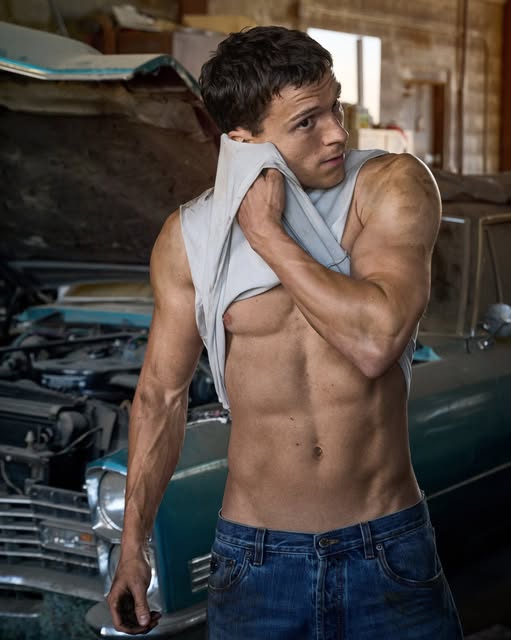
Tom Holland in Men’s Fitness.
I laughed really hard at one older gay writer who pulled out the old “I’ve forgiven Anita Bryant, and how you react to her death tells me more about you than it does about her.’ How he can breathe up there on his high horse of moral superiority, but then again I didn’t become famous for writing the stupidest episode of a popular television series, so CLEARLY he’s a better person than the rest of us! However will I go on, being judged by such an enormous talent? For the record, I turned on Stephen King after aftr decades of fandom, beginning with Carrie, for lauding The Chatelaine of Castle TERF and asking about her next book under a man’s name about a man when her most recent work was a transphobic hate crime. Donated all my copies of his books–including unread ones, stopped following him everywhere, and haven’t bought anything new of his in several years. I stopped reading STEPHEN KING; you think you mattered more to me than my favorite writer for forty fucking years? ↩︎
I am still shaking my head at the stupid ass (whose profile picture was of him flexing his muscles shirtless). Maybe fucking crack a book before opening your stupid mouth and making an ass of yourself publicly? ↩︎
Friday morning in the Lost Apartment. It’s going to rain all day today–including torrential flooding-type rains later on and that’s fine. It’s not as cold in the house this morning as I was expecting it to be (thank you, H-VAC system), but I also didn’t get up ridiculously early this morning, either. Sparky let me sleep late, bless his little heart, and I feel very rested and relaxed this morning. Ah, it’s sixty outside right now; that explains the lack of chill in the air. I’d thought it was going to stay cold, but the rain is giving us some respite and it will drop into the forties later–after the rain stops. I have some errands to run today–including the gym later–and I don’t have to work at home for terribly long today. Yay! I am hoping for a productive day. I wasn’t as tired as I thought I might be when I got off work yesterday, and despite the cold was able to come home and get some good work done on the book. Huzzah! I am starting to feel better about my abilities again–the writing I’ve been doing lately has been rather satisfying, and I don’t hate what I am writing. Progress?
Someone posted on-line yesterday–I wish I could remember who it was–that President Carter’s funeral was very hard to watch because “it also felt like a funeral for the United States1“, which was very aptly put. President Carter–a truly good and decent and caring human being, the acme of a true Christian with a very real faith–being laid to rest does seem to end the time of decency and kindness, and all we have to look forward to is the dismantling of our rights, the end of the rule of law, and the looting of the entire country to make billionaires even richer as the world burns as a result of their bottomless greed; the world is on fire already, thanks to those monsters. I keep hoping for a French-style Revolution, complete with tumbrils and guillotines, but it’s probably already too late for the world. I’m probably not the only person who is feeling a bit of existential dread about 1/20 this month? But I continue to monitor my news intake, and ignoring the legacy media has been marvelous. I am not willing to give up my own sanity to give them clicks and ratings this time around, and I need to save my energy and my mental capacity to fight the stuff that really matters. Everyone always forgets he likes to say insanely stupid things for the sake of outrage and attention, while diverting everyone’s attention from what his foul party is actually doing. Of course, knowing the Supreme Court has given him the authority to do anything he pleases, even violate the Constitution at will, is terrifying. How bad are things going to get here? I no longer have faith in the basic overall decency of other Americans; these are the same types of people who cheered the fall of the Roman Republic and the rise of a dictator/emperor.
Freedom is often too much responsibility for people, seriously. Most prefer to be told what to do, rather than think and reason things out for themselves. I grew up in a country that valued education and science; the war on poverty declared by LBJ in the 1960s pushed for adult literacy and for everyone to get their high school diploma, which was sold as the key to a prosperous life. We also lined up as a nation to get every new vaccination that came along in an effort to end deadly disease outbreaks. There was more of a “we’re in this together so let’s work together” mentality, that started going away under the twisted, paranoid and criminal mind of Richard Nixon. (The unconstitutional tend toward fascism has always been there in that party–Red or Lavender Scare, anyone?) I still cling to that childhood memory of a nation that was trying to do better by its citizens for the betterment of all, but it’s one of the many myths I was raised to believe in as a child. It probably wasn’t as true then as I think it was; the 60s were a very turbulent and violent time. My childish brain wasn’t developed enough to cope with a lot of the cognitive dissonance my early miseducation into American mythology created, but as I got older I began to understand “if this is true, then this must be true, and if that is true than this is very wrong.” The only thing I am intolerant of is intolerance, which was also troubling until I read about the paradox of tolerance.
Well I have high hopes for this weekend, and I hope everyone has a lovely weekend too–in whatever way you want. The horror in Los Angeles continues unabated, as does the horror of the heartless smug trash who hate California. I do not hate California, for the record. I lived there for eight years, and while that might not have been the best years of my life by a long shot, that wasn’t California’s fault. California is majestic and beautiful; there’s no more scenic highway than Highway One up the coast from LA through Big Sur to San Francisco. The natural parks and the mountains are gorgeous. The major cities are all so vastly different from each other they might as well be in different states. The last time I was in California was for San Diego Bouchercon, and I had a lovely time. I used to do events in West Hollywood and San Francisco when A Different Light bookstores were still open. I wouldn’t mind living in California, if I could afford it; I’d certainly feel a lot safer there than I would in most of the country.
Anita Bryant is dead, and here’s hoping it was slow and excruciatingly painful. There will be a newsletter about her death, what she did, and why I will not shed a tear for her or her loved ones. There’s nothing like seeing a celebrity on television when you’re a teenager telling you you’re a pervert and a pedophile and a deviant. Back at you, bitch, tenfold. Hope you’re enjoying your backstroke in the lake of eternal fire in hell for all eternity. There will never be forgiveness in my heart for you.
And on that note, I am heading into the spice mines. Have a lovely Friday, Constant Reader, and I hope to be back at some point with something else later on today, whether it’s an essay for my newsletter or another post here; we’ll just have to see.
They actually said “america”, but we are NOT America; America is the entire continent, from the Arctic to the Antarctic, and this default is an insult to every other other person born and raised on this giant land mass. Chileans and Canadians and Ecuadorians are just as much America as we are. We need to stop doing this. ↩︎