Whole Lotta Trouble

Be gay, do crime.

I don’t remember the first time I saw that phrase somewhere, and I don’t know where it originates from, but actually–being gay used to be a crime (and our “supreme court” seems determined to make that so again), so I’ve always wondered if that was where it started from. I do like the phrase, though.

I also don’t remember how Sins of the Black Flamingo came to my attention, but it did. I subscribed so as not to miss an issue, and intended to read it all in one sitting so I could write about it…but never got around to it, like a loser, and as I was looking through the draft entries for the blog the other day, I saw that I’d started an entry after reading the first issue…but never finished reading the book nor, obviously, finished writing the entry.

the book nor, obviously, finished writing the entry.

And since the main character is gay…what better time to finish reading it, and blogging about it, then during Pride Month?

It did make sense to me.
I’ve read comic books for most of my life (in fact, comics are why I bought an iPad in the first place), but I’ve also taken long breaks from them, so am neither an expert nor even a super fan (although I would love to do a crime novel set in and around a comic books store; which could be fun and comical). I remember comics I read as a kid, and have some vague memories of other times when I dipped into the comics world as an adult. My iPad is filled with comics that I’ve never gotten around to reading—but what a lovely long weekend reading them all would make! Or maybe just take the iPad with me on a trip and read comics the whole time?

Anyway, I digress. I do need to do a longer form essay about my comics history while stressing the importance of how little I do know about my beloved comics…maybe for Pride next year, since it would take some serious rereading and research to do properly…and it could tie into one of the books currently in progress…but I am getting away from the purpose of this post: Sins of the Black Flamingo.
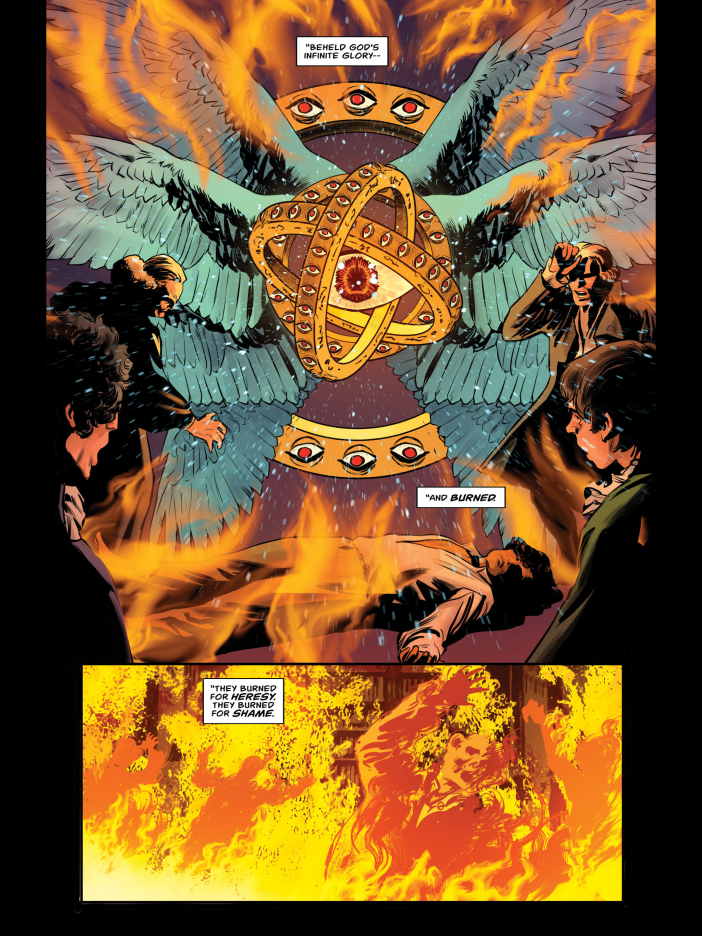
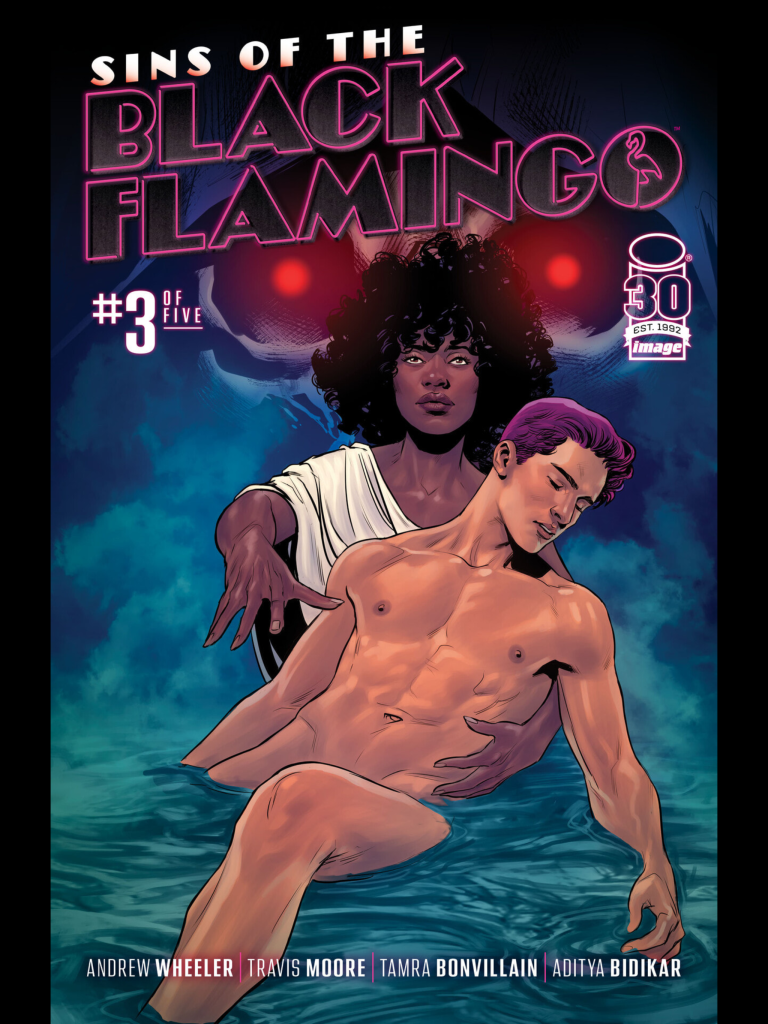
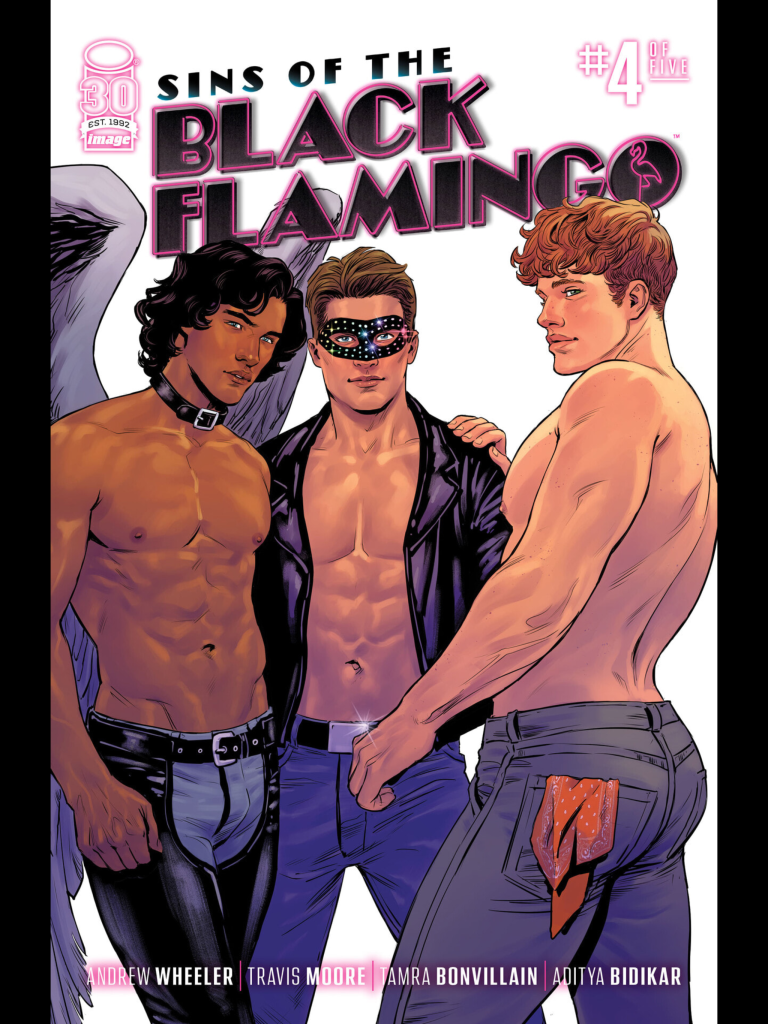
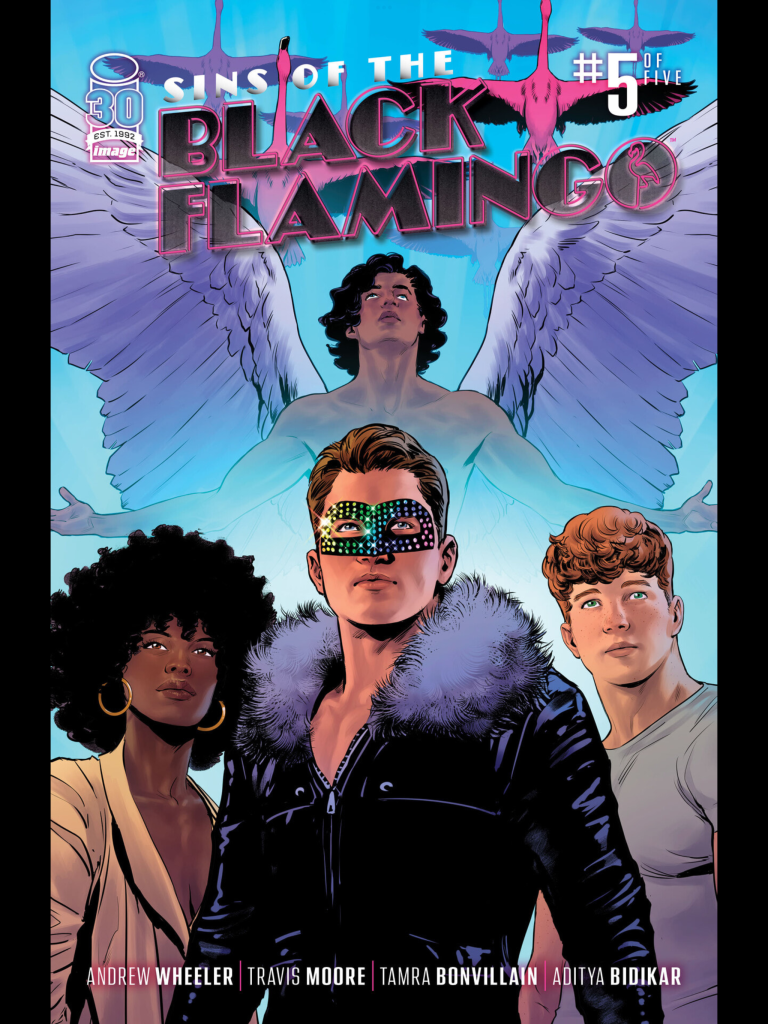
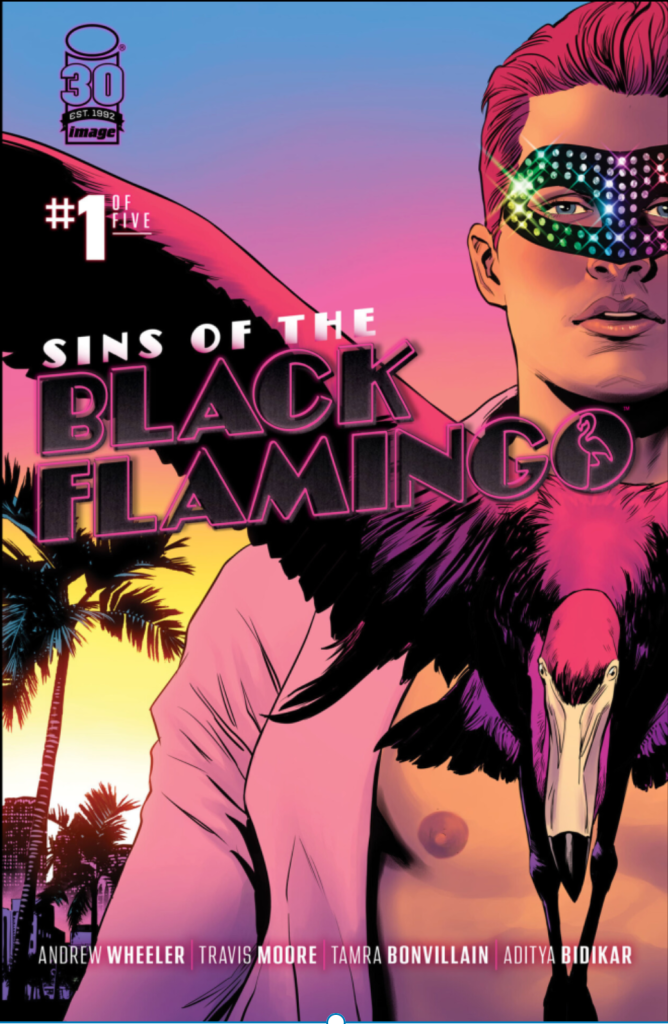
I mean, isn’t this art amazing?

Comic books helped shape me and my tastes. The original DC superheroes I followed were still drawn as ideal men of the past, like the 40s and 50s, big with a  barrel torso, and muscular but not defined. DC Comics hadn’t really updated its characters from their early days much; but it was during my childhood at the end of the 60s and early 70s that they began modernizing their comic characters, their costumes, and how they looked—which I also noticed. This was also around the time that men’s bodies became more sexualized, and what was hot and sexy for men began to change. The women super-hero’s costumes also became more sexualized, as were their bodies (the Legion of Super-Heroes ALONE had some of the more revealing sexy costumes. Queer super-heroes (although why I never made the connection about Wonder Woman and the Amazons with their island of women only is a mystery to me) were non-existent and wouldn’t start showing up until the late 1980s and early 1990s—and it’s still a few and far-between kind of thing (the Will Peyton Starman run always seemed queer to me, which I’ll need to explore at another time).

So, you can imagine my delight to find this run with a gay burglar as the main character, who wears a costume and is extremely good at his job (I’ve always had a soft spot for burglars in fiction) and that was why I subscribed to the series. (Still shaking my head at how long it took me to finally read them all, and there was an pretty amazing cliff-hanger at the end of #1.)

But when I was a kid, the characters and story interested me more than the artwork, and even with my love of the characters and stories, I never followed either artists I enjoyed or writers, either. Which is probably not the best way to enjoy them, really; it was a friend who was an exceptional artist and comics fan in the 1980s who made me aware I should be paying attention to the artists and the writers…and I did find some extraordinary comics by looking for artists and writers of books from there on. The two I remember the most from that time are Todd McFarlane and John Byrne.

Sins of the Black Flamingo is self-classified as “occult noir,” which is a term I absolutely love and now can recognize that occult noir is something I absolutely love and probably writeand will most likely explore more in my own work going forward, since I now know what to call it, because supernatural never really fit in the same way and I don’t feel like the books I write are actually full-fledged horror, but occult noir? Oh, hell, yes.

Anyway, the Black Flamingo is the alter-ego of our hero, Sebastian Harlow. The Flamingo is probably one of the top cat burglars in the world (as you may know, I love cat burglars and originally made Colin one in Bourbon Street Blues), and Sebastian is this interesting combination of my two series characters, of all things; he looks and is built like Scotty, with the same approach to sex as he did before he met the boys, but has the dark worldview and cynicism of Chanse MacLeod…so naturally, I was going to be drawn to the character. IN the very beginning of Book One, he is hired to steal something from a right-wing museum—basically a museum dedicated to honoring white supremacy. It isn’t until he steals the item they’ve hired him to find that we learn the backstory behind the item…and a golem named Abel is brought to life, and Abel is hunky AF, I might add.

We also meet Sebastian’s close friend and ally, Ofelia, a Black witch—and yes, this is very much occult noir. The art is fantastic, and done by Travis Moore, with Tamra Bonvillain as colorist, Aditya Bidikar, and editor Andy Khouri, and Andrew Wheeler was the writer.I highly recommend this—if for no other reason than it’s a great gay story with an interesting main character, and who would have ever thought they’d see a gay circuit party within the pages of a comic?

I do hope there’s more adventures in store for the Flamingo in the future. Highly recommended.

Where Do I Go From Here

The earliest years of my childhood–with a few minor exceptions–are lost in the foggy distant parts of my memories, unable to be summoned at will but sometimes resurfacing at the oddest moments. I don’t, for example, really remember much of how I started reading. I remember being fascinated by dinosaurs and getting dinosaur books from the library; I remember Scholastic Books Fairs and going to the library, both the Chicago Public Library’s nearest branch as well as the one inside my elementary school. I remember, vaguely, comic books: Richie Rich, Caspar, Wendy, Dot, Little Lotta and anything Disney before moving on to the world of Archie and Millie the Model before discovering, and loving, the world of DC super hero comics accidentally. Comic books were only a dime or twelve cents when I was a kid with an allowance of a dollar per week, so I could get quite a few comics with my allowance every week rather than trying to save it for another week so I could spend $1.50 on a Hardy Boys or Nancy Drew (by the time I discovered them, of course). I would not, nor would I ever, consider myself to be an expert on comics; I was a fan, and not a rabid one, either. I never learned the names of writers or artists (I do, however, remember Denny O’Neil from the 1970’s) until one of my returns to comics (I often went years without feeding my super-hero addiction); the 1980’s return got me learning names like John Byrne and Tim McFarlane. It’s always been a dream–one I don’t return to very often–to actually write for a comic title (I really really really want to write for Nightwing) someday but the older I get the less likely that item will be scratched off my lengthy bucket list (someday I might blog about the bucket-list things I am slowly becoming aware that I will never ever be able to accomplish).

Naturally, I’ve been looking forward to reading Alex Segura’s Secret Identity ever since the title was announced: comic books? The 1970’s? A crime story? COUNT ME IN.

And I am pleased to report it did not disappoint in the slightest.

Her eyes fluttered open at the sound.

Carmen Valdez rolled out of her small twin bed with ease, the muscle memory kicking in–even now, in the middle of the night. The shrill scream was familiar, too.

She tiptoed across her small bedroom, avoiding the toys strewn on the floor, as she made her way to the door.

Another scream.

Mami.

The screaming and arguing were routine. Carmen found that she’d become numb to it. She could almost predict it, in the hours before bed. If Mami and Papi were drinking–drinking that stuff–it was a bad sign. It meant they were changing. Becoming meaner. Darker. Something else. She would rush through her routine, rush to get to the relative safety of her room, her closed door, her darkness.

But she also knew the darkness could only shield her from so much. It hid her, but it didn’t silence then. She knew the screams would come. Carmen would just pray she could sleep through them.

I turned fourteen in 1975, and the entire world seemed to be, I don’t know, in some kind of transition that most people in my sheltered world believed would wind up not being good. We were already looking back; American Graffiti had struck gold with a nostalgia craze driven by the memory of “how much simpler (better) things had been back then” (despite the fact American Graffiti is actually a really bleak, dark movie) that was only further amplified by a resurfacing of the Beach Boys and the airing of Happy Days. My high school had “sock hops” (of all things) and my sister played the double album of the Beach Boys’ Endless Summer endlessly. It was easy, of course, to look at the sanitized world of television shows like Happy Days and repeats of Leave it to Beaver and wistfully wish for a simpler time…particularly when impressions we were getting of New York City wasn’t the pristine, clean city of Doris Day movies like Pillow Talk and Lover Come Back but the dirty, gritty noir sensibilities of movies like The French Connection, Shaft, and Serpico. I was already a reader, reading fiction for adults but still occasionally grabbing a comic book or two from the spinner rack at the Jewel Osco, or Mad from the magazine rck at the 7/11 on Briarcliff Road in Bolingbrook, the extremely white suburb my family had escaped to from Chicago and its desegregated schools.

It was also a weird time for comics, to be honest.

So, revisiting that time in Alex Segura’s new novel, Secret Identity, was interesting.

Alex’ book focuses on Carmen Valdez, a young Cuban-American woman living in New York and working as secretary to the publisher at Triumph Comics, a company much lower on the food chain than either Marvel or DC–the ones everyone knows–and hoping to get her own break into the business as a writer. She learned to speak English reading comics (mostly Archie and Betty and Veronica), but eventually moved on to caped crusaders. She gets an opportunity when another writer at Triumph asks for her help in putting together a new hero, the Legendary Lynx–even as a more experienced person in the business tells her not to trust Harvey Stern, the writer. But with all the hope and idealism that a hardscrabble life in New York with a dead-end job in a dying comics company has somehow not stomped out of her yet (ah, to be in my twenties again…), she takes the plunge and collaborates with Harvey–who winds up dead, shot in the forehead. No one knows the new comic Harvey had delivered six scripts for (under only his name) had any input from Carmen–who did the yeoman’s share of the work. Now she has to figure out how to reclaim her character and her work. To do so, she has to find out more about who Harvey was…and that means getting mixed up in a police investigation and eventually into the crosshairs of the killer.

I also appreciated the fact that “stolen work/characters” was the driving force in this book; comic book history is riddled with these kinds of situations, and it was fun seeing it from an insider’s point of view.

The story’s greatest strength is the character of Carmen. Within a few chapters of the story I felt like she was someone I actually knew, had talked to, maybe even had wine or drinks with; she felt like a friend…definitely someone I’d want to know in the real world. Another strength is Segura’s knowledge of the world behind the scenes of a comic book company and the industry itself. (I couldn’t help but grin periodically whenever someone referred to comics as a dying form; the 70’s slump was followed by a renaissance no one could have seen coming, and they are still going strong today.) Carmen’s relationships with the people in her orbit are also realistic and strongly drawn.

An added bonus inside the book are actual pages of art from The Legendary Lynx–which are strong enough to make a good comic book on their own (something we might be looking for in the future, Alex?).

Quickly paced with strong, believable characters, this was a terrific read. Thanks, Alex!