Time Will Reveal

Last night I got home from work early; after stopping at the grocery store to alleviate some of the errands I must run today. I cleaned the living room and worked on organizing the books some, did some laundry, and did the living room floor, as well as laundered the living room blankets and vacuumed the love seat and my easy chair. Mindless chores, as I mentioned on both my panels at Comic Con last weekend, are marvelous for brainstorming and thinking; which I did a lot of. The Short Story Project is also inspiring me, which is really cool, too. The Facebook ban is freeing me up to do a lot more reading, a lot more brainstorming, and so really, I have to thank not only the Puritan trash who keep reporting my pictures of shirtless men but the equally puritanical censors at Facebook, whose word is law and cannot be questioned. As I mused early on in the ban, all this is really succeeding in doing is breaking me of the Facebook habit. How horrible! What a punishment!

Assholes.

So, last night I repaired to my easy chair once I had made myself something to eat and the living room was cleaned and organized. I started looking through my Amazon Prime app on the Apple TV–I can’t tell you how nice it is to have that app now, so I don’t have to switch over to the Prime function of the TV, which doesn’t work as well–and realized that I had subscriptions to both Acorn and Starz through it! I found a bunch of wonderful movies that I’d like to see again, or haven’t seen and want to, on the Starz menu; likewise for some series on Acorn. I settled in with my book and started watching The Towering Inferno, which I had actually never seen. Highly entertaining, badly acted, and starring a smorgasbord of Oscar winners and other interesting casting choices (O.J. Simpson! Mike Lookinland! Soap diva Susan Flannery! Susan Blakely! Richard Chamberlain! Robert Vaughn!), I kept rolling my eyes at the terrible dialogue and immensely stupid situations, not to mention the insane solutions to the fire they kept coming up with–um, it was an electrical fire; yes by all means use water so people will get electrocuted. 

Seriously.

I also noticed a rather obvious theme that runs through all disaster movies–human hubris, and human greed and incompetence always seem to play a part in the disaster. To bring the construction in under budget, Richard Chamberlain cut corners in safety features  as well as in the specifications for electrical wiring. In The Poseidon Adventure the ship is top-heavy because they didn’t take on enough ballast-in fact, removing some–to try to make it to their final port on time as they are running behind; which of course made the ship prone to capsizing in the case of a tidal wave. But next up on my Starz viewing is the 1969 film Airport, based on the Arthur Hailey novel and the blockbuster hit that really kicked the Disaster Movie craze of the 1970’s off–even though the movie is about more than just the imperiled airplane. I’ve not seen this movie, or reread the book, since I myself worked for an airline at an airport; this could make it really interesting.

As for the Short Story Project, I may have mentioned sometime this week that I discovered a collection of Ross MacDonald short stories on my shelves that I’d forgotten I had, The Archer Files.  I read the first two stories in that collection this week. I came to MacDonald rather late in life; I became aware of him in the 1970’s, but his book covers, with their lurid scantily clad women and back cover blurbs that promised machismo and tough guy behavior, didn’t interest me. I didn’t start reading MacDonald until years later, when Christopher Rice recommended him on a panel we both were on. I’d come to love John D. MacDonald in the 1970’s, and so I decided to give Ross a whirl. I think the first one I read was The Drowning Pool, and after that, I was completely in on Ross MacDonald. I have also come to a great appreciation for the extraordinary talent that was his wife, Margaret Millar…I love to imagine what their dinner conversation was like.
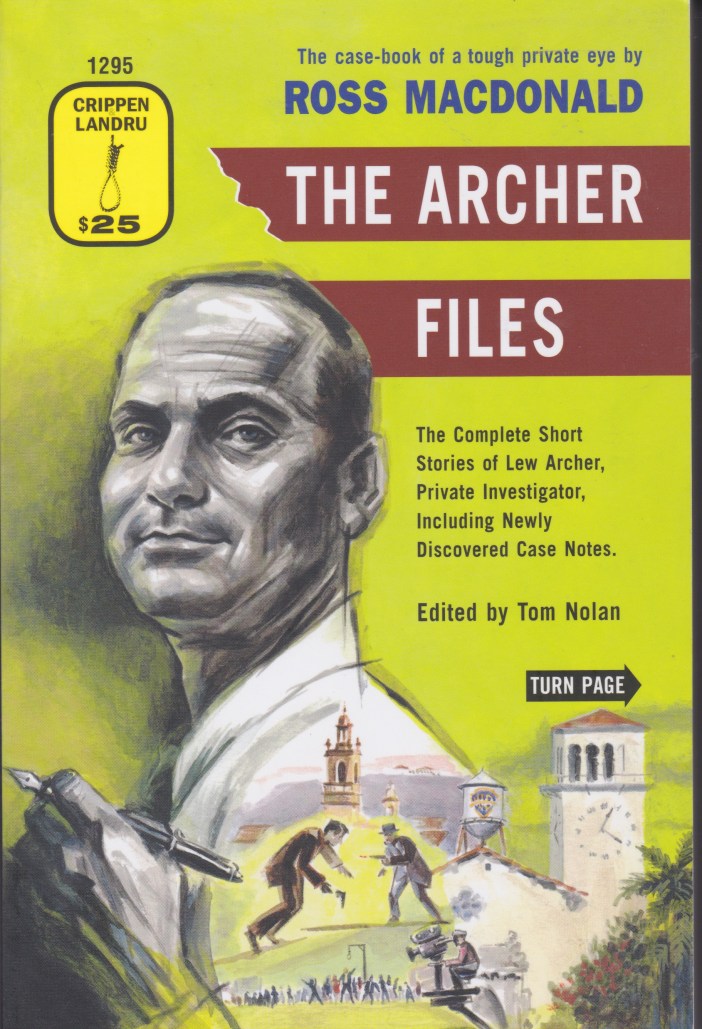
the archer files

The two stories, “Find the Woman” and “Death by Water,” were not originally written or published as Archer stories; they were adapted and turned into Archer stories later, after MacDonald was dead and this was authorized by the estate. The stories work as Archer stories, which is really all that matters. I’ve not yet read any of his non-Archer novels, but some of them are in the TBR pile; I’ll be curious to see if there’s a stylistic difference, or a significant change in voice.

I sat in my brand-new office with the odor of paint in my nostrils and waited for something to happen. I had been back on the Boulevard for one day. This was the beginning of the second day. Back in the window, flashing in the morning sun, the traffic raced and roared with a noise like battle. It made me nervous. It made me want to move. I was all dressed up in civilian clothes with no place to go and nobody to go with.

Then Millicent Breen came in.

I had seen her before, on the Strip with various escorts, and knew who she was; publicity director for Tele-Pictures. Mrs. Dreen was over forty and looked it, but there was electricity in her, plugged into to a secret source that time could never wear out. Look how high and tight I carry my body, her movements said. My hair is hennaed but comely, said her coiffure, inviting not to conviction but to suspension of disbelief. Her eyes were green and inconstant like the sea. They said what the hell.

That is how “Find the Woman” opens, and what a great example of the hardboiled, noirish style of crime writing. Not a lot of words, not a lot of sentences, and yet we get a strong sense of Archer’s character, just out of the war and chafing restlessly at his new life and existence, and the danger inherent in Millicent Breen. She is beautiful, older, sexy and dangerous; she wants Archer to find her daughter, a movie starlet who has disappeared, and this leads Archer into the  dangerous world of movie stars and film people, of love gone astray and a slightly sexist depiction of restless women who might love but need someone in their bed every night. I enjoyed it, not only as an example of the writing style but as a time capsule; it was easy to picture this in black-and-white, with Bogart as Archer and maybe Myrna Loy as Millicent Breen.

He was old, but he didn’t look as if he were about to die. For a man of his age, which couldn’t have been less than seventy, he was doing very well for himself. He was sitting at the bar buying drinks for three young sailors, and he was the life of the party in more than the financial sense. In the hour or so that I  had been watching him, he must have had at least five martinis, and it was long past dinner time.

“The old man can carry his liquor,” I said to Al.

“Mr. Ralston you mean? He’s in here every night from eight to midnight, and it never seems to get him down. Of course some nights he gets too much, and I have to take him home and put him to bed. But next day he’s bright as ever.”

And so begins “Death by Water.” Again, note the writing style; the sparse use of words to get a point across, the inherent toughness in the words chosen and how they are put together. Mr. Ralston ends up dead later on, of course; drowned in the swimming pool, and Archer is on the case. It’s a great little crime procedural, with Archer taking mental notes as he talks to witnesses and the people involved, and once the case is actually solved, it’s pretty clear that the solution was right there in front of our faces all along. Well done!

And now, back to the spice mines with me. Paul’s going into the office, I have some errands to run, and we’re going to go see I, Tonya tonight; I intend to do a deep, overdue cleaning of the kitchen today as well, around writing and editing.

 

Nobody Told Me

Friday, and a Holiday Weekend Eve. Huzzah! I am going to get so much done this weekend, Constant Reader, you have no idea. Huzzah! Huzzah!

One thing I did notice this week–and this is really funny–is that when I was posting my book covers and book blurbs on Tumblr this week ((you can follow me here) I saw that in one of my former y/a’s, I’d used a name that I am again using in my WIP; obviously, that’s going to have to change! I also realized I was going to need to reread that book (Sara, in case you were wondering) to make sure I’m not pillaging other names from it, either. This happens, you see, because of manuscripts I wrote in my twenties and early thirties, and names I used in those books that I have re-used in rewrites of them or in new books. I also always would come up with character names for short story or book ideas; and so those names are already lodged in my head and when I need a new character name they boil up in my subconscious. So, now I have to rename this girl…and hopefully, I won’t have to rename anyone else.

(This hilariously happened another time, with two male names: Chris Moore and Eric Matthews. I originally came up with those names in the 1980’s when I was making notes on a fraternity murder mystery–great idea I should revisit–and then, when I was writing Every Frat Boy Wants It, I used those character names. In another irony, they were both from a small town in the California mountains, Woodbridge. When I was revising and rewriting and finishing Sleeping Angel, set in a small town in the California mountains named Woodbridge, I used those character names again and didn’t realize what I had done….which sort of makes Every Frat Boy Wants It kind of a sequel to Sleeping Angel. My work always somehow winds up connected in some way…)

I’ve been reading a lot of short stories lately; in fact, I’ve read about six over the last two days! How cool is that? I discovered that I had a collection of all Ross McDonald’s Lew Archer stories, The Archer Files, and dug into that last night while I was waiting for Paul to come home. I also can’t stop reading Troubled Daughters Twisted Wives by Sarah Weinman, and also read another couple of Laura Lippman’s stories in her collection Hardly Knew Her. There was a discussion recently on social media about short stories, and how the market has been slowly imploding over the last twenty years or so…it was interesting, and it also made me curious. I generally don’t read a lot of short stories–hence the Short Story Project–and yet, whenever I do read short stories I enjoy the hell out of them. You should always read the kind of things you like to write, and perhaps the reason I have so much trouble writing short stories is because I don’t read them very often (yes, yes, I edit anthologies, but that’s an entirely different thing–but maybe because I’ve done so many anthologies is part of the reason why I don’t read short stories in my free time? Hmmmm, something to ponder there), and frankly, reading these amazing short stories since the Short Story Project started has been kind of inspirational for me. So, the Short Story Project is working. Huzzah!

One of the last two stories I read in the Weinman anthology were “Lavender Lady” by Barbara Callahan; the story was originally published in Ellery Queen’s Mystery Magazine in September 1976 and was nominated for an Edgar Award for Best Short Story:

It was always the same request wherever I played. College audiences, park audiences, concert-hall audiences–they listened and waited. Would I play it in the beginning of a set? Would I wait till the end of a performance? When would I play Lavender Lady?

Once I tried to trick them into forgetting that song. I sang four new songs, good songs with intricate chords and compelling lyrics. They listened politely as if each work were merely the flip side of the song they really wanted to hear.

That night I left the stage without playing it. I went straight to my dressing room and put my guitar in the closet. I heard them chanting “Lavender Lady, Lavender Lady.” The chant began as a joyful summons which I hoped would drift into silence like a nursery rhyme a child tires of repeating. It didn’t. The chant became an ugly command accompanied by stamping feet. I fled to safety.

Mick Jagger famously said he’d rather be dead than singing “Satisfaction” when he was forty-five; that comment came back to bite him in the ass as he was singing it when he was in his sixties. I often wonder about that; how tired musicians must become of playing songs that are trademarks; the monotony of singing the same songs day after day, year after year. Imagine how many times Judy Garland sang “Over the Rainbow,” or Cher has sung “Gypsies Tramps and Thieves,” Madonna “Like a Virgin,” and so forth. How do you manage to do it without it becoming rote, routine, dull and boring?

But what makes this story so strong is that our main character’s signature tune, “Lavender Lady,” has a dark history. The song is beautiful and beloved, but the story behind it, the story that inspired the heroine to write it, is twisted and nasty. She was born into a wealthy family, neglected by everyone, and was kidnapped by her nanny…who was the Lavender Lady. That is the story behind the song, and so you can imagine how anguishing it is for her to sing it, over and over again, to have it be the signature tune that audiences expect for you to perform, come to hear; reliving that awful memory every time you play the first chord and sing the first note.

Terrific story!

The other was written by the amazing Vera Caspary, who also wrote the classic novel Laura, which of course was made into an even more well-known classic film. This story, called “Sugar and Spice,” which is the story of a very twisted relationship between two cousins.

I have never known a murderer, a murder victim, not anyone involved in a murder case. I admit that I am a snob, but to my mind crime is sordid and inevitably associated with gangsters, frustrated choir singers in dusty suburban towns, and starving old ladies supposed to have hidden vast fortunes in the bedsprings. I once remarked to a friend that people of our set were not in the homicide set, and three weeks later heard that her brother-in-law had been arrested as a suspect in the shooting of his rich uncle. It was proved, however, that this was a hunting accident and the brother-in-law exonerated. But it gave me quite a jolt.

Jolt number two came when Mike Jordan, sitting on my patio on a Sunday afternoon, told me a story which proved that well-bred, middle-class girls can commit a murder as calmly as I can knit a sock, and with fewer lumps in the finished product. Mike had arrived that morning for an eleven o’clock breakfast, and after the briefest greeting had sat silent until the bells of San Miguel started tolling twelve.

As I mentioned, “Sugar and Spice” tells the story of two cousins; Nancy and Phyllis. Nancy’s father was the richest man in their small town, and so therefore Nancy was rather spoiled and had a privileged upbringing, was used to getting her own way. Phyllis’ father walked out on her and her mother, and so her mother was forced to give piano lessons to support them. Everyone in town felt sorry for them; as they were quite poor. Nancy was overweight, ungainly and unattractive; Phyllis was kind of effortlessly beautiful, and their grandmother preferred Phyllis, constantly insulting Nancy and putting the two girls at odds with each. Mike Jordan, as mentioned above, is telling the story of the two cousins, and the murder of actor  Gilbert Jones, to his hostess, Lissa. As he gets to know both girls and they get older, the twisted relationship between the two girls becomes even more entangled and bitter and twisted, as they tend to keep falling in love with the same man. The story is fantastic, absolutely fantastic, and a master class in how to build suspense in a short story. Wow. Amazing.

And now, back to the spice mines.

539f6f8b18bbb_-_guy-without-his-shirt-1004-large-new