The traditional mystery often gets a bum rap by mystery fans. I’m not sure why that is; these books have never gone out of style, have never decreased in popularity, and have always been the backbone of the crime/mystery genre. They are often (wrongly, I think) identified with Agatha Christie–if anything, Christie should be identified with every sub-genre of crime/mystery fiction. She wrote private eye novels (Poirot); dark noir (Endless Night); spy fiction (N or M?, The Man in the Brown Suit, They Came to Baghdad); historicals (Death Comes as the End); and even romantic suspense (as Mary Westmacott). Sure, she often relied on the amateur sleuth–her most famous amateur being probably Miss Marple–but she literally did everything first, really.
Probably why everyone refers to her as the Queen of Crime Fiction.
But the traditional mystery, for some reason, gets short shrift in our modern world, despite being one of the most popular subgenres of crime fiction. Why? I don’t really understand it. Sure, there’s not any blood or sex or violence–the sort of thing generally used to sell everything from television shows to movies to laundry soap and deoderant. Many of us grew up reading books about amateur detectives, from Nancy Drew to the Hardy Boys to Trixie Belden. So why do so many turn their noses up at the traditional mystery, also known as the cozy mystery?
I think it’s much harder to write about crime without using the tough guy male lead (stereotype), blood, violence, swear words, and sex. Is it this lack of the “rougher” aspects of crime that earned these books the nickname “cozy”?
What precisely does the word cozy mean, used as a book descriptor in this way? Ask five mystery fans/writers, and you will get five different answers. It’s often hard to quantify the variety of subgenres within the mystery/crime field. Everything else aside, I think the most important thing, the key, for a mystery novel to get this kind of classification is that the book focuses, on one level, on a sense of community; the reader develops a warm, comfortable feeling, the kind that you usually get from visiting family and friends you don’t get to see all of the time. You open the book and start reading and already feel relaxed and at home; happy to see people you care about, are interested in, and are excited to find out what they have been up to. Donna Andrews’ Meg Langslow series is an excellent example of this; so is Leslie Budewitz’ Spice Shop mystery series (both series, obviously, are favorites of mine). These books welcome you in, invite you to put your feet up, get comfortable, and spend some time with your old friends you’ve not seen in a while.
This, naturally, is very difficult to establish when writing the first book in a new series of this kind; how do you immediately establish this warm environment where the reader feels comfortable enough to kick off their shoes and relax? It’s not the easiest thing to pull off for an accomplished writer; so it’s all the more remarkable when someone nails it in their very first book.
Mia P. Manansala nailed it in her debut.
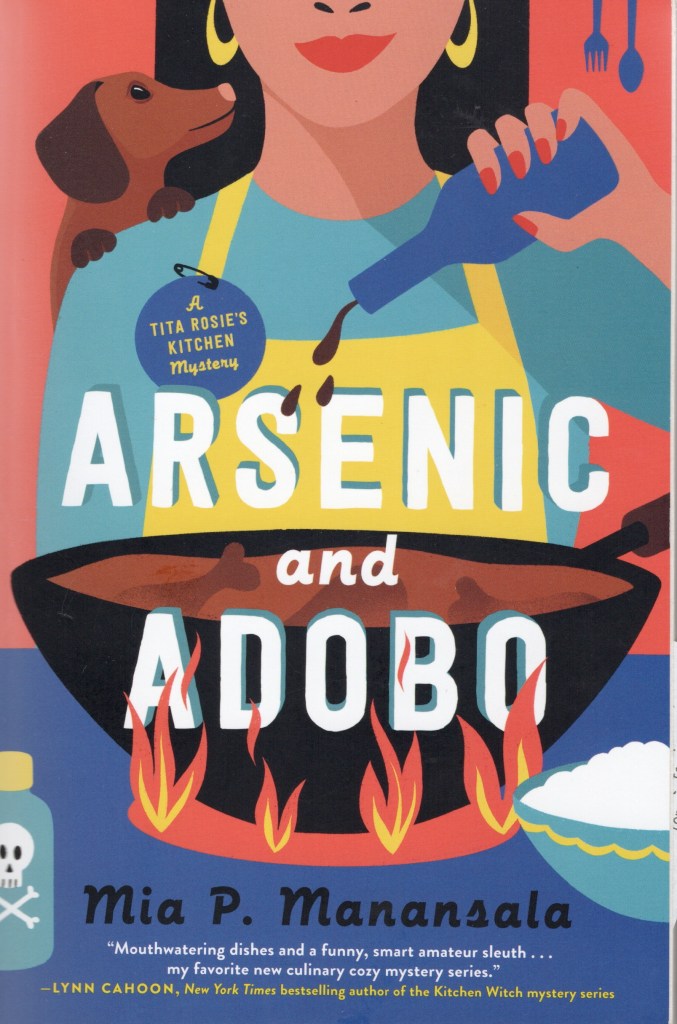
My name is Lila Macapagal and my life has become a rom-com cliché.
Not many romantic comedies feature an Asian-American (or dead bodies, but more on that later), but all the hallmarks are there.
Girl from an improbably named small town in the Midwest moves to the big city to make a name for herself and find love? Check.
Girl achieves these things only for the world to come crashing down when she walks in on her fiancé getting down and dirty with their next-door neighbors (yes, plural)? Double check.
Girl then moves back home in disgrace and finds work reinvigorating her aunt’s failing business? Well now we’re up to a hat trick of clichés.
And to put the cherry on top, in the trope of all tropes, I even reconnected with my high school sweetheart after moving back to town and discovered the true meaning of Christmas.
Okay, that last part is a joke, but I really did run into my high school sweetheart. Derek Winter, my first love.
First of all, can we talk about the voice?
It is impossible not to fall in love with Lila’s voice from the very first sentence of the book. She is smart and funny and eminently likable, which is important in a traditional mystery (no one wants to read a cozy whose main character is an unlikable bitch) and much harder to do than most people who don’t actually write books think it is. Lila is a remarkable character; very clear-eyed about what she wants and what she doesn’t, as well as who she thinks she is and wants to be. She’s returned from her big escape to the big city to the small town she wasn’t terribly happy in when she was growing up–her past experiences continually are reminding her, and not in pleasant way, of why she left in the first place. She never intended to return home (as Thomas Wolfe said, you can’t go home again), but she is back and rather than focusing on what she is certain everyone she knows or is related to sees as her “failure,” she intends instead to focus on helping save her aunt’s restaurant business.
The immense strength of this story rests upon those family bonds, and Lila’s recognition of just how important those bonds–family, friends, community–actually are to her; and her growing realization, over the course of the books, that those things she once thought were strangling and restraining her are actually where her own power comes from.
The mystery itself is also strong: Lila’s wretched local ex, whose mother has since married a businessman who rents Tita Rosie’s building to her and is a total dick, has taken to writing shitty reviews of local restaurants, apparently targeting one and trying to destroy its business before moving on to another. Lila’s relationship with him is also strained; and she also doesn’t like the dickish stepfather either. It is while she is serving them lunch that her ex keels over face-first into his plate–dead from arsenic poisoning. In the food Lila fed him, and came from her aunt’s kitchen. The financially strapped business is shut down pending an investigation into the murder and a health department inspection, and there is the very real fear that Tita Rosie may lose her restaurant. Lila takes it upon herself to investigate and find the real culprit, to clear herself as well as her aunt and the beloved family business of any wrongdoing and scandal. The journey, which introduces us to her friends and family, and welcomes the reader into their charming world and community, twists and turns and is full of surprises every step along the way–as Lila also learns just how much the restaurant, her family, and her friends really mean to her.
This book is absolutely charming, well-written, and very fun. I cannot wait to revisit Lila and her crew in the second book, Homicide and Halo-Halo. Mia P. Manansala is definitely one to watch, and it’s going to be fun watching her career reaching even more heights than she has already achieved.

 Queer and Loathing in America