Hollywood has always been interesting to me, ever since I was a kid. I am not as obsessed with Hollywood and celebrity culture as I used to be; I used to love awards shows but now find them kind of tedious and a lot of to-do about nothing very much. Paul and I used to watch any and every awards show, regardless of what they were for; now it’s just easier to follow live updates and skip the forced, awkward scripted banter and speeches where winners attempt to thank everyone they know before the band starts playing them off.1 That’s always cringey to me–not for the person the band is playing for, but for the event itself. I get that they want it to end on time, but at the same time it seems bad form to celebrate someone and then cut them off as they do celebrate? Your mileage, as they say, may vary.
One thing I did notice when my Hollywood fascination was at its peak was how cleaned up and sanitized Hollywood bios were, as opposed to the fiction written about Hollywood. You’d never know, for example, from reading a biography of Spencer Tracy that he wasn’t just “good friends” with Katharine Hepburn, or that Roddy McDowell never married for a reason, or that some stars may have been forced to have sex with casting directors, agents, and producers to get started. But those marvelous Hollywood novels (dismissed and disdained by critics as trash) were so much fun to read, and they always ended in tragedy. I also always wondered–affairs and divorces were also fairly common amongst Hollywood celebrities–how much truth there was in those stories; often I could identify characters as real people (for some books–cough Valley of the Dolls cough–trying to figure out who the characters were based on was part of the fun of reading them). And of course, the existence of “studio fixers”–yeah, there’s still a bunch of stories from Hollywood’s past we may never know the real story behind, let alone the stuff they buried so completely it’ll never be known–definitely speaks to the need for them, so yeah, Hollywood had a lot of secrets.
And now, knowing what I know about powerful Hollywood figures and how they behave? I’d be more surprised if they didn’t see the contract players as a harem of men and women for them to play games with.
I also have a tendency to avoid highly praised writers and books (and other forms of entertainment, of course), because I always end up disappointed, which is fault of neither author nor their work. Jordan Harper has been praised a lot, so I was hesitant to read him…but having now read Everybody Knows, I don’t regret waiting to read it because I saved a real treat for myself.
For want of a better word, wow.
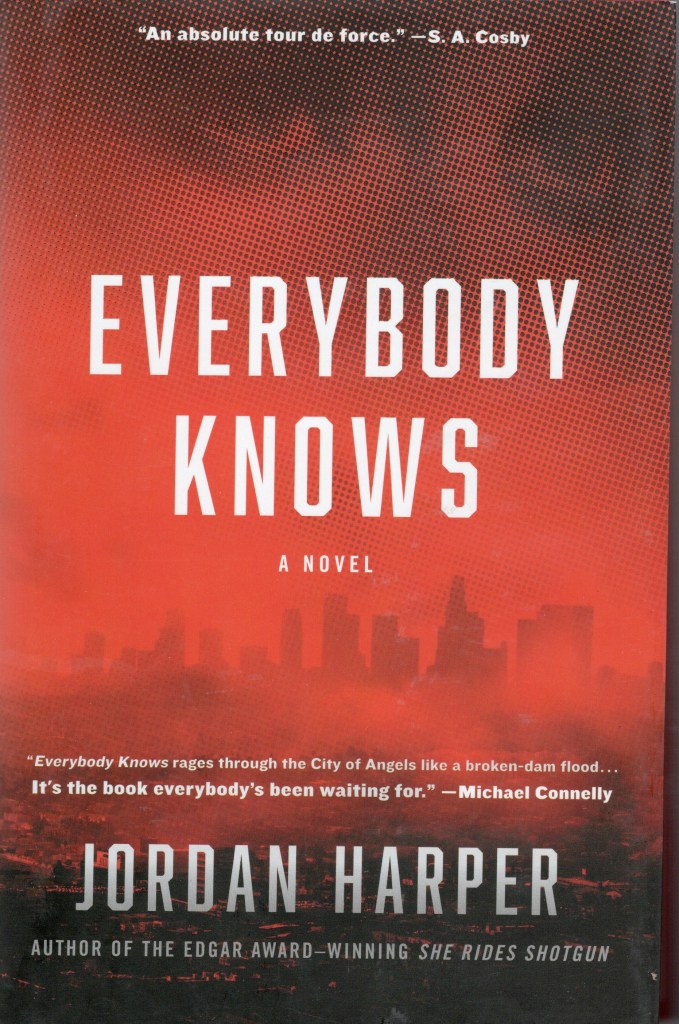
Los Angeles burns.
Some sicko is torching homeless camps. Tonight they hit a tent city in Los Feliz near the 5. The fire spread to Griffin Park. The smoke makes the sunset unbelievable. The particles in the air slash the light, shift it red. They make the sky a neon wound.
Mae waits outside the secret entrance to the Chateau Marmont. She watches Saturday-night tourists wander Sunset Boulevard, their eyes bloodshot from the smoke. They cough and trade looks. They never thought the Sunset Strip would smell like a campfire.
Mae moves around the sidewalk like a boxer before the fight. Her face is sharp and bookish, framed in a Lulu bob. She wears a vintage floral jumpsuit. She’s got eyes like a wolf on the hunt–she hides them behind chunky oversized glasses. Nobody ever sees her coming.
Jordan Harper is an amazing writer. That’s where we need to start with this book. Yes, the story is compelling and fascinating and dirty and sleazy and makes you kind of want to take a Silkwood shower. The characters–all of them, from the two leads on–are defined and fully dimensional, with interior lives and motivations. Our two main characters, Mae and Chris, are modern-day fixers…but in modern times they’re called “flacks” and work for “p.r. firms”, even if their job is the same as the tough guys who worked for MGM and Warners and Fox back in the day. But the writing is what sold me on book and writer; those opening paragraphs are as fine a series of opening paragraphs I’ve ever read. The dialogue is real, the characters are awful but you understand why they are awful–and both Mae and Chris have seen their fair share of horrific cover-ups and helping their clients get off scot-free every time they get in over their heads. In the very first chapter, Mae is on the job helping a young former child actress transitioning into adult roles out of drug overdose situation in her rooms at the Marmont, and her quick thinking and moving gets the young woman out of there without being seen or caught.
Mae is very good at her job.
Her boss sets up a meeting with her–off the books, away from the office–but on his way to meet her, he is murdered. It’s supposedly a car-jacking go wrong, but Mae has to wonder, is it? He’d seemed like he was about to hit a financial bonanza, but needed her help. Mae decides to look into his murder–which Chris winds up working as well from another direction. Mae and Chris didn’t work out the first time–but they’ve never forgotten each other, and soon join forces. Both were coming to the conclusion that their jobs were sleazy and they were helping bad people get away with doing bad things, and when they realize what is at the root of all the trouble, they see it as an opportunity to make some cash and perhaps do a little good on their way out to retirement.
And what’s going on in Hollywood is something horrible, indeed.
I loved this book, and deeply resented not having the time to read it all the way through in one sitting, so am really glad I made the time to sit down and finish it–in one sitting. I was about forty or fifty pages in, and sat down and didn’t budge till it was done. That authorial voice! The influence of the hardboiled masters is clearly there, but Harper has his own distinctive style and authorial voice that makes him unique in the business–and that’s not an easy thing to do.
I can’t wait to read more of his work.
- I do think this aversion, or lack of interest, in awards shows has come from attending so many writing awards banquets, and yes, it’s a lovely problem to have. At some point I will go talk about my antipathy to awards…but must and always will confess to loving being nominated for things. My jones for that itch to be scratched has happened more than I could have ever dreamed. ↩︎

 Queer and Loathing in America