Kyrie

Well, I finished “Fireflies” yesterday and got it sent in to the market; we’ll see how it goes. It’s kind of a stretch for that particular market, I suppose, but we’ll see how it goes. If they don’t want it, at least it’s finished. Who knows, there may be some editorial notes that will make it even better.

Two stories I sent out into the world–“Lightning Bugs in a Jar” and “Neighborhood Alert”–were turned down; no surprise, really; I am starting to realize my stories, while crime oriented for the most part, aren’t really mysteries, which kind of precludes their acceptance into mystery magazines. But that doesn’t mean I’m going to stop writing them, of course. I’ve thoroughly been enjoying myself this year writing short stories, so why stop doing something that gives me pleasure? They are also wonderful exercises in voice, tone, character; even in plotting, to a certain degree; I also feel that working on them is improving my writing (although, from looking at the Scotty book and the WIP, I am not so certain that’s true! Ha ha ha–just kidding; no more self-deprecation here). The problem, of course, is how does one monetize that work, so that it’s not just a writing exercise but something that can provide an income stream? The truth is, of course, that there are markets out there for crime fiction that may not be recognized necessarily as markets for crime fiction. But at the same time, getting published in places outside the recognized crime genre could be a way of getting my name out there and recognized, building the brand, as it were.

God damn, how I hate the term brand when it comes to writing! It just seems wrong, but I get it, and why it’s used. But that doesn’t have to mean I like it.

I have to confess, I had a slight crisis of confidence on the WIP yesterday.  I’ve been working on it for so long–off and on for at least two years–that I was starting to think, meh, maybe I should table it for good and be done with it. But as I was watching Harlan Coben’s Safe on Netflix last night (we enjoyed it), it suddenly occurred to me that there was a glaring hole in the middle of the entire thing; I’ve never really understood why some of the things that happen in the book actually do happen. Without that knowledge, is it any wonder I can’t get inside the characters? And without being able to really understand the characters and why they do the things they do, how can I possibly write about them honestly, realistically, and have the story I’ve devised for them actually work? So, the problems with the WIP that I’ve had all along basically stem from two things: a lack of understanding of who the characters are and their motivations, and not really knowing how to end it properly. So, my goal for this week is to do exactly that; go back to the beginning and figure out who my characters are and what the plot of the book really is. I still like the idea of having the entire book play out over the course of a weekend, from Friday night to Monday morning, and I think I can make that work, but I need to know who the characters are, what drives them, what drove them, and why they do the things they do. Which is what is missing from the book, the emotion and the understanding. “Oh, I need this kid to be a bastard, so he is a bastard.” No, that doesn’t work.

So, it’s kind of back to the drawing board for me. I am going to work on those characters and the plot of this book while I work on the Scotty; and if ideas some to me about Muscle, so be it; I will also work on it. But the primary focus has to be the Scotty book, which I need to get finished by July 1. And that’s very do-able. The first draft is nearly half-way finished; so the goal this week is to read what’s already done and take notes, while preparing for the next four or five chapters.

And, as I have always said, it’s never a bad thing to go back to the drawing board sometimes. You shouldn’t ever force a book or a story.

For your enjoyment, here’s the opening for “Don’t Look Down”:

Jase shifted the Fiat’s engine into a lower gear as he started up the steep hill. He hadn’t driven a standard transmission since college, but he did remember hills required downshifting. As the Fiat started climbing he passed two handsome, tanned men on mountain bikes, sturdy thighs straining against their brightly colored Lycra casing. According to the directions, he would be in Panzano when he reached the top of the hill.  There was a parking lot off to the left and just beyond that he could see a stone wall. The hill—or mountain, he wasn’t sure which—dropped off into a valley to the right, vineyards and olive trees spreading out to the next sloping hill.  A low stone wall hugged the right side of the road nearer the crest of the hill, with barely enough space for pedestrians or mountain bikes. All the roads had been incredibly narrow since he’d left the highway, with many sharp blind curves as the road weaved in and out and around and along mountains.  At one point an enormous bus coming the other way had almost forced him onto the shoulder, missing the black rental car by inches. He glanced up at the directions tucked into the sun visor. At the crest of the hill there would be another sharp, almost ninety-degree turn to the left, and to his right would be the triangular town center of Panzano-in-Chianti. To get to the hotel, because of the narrow one-way streets, he’d have to circle around the  triangular town square to get to the little hotel.  

The sunlight breaking through the clouds in the valley was beautiful.

Philip would have loved this, Jase thought. He always wanted us to see Italy.

All he felt was a twinge of sadness, which was better than breaking down into tears. He was healing, needed to get away from the apartment, the neighborhood, seeing Philip everywhere he turned, everywhere he looked.

And what better way to do that than two weeks in Italy?

28684878_1224228877721777_1611553184461666820_n


Burning Heart

Sunday morning, and yet another good night’s sleep. It truly is amazing what a difference that can make in one’s life; I miss the days when I could simply tumble into bed and close my eyes and, as Paul once put it, “sleep through a nuclear holocaust.” Yesterday was a good day; I got groceries and did some cleaning. I read both “This Town” and “Don’t Look Down” aloud, did the necessary clean-ups on them, and this morning I am going to read “Fireflies” aloud and see if it, indeed, does hold together. I wrote the first draft of “Fireflies” something like thirty years ago (!) and it’s still in the file folder, handwritten (because until computers, I almost always hand-wrote everything); I am still not entirely certain the story works; but we will find out today when I read it out loud.

I was very pleased with the two stories I read aloud yesterday, and if I do say so myself, I feel “This Town” is one of the better stories I’ve written. I’m going to read “Fireflies” aloud this morning, and then I’m going to work on “This Thing of Darkness” for a little bit, see how that goes, and then maybe dive into one of the two novels I am working on (focusing on, really; there’s a third I started writing a couple of weeks ago, which I am itching to get back to, but that’s just crazy talk). I also started reading Alex Segura’s Blackout yesterday, not getting very far, alas; but I am looking forward to getting further into it. I also started reading Martin Edwards’ Edgar Award winning The Golden Age of Murder, which is my new ‘read a chapter or two before bed’ book. We also started watching Harlan Coben’s new Netflix series, Safe, and are really enjoying it thus far.

My kitchen is also a disaster area; I made ravioli last night and yes, well, a mess is a bit of an understatement.

I also stopped at Office Depot yesterday to purchase pens. I’ve discovered a new brand of pen that I absolutely love: Tul, with a dash over the u. They sent us a couple of them at the office a month or so ago, and I absconded with them, as is my wont, and then bought a couple more. Yesterday I bought several more packs of them. I’ve always been a bit of a pen nerd, and I also noticed last night, as I made notes in my journal, that my blank book is almost full; time to get a new one soon. Yay! I really am glad I’ve gone back to keeping a journal to write notes and ideas down into; I’ve worked out issues with several of my short stories this year in it, as well as the books.

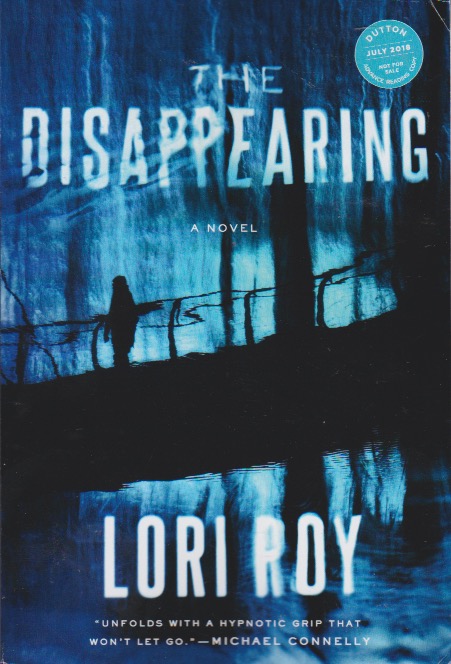
I also managed to finish Lori Roy’s upcoming new release, The Disappearing, last night.

the disappearing

Lane Wallace is alone inside Rowland’s Tavern when the front door flies open. A man stumbles inside, bringing with him a spray of rain that throws a shine on the hickory-brown floors. He scans the dark rooms, stomps his feet, and draws both hands over his wet, round face. If the man says anything, Lane doesn’t hear him for the rain pounding the tin roof and the palm fronds slapping the front windows. It’s supposed to rain through the night, and all around Waddell, people will be keeping a close eye on the river.

Lane smiles because maybe the man is a friend of a friend and not a stranger. She’s expecting a big crowd tonight, and one of her regulars might have invited him. But he doesn’t smile back. Slipping her phone from her back pocket. she lays it on the bar top where the man will be sure to see it. It’s a subtle warning, but if the man is looking for trouble, it’ll make him reconsider.

He’s a little on the heavy side; doughy, a person might say. From behind the bar, Lane asks the main if a beer’ll do him, and as he slides into a booth near the front door, he nods. Hr regulars, men who’ve known her all her life, or rather who have known her father, won’t show up for another hour or so but Rowland Jansen will be back any time now. He ran out to move his car and Lane’s to the higher and drier ground of the parking lot out front, so she won’t be alone with the man for long.

This is Lori Roy’s fourth novel, and it’s quite an achievement. His first three novels–Bent Road, Until She Comes Home, and Let Me Die in His Footsteps–were all shortlisted for Edgar Awards; she won Best First for Bent Road and Best Novel for Let Me Die in His Footsteps, raising her up into the exalted, rarified air of the Multiple Edgar Winner Circle. I’ve only read Bent Road–I do own the others, will every intent to read them at some point; too many books, not enough time–and it blew me away with its stunning depiction of rural Kansas, its juggling of two separate time-lines, and its thematic exploration of how the pains and evils of the past can influence the present.

That same theme runs through this stunning new novel, The Disappearing, as well, and is explored even more deeply and explicitly than in the first. Waddell is a small town in north Florida, amorphously near Tallahassee; Roy’s captured the feel of rural small town Florida deftly (there is, as not many know, a huge and significant difference between the coastal cities of Florida and the insular, small towns of the state’s interior). She plays with the memories of Ted Bundy’s journey through the area; a young woman, a student at Florida State doing some internship work at a local, fading plantation is missing, which has stirred up all those fearful memories of Bundy’s spree. The plantation also shares a boundary with a closed reform school for boys, whose own violent and possibly deadly past has also come back to haunt Waddell.

But it’s also an exploration of family, and how the damage from a past history of deep violence and emotional abuse, locked away and ignored, can reverberate through the years and have deep, horrific implications on the present. Susannah Bauer’s disappearance triggers a chain reaction of emotion and violence and horror, spread over the course of a few days after the night of the heavy rain, that will continue to cycle through the future unless honestly and painfully dealt with in this present.

There are four point of view characters in The Disappearing: three women from generations of the same family–Erma, the matriarch of the Fielding family, with her guilts and secrets festering inside her for decades; Lane, her daughter, whose own emotional damage and baggage perpetuates the cycle; and Lane’s younger daughter, Talley, whose wanderings due to her own loneliness and unhappiness makes her the holder of most of the secrets and truths of the present. The fourth point of view character is Daryl, a mentally disabled young man who is the groundskeeper at the church, and his story is told in the recent past rather than the present, as Lori Roy deftly spins all the secrets and lies and horrors of the town of Waddell into an astonishingly well-blended tale of flawed people and the damage they can leave in their wake.

Even more impressive than the characters and the story itself is the mood and the voice; the way she maintains this almost dreamy tone, creating the perfect mood for the story is masterful. The voices of her characters are compelling and real; only Daryl tells his story in the first person; the others are a very tight third person present tense. The shifts in voice, the tone, the tense and the word choices and the imagery, kept reminding me of Faulkner’s brilliant The Sound and the Fury, and in a very good way.

The Disappearing is an extraordinary achievement, and is destined to make awards short-lists and all the Top Ten lists for 2018.