Ah, the wonderful world of daytime soaps. It’s so weird to me that there are only four (The Young and the Restless, The Bold and the Beautiful, Days of Our Lives, and General Hospital) left on the air. At the height of my soap addiction, I watched more than four of them. I mean, you literally could spend the entire day from about eleven till three thirty watching them back then–four and a half hours solid of soaps. Usually there would be some kind of Good Morning America show on, followed by game shows, and then came the dramas. A lot of those game shows came and went, but ones like The Price is Right never seemed to go out of favor with audiences while the others waxed and waned.
Dark Shadows was the one I really loved when I was a kid, and to this day I still remember it fondly.
When we moved to Kansas in the mid 1970s, the town where we lived was only able to pick up one television station, a CBS affiliate out of Kansas City–less than half a year after we moved there we were able to get cable–but that first summer we lived there and I didn’t know anyone? All I did was read and watch television…and with only one channel, there really wasn’t much choice during the day so Mom and I started watching the CBS shows, and I am sure I am going to forget one here: Love of Life, The Young and the Restless, Search for Tomorrow, As the World Turns, Guiding Light and Edge of Night. (The latter was always one of my favorites, because there was a shit ton of crime. It was really a law-and-order soap, originally created to compete with Perry Mason on radio and had all the markings of a soap, with the usual love triangles, adultery and questionable parentage like all the others–but there was also always a very tangled and complicated murder mystery story running, usually connected to organized crime and sometimes not–but the main characters of the show were inevitably district attorneys and lawyers. Everyone on this show was eventually either murdered or went on trial for murder, which I thought was interesting.)
But the next summer, when I was at home all day, Mom still watched Y&R, but she’d moved on to shows I used to watch with my baby sitter in Chicago (General Hospital and One Life to Live) and a newer one I used to watch with my sister, All My Children, before switching back to CBS for Edge of Night. This was, of course, the beginnings of the General Hospital phenomenon of the late 1970s/early 1980s, primarily focused on Laura (and later, Luke and Laura) and while I did enjoy those stories…my favorites quickly became the Quartermaines, and Jane Elliott as Tracy, in particular. I became obsessed with the shows, watching them whenever I could, and then one day I found this book at a second hand store when I was about seventeen:
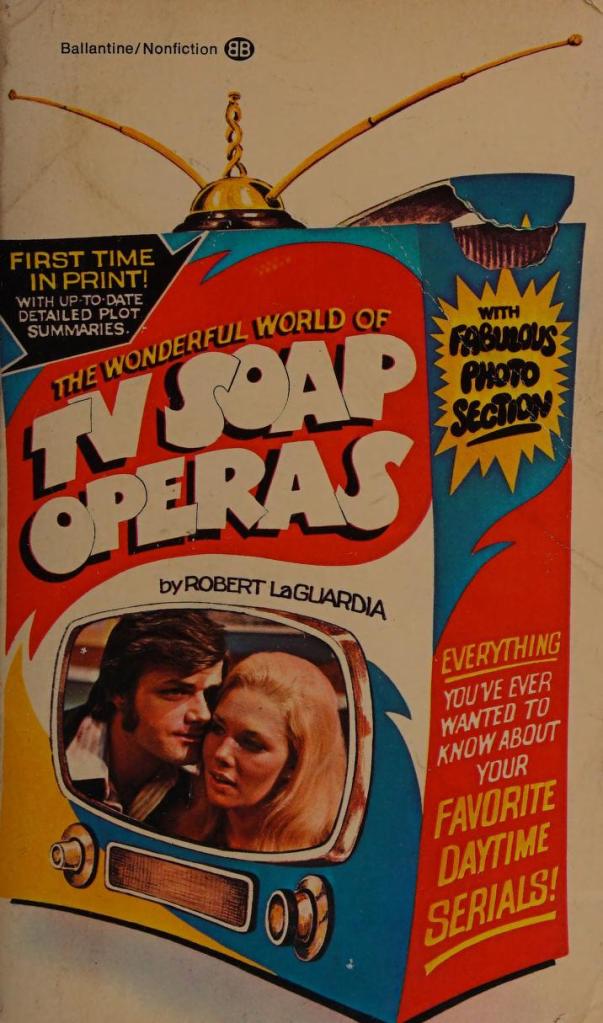
It was already out of date; at the time it was published the most popular show airing was NBC’s Another World (General Hospital was breaking all ratings records in the present day), so a lot of the book, when talking about modern times, focused on Another World, and its primary ratings driver, the love triangle between Steve, Alice and Rachel (George Reinholt, Jacqueline Courtney, first Robin Strasser and then Victoria Wyndham as Rachel; Reinholt and Courtney made the book’s cover). By the time I got to the book, Another World‘s ratings were already in free fall and ABC was in firm control of daytime’s ratings. It was also more of a puff piece rather than any in-depth reporting and digging. It was all about how talented and hard-working every one involved in daytime was, and conflicts and other off-camera issues were completely ignored. (It was updated several times, and the last edition I had a copy of, Soap World, was much better and not so “aren’t they all AMAZING?”)
But what was interesting to me about the book the most–and Soap Opera Digest–was that they both had summations/summaries of the soap’s plots from the beginning (not everything, obviously, but the main through plots and popular stories); that was how I actually learned how to write a synopsis. Interested in soaps and fascinated by these summaries, I started doing my own–inventing soap operas, coming up with the family relationships and marriages and so forth, and then would start writing the summaries. I also used to always have a bit of fun writing soap spoofs, generally casting my friends as “characters” and coming up with story lines and writing those summaries, even mini-episodes. I did several of these over the years, but the best was the one I wrote around my fraternity friends, The Young and the Pointless–and I have to say, I learned a lot writing that one. The others I’d done earlier didn’t last long and I’d get bored with it and stop; Y&P (as I called it) ended up being three “seasons” of twenty or so “episodes”, and I soon began understanding the struggles of soap writers–how do you top yourself with a story line? The need to constantly bring in new characters and subplots and balancing everything, until it became a bloated mess and I “canceled” it myself after the third season.
The first book I ever wrote, which I’ve mentioned before, was a sprawling soap opera about a small city in Kansas. Again, it was a learning experience and a difficult one at that; writing this book taught me about overwriting and filler; how bad dialogue can be if you don’t speak it aloud as you write it; and again, balancing characters and plots and subplots and story and keeping track of it all was insane. I’ve borrowed things from it over the years–plots, subplots, characters, locations, etc.–but always knew there was no point in trying to trim it down and use it as is. Murder in the Garden District’s case, in fact, was lifted fully from that manuscript; it was the main story. And I’ve used names from that manuscript repeatedly; they pop into my head unbidden and it isn’t until later that I realize where they came from and I change them.
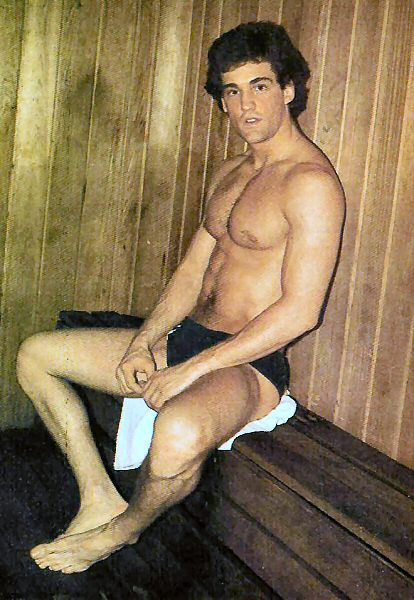
I watched many soaps over the years; I’d often watch other soaps with friends who watched those shows and would get into them for a bit before going back to my solid three: All My Children, One Life to Live, and General Hospital. I wrote a paper in college for a graduate level course on American culture in the 20th century; the paper was called “How Storylines on Daytime Television Drama Series Reflected Changes in the Mainstream Culture.”1 It was over a hundred pages long, and traced how the soaps went from being primarily marriage and divorce drama to mining social issues for story. I got an A on the paper, of course (I always got A’s on anything I had to write), and I’ve always had some of that information left in my head; and of course as the 1980’s began, they began casting beautiful young men with exceptional bodies to play heroes and villains on the shows–John Wesley Shipp is one I’ve never forgotten, and he’s still a handsome older man today, and so I was also able to occasionally see beautiful men shirtless or in speedos. I approved of this trend 100%.
I eventually stopped watching them in the mid-1990’s, when I realized I could keep up with them or use that time to write; I chose to write instead. But even though I no longer watched, I kept up with them some on line and so forth. The twenty-first century purge was horrible to watch, as shows that had once been a popular mainstay of daytime television were mercilessly canceled between 2001 and 2012. It’s hard to believe there are only four left airing, and there haven’t been many in prime time for decades–although the continuing nature of the soaps is now the nature of almost every television series–that cliffhanger shit really does get people to tune back in.
But I always remember them fondly. There were so many wonderful stories over the years–including some completely insane ones–and characters, too. Luke and Laura on General Hospital, Greg and Jenny on All My Children, Viki’s dissociative identity disorder on One Life to Live, and all the wonderful murder mysteries and insane courtroom dramas are all remembered fondly by me–and then of course there was Erica Kane.
It just doesn’t seem like daytime anymore, without Susan Lucci chewing everything in sight as Erica Kane every afternoon, does it?
- I really wish I had a copy of it, but it disappeared over the years and many cross-country moves. ↩︎

 Queer and Loathing in America