Italian Summer

Eight or so years ago at this time Paul and I were in Italy. Sigh, Italy. God, how I love that country. I would love to live there in a village in Tuscany–well, really, anywhere in Italy would work just fine, really. I do so hope we’ll be able to go back someday. I’d love to see Pompeii, Milan, and Rome. And both Corfu and Capri–especially after reading (listening) to Carol Goodman’s wonderful The Night Villa. (One of the real life incidents she mentioned in the book from Capri’s history fascinated me, and took me down a wormhole and now I want to write about that historical incident, of course.) I have since written a short novella (or long short story) set in Italy called “Don’t Look Down,” which was included in Survivor’s Guilt and Other Stories, and I have another novella-in-progress set in Venice called “Festival of the Redeemer,” which I hope to polish and edit at some point before the end of the year. Sigh, Italy. What a beautiful country, with lovely friendly people and the most amazing food and….so beautiful. You can see why the Renaissance flourished there.

I got the final edits on “Solace in a Dying Hour”–two questions (one in which I had made a mistake) and the rest was copy edits and the deletion of a paragraph. So that’s a wrap, methinks, and I am really fond of the story, too. It was my first venture into Louisiana urban legends and myth; well, really the second, because I did write “Rougarou” about a decade ago, but it’s been a while since I’ve turned to Louisiana legend and folklore to write a story, and writing about le feu follet was a lot of fun. I want to do more of these, of course; as Constant Reader may remember, I’ve become fascinated by the story of Julia Brown and the Great Hurricane of 1915, when her town, Freniere, was wiped off the map. Freniere was located on that narrow strip of land running between Lake Maurepas and Lake Pontchartrain; if you’re driving west out of New Orleans on I-10, and then take the Hammond exit north on I-55, that’s the land the bridge is built on (when you’re actually driving over dry land, that is). I’ve always called that swamp the Manchac Swamp, but I don’t think that’s it’s real name (and I’ve called it that in books, too. Yikes!). You cannot get to the location where either Freniere or Ruddock (the other town in that area that was wiped away by the Great Hurricane of 1915) any way except by boat; apparently some of the swamp tours will swing by the old location where the graveyards still are, but the wreckage and remains of the towns are long gone. Both towns were only reachable by train or boat when they actually existed; there were no roads in or out of town, which always makes me think why would anyone want to live in such a remote and isolated place? But yes, you can bet the witch Julia Brown will appear someday in something I write.

I also got a rejection for a story yesterday, but it was one that I expected so it didn’t sting. I knew it was a long shot to begin with, so that’s fine, and I can certainly send it to another market, which I will most likely do after reading it again to make sure it’s actually quite terrible and I was in a complete state of denial about it being publishable in the first place. Rejection is just part of the game, of course, and there are any number of reasons your story doesn’t get accepted that have nothing to do with the story’s quality itself. I like my story and I think it’s clever, but that doesn’t mean it doesn’t need to be looked over another time, you know?

I feel rested this morning. I was very tired when I got off work yesterday afternoon, which is fine; I’d rather be tired after work then during it, you know? I didn’t get much of anything done once I got home, either–I had to pick up the mail and a prescription on my way home; today I can just come straight home–and I have some things I need to get taken care of when I get home from work tonight. Which is cool, I think I can spend a bit of time preparing (I have to make a promotional video–which clearly I’ve been putting off as it is due to be turned in tomorrow) and of course, I have to make the kitchen in the background behind me look–well, not embarrassing for me, at the very least. (Although I don’t know how much more embarrassed I can get filming myself. I hate the sound of my voice and I hate the way I look on video recordings–mainly because the actuality of how I look does not come close to the way I see myself in my head–pictures, recordings and the mirror often provide deeply disturbing shocks for me.)

And on that note, I am going to head into the spice mines this morning. Y’all have a marvelous day, and I’ll be back tomorrow for another entry. See you then!

I Hear You Knocking

I really wish I had discovered how marvelous audiobooks are for long drives years ago. My God, listening to audiobook rather than music makes the drive so much more enjoyable; sure, I do zone out every once in a while when I am driving and listening–I always go off on some kind of mental tangent at some point or another when I am highway driving for a long time, which means I sometimes have to rewind because I missed something–but my old fears of audiobooks in the car (I would get so involved in the story I’d stop paying attention to the driving, or the driving would require so much attention I wouldn’t be able to listen to the book anymore) also proved to be for naught. The drive is still the worst part of the trip (other than the not-being-able-to-sleep thing), but audiobooks have dramatically improved the entire experience so much that I almost don’t mind the drive anymore….almost.

I also wish I’d started reading Carol Goodman a lot earlier. I don’t recall how or why I first discovered her work, but I am a big fan and I was delighted, after reading (and enjoying the hell out of) The Lake of Dead Languages recently to go ahead and download The Night Villa for the trip.

It may just be my favorite Goodman to date.

When the first call came that morning I was with a student, so I didn’t answer it.

“Don’t worry,” I told Agnes Hancock, one of my most promising classics majors, “the machine will get it.”

But it stopped after the third ring.

“I guess whoever was calling changed his mind,” Agnes said, relacing her fingers to conceal the ragged cuticle on her right thumb. She’d been gnawing on it when I found her waiting outside my door–ten minutes early for my eight o’clock office hours. Most of my students were sound asleep at this hour, which was why I held my office hours so early: to discourage all but the most zealous. Agnes was definitely a zealot. She was on a scholarship, for one thing, and had to maintain a high average, but Agnes was also one of those rare students who seemed to have a genuine passion for the material. She’d gone to a high school with a rigorous Latin program and gotten the highest score on the national Latin exam in the state. Not shabby for a state as big as Texas. She wasn’t just good at declensions, though she had the ability to translate a line of ancient poetry and turn it into poetry again, and the agility of mind to compare the myths from one culture to those of another. She could have a successful academic career in classics or comparative literature. The only problem was that her personal life was often chaotic–a result, I suspected, of her looks.

So far, the majority of the Goodman novels I’ve read all have to do with private schools and usually involve a Classics professor; just as in The Lake of Dead Languages, our main character in The Night Villa is a professor of Latin, who can actually sight-read (translate as she reads), but unlike the others, (set in Ne England) when The Night Villa opens we realize our main character is actually a professor at the University of Texas and lives in Austin. The others also were more Gothic in nature; brooding old buildings that used to be family mansions, now converted into schools and dormitories, slightly older heroines with dark secrets in their past that come back to haunt their present, the “woman in danger” trope replayed and revamped beautifully, with poetic writing and vivid settings you can see in your head (had Goodman published back in the 1970s and 80s, I guarantee all the books would have a young woman with long hair and long nightgown running away from a creepy mansion with a light on in one window). Our main character is Sophie Chase, a young woman teaching at UT with a sad backstory–orphaned young, raised by her grandparents and her aunt (M’Lou); she also had a long term relationship with a young man named Eli that ended up badly after she lost their baby in a tragic fall and he became involved with a mysterious, cult-like group. The opening of the book is a lot more violent and in-your-face than what I’ve become accustomed to with Goodman’s work; Sophie and some other professors are interviewing students for a possible internship with an archaeological dig going on in Herculaneum (a city which suffered the same fate as Pompeii and by the same volcanic eruption, but didn’t the press Pompeii did). During Agnes’ interview a troubled young man she used to date comes into the interview room with a gun and starts shooting–Sophie is shot in the chest and loses a part of her lung, but she ends up going on the trip to Italy as one of the other professors who was supposed to go was killed by the gunman. They are being hosted on the island of Capri in the bay of Naples by a billionaire software designer with an interest in archaeology. He has built his own villa on the island as a replica of the villa they are excavating in Herculaneum, the Villa della Norte, the Night Villa. A discovery of some papyrus scrolls in the ruins that reveal some information about an ancient slave girl from the time also has intrigued Sophie, which is part of the reason she has agreed to go–as well as wanting to get away from Austin for a while. (Sophie wrote her dissertation on the slave girl; this discovery offers to give her more insight and information about the girl for the book she is writing.)

The book is, if you’ll pardon my language, fucking amazing. Not only do we have Sophie dealing with the aftermath of a massive emotional and physical trauma (getting shot and losing part of your lung is a serious fucking trauma), but also the fallout from the end of her relationship many years earlier; a kind of feeling of responsibility for Agnes and how she is dealing with the guilt and trauma of the boyfriend going nuts and on a shooting spree (it ended with him shooting himself); and of course the mystery of the scrolls. The scrolls also give a beautiful insight into life in ancient Herculaneum and in the Roman Empire and also tell a story about the slave girl. It’s an exceptionally good novel, literate and smart and complex and multi-layered; and I haven’t even covered everything in the story here. Sophie is strong and likable and vulnerable; she makes for a great heroine, and she also has so much empathy for other people you can’t help rooting for her.

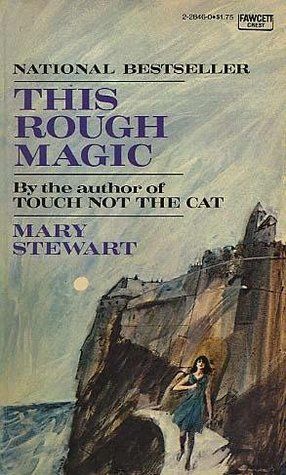
The book, set mostly on Capri, reminded me a lot–in a good way–of Mary Stewart’s This Rough Magic with its Corfu island setting; Goodman is also exceptional about setting and place. I could see the Bay of Naples and Mount Vesuvius; the ruins of the city buried by the eruption; and I also love how she weaved mythology and the ancient mysteries as an integral foundation of the story. I would even go so far as to say Goodman is the modern equivalent of Mary Stewart–which is high praise indeed.

Between Two Islands

One of the best parts of the Reread Project is reminding myself how much I truly love and appreciate certain writers.

Mary Stewart is certainly at the top of that list.

As I’ve mentioned before, I read most of Mary Stewart’s so-called “romantic suspense” novels when I was a teenager or in my early twenties, my favorites being The Ivy Tree and Airs Above the Ground.  Unfortunately, the mists of time and my faulty memory have robbed me of just how good the other books she wrote were; I recently reread The Moon-spinners and loved it more than I remembered loving it the first time; likewise, I started rereading This Rough Magic this week (finishing yesterday) and it, like The Moon-spinners, is fucking brilliant; far better than I remembered it being–and frankly, far better than it had any right being (says the incredibly jealous author).

Like most of Stewart’s novels, the book is set somewhere other than England–this one is Corfu, just off the coasts of Greece and Albania. (The Moon-spinners was set on Crete, and My Brother Michael was also set in Greece.) I’ve always wanted to visit Greece; it’s on my bucket list with Egypt, France, Germany and England. I loved Greek mythology and history when I was a kid, and of course I absolutely loved Mary Renault’s novels about ancient Greece. Lately I’ve become more and more interested in the history of the Eastern Roman Empire; aka the Byzantine empire, as well. Paul also would love to return to Greece–he spent a summer there as a teenager as an exchange student.

Stewart is often described, and counted amongst, romantic suspense novelists of the mid to late twentieth century, primarily because she was a female writing suspense novels about women in a time period where publishing didn’t know how to market women-driven suspense novels written by women. While there are slight elements of romance included in her novels, it’s often an afterthought, and rarely actually drives the plot–it’s more like a little lagniappe; something extra tossed in to appease editors and readers that she really had no interest in exploring. At first, you think, wow, her characters kind of fall in love awfully quickly with total strangers–and then you realize, oh, of course they did–women weren’t really allowed to be sexual beings in those days so it had to be masked as falling in love plus the “romance” elements were easily explained by the “trench warfare mentality”–in which soldiers become bonded to the guys they are serving with because they are responsible for each other’s lives; it’s not a stretch to see a romantic attachment grow between two people who are in a tough, difficult situation in which they could easily both wind up dead.

35bf4dd563c369f8ea00531721b47a74

“And if it’s a boy,” said Phyllida cheerfully, “we’ll call him Prospero.”

I laughed. “Poor little chap, why on earth? Oh, of course…Has someone been telling you that Corfu was Shakespeare’s magic island for The Tempest?

“As a matter of face, yes, the other day, but for goodness’ sake don’t ask me about it now. Whatever you may be used to, I draw the line at Shakespeare for breakfast.” My sister yawned, stretched out a foot into the sunshine at the edge of the terrace, and admired the expensive beach sandal on it. “I didn’t mean that, anyway, I only meant that we’ve already got a Miranda here, and a Spiro, which may not be short for Prospero, but sounds very much like it.”

“Oh? It sounds highly romantic. Who are they?”

“A local boy and girl: they’re twins.”

Lucy Waring, a twenty-five year old British aspiring actress, finds herself on the island of Corfu visiting her very pregnant sister who married very well–to a wealthy Italian banker whose family owns an enormous property on Corfu, which includes an enormous castle-style main structure and two guest villas some distance away, all gathered together on the shoreline of a small, private bay. Lucy’s big break has just come and went in a play that closed after only two months, so she has gratefully accepted her sister Phyllida’s invitation to come stay for a while with her on Corfu. There’s a photographer staying in the other villa; the main castle is being rented to a retired British actor, Sir Julian Gale, best known for his performances in Shakespeare (The Tempest in particular) and his son Max, a composer–and trespassers are forbidden and frowned upon. That very first day Lucy decides to go down to the beach and sunbathe, and while she is down there she makes the acquaintance of a friendly dolphin, much to her delight–and the suspense begins when someone starts shooting, with a silenced gun, at the dolphin. She assumes the shots are coming from the castle, so she goes storming up there, and soon becomes entangled in the affairs of Sir Julian and his son Max.

Stewart’s mastery as a story-teller is so complete that she doesn’t waste a word or a scene; her economy of writing is astonishingly complex and clever. For example, that opening sequence, quoted above, seems like simply a lovely back-and-forth introduction to Lucy and her sister while establishing their affectionate closeness; but Stewart uses that dialogue to tell the readers things that are going to be important to the novel: they are on Corfu, references to The Tempest are scattered throughout the book and are incredibly important, not just to the story but for the atmosphere (Stewart was an incredibly literate writer; references to classic literature are scattered throughout her works, be it Shakespeare or Greek mythology or Tennyson, etc.), and even the throwaway line about the twins, Spiro and Miranda, isn’t a throwaway–the two are very important to the story.

And Lucy Waring is no shrinking violet, either–none of Stewart’s heroines are. Lucy courageously thinks nothing of putting herself in danger in order to help catch a monstrous, sociopathic killer:

He must have felt me watching him, for he flicked me a glance, and smiled, and I found myself smiling back quite spontaneously, and quite without guile. In spite of myself, in spire of Max, and Spiro’s story, I could not believe it. The thing was, as I had said to Max, impossible in daylight.

Which was just as well. If I was to spend the next few hours with him, I would have to shut my mind to all that I had learned, to blot out the scene in the cellar, drop Spiro out of existence as if he were indeed dead. And, harder than all, drop Max. There was a curiously strong and secret pleasure, I had found, of speaking of him as “Mr. Gale” in the off-hand tones that Godfrey and Phyllida commonly used, as one might of a stranger to whom one is under an obligation, but whom one hardly considers enough to like or dislike.

There’s also a few amazing chapters in which Lucy, having found the definitive evidence to convict the killer, is trapped with nowhere to go on his sailboat when he returns–she hides, but is spotted, and then reveals herself and in an astonishing display of bravado tries to play the entire thing off, but winds up going overboard herself and trying to make it to shore–only to be helped by the very dolphin she herself had helped rescue earlier in the book.

As I said, nothing happens or is done in a Stewart book that doesn’t have significance or come into play later.

I cannot tell you how much I loved rereading this book, and while I’d love to dive into another Stewart reread, I’m probably going to do another Phyllis Whitney–oh, and I buried the lede! I read the entire thing as an ebook on my iPad–so I have finally broken through that final barrier to reading books electronically, and may never pack a book to take with me when I travel again as long as I live!

Who says you can’t teach an old queen new tricks?