Angie Baby

Agnes Nixon died yesterday. For those of you who don’t know who she was, she created the long-running soaps One Life to Live and All My Children, among others, and worked on numerous others as well. She created two of the greatest female characters in television history–Victoria Lord on One Life to Live and Erica Kane on All My Children, both of whom made daytime legends of the actresses who played them, Erika Slezak and Susan Lucci.

I loved soaps, and it wasn’t until the late 1990’s that I stopped watching them because i needed the time to write. When I was a kid, both of my parents worked so during the summers a lady down the street watched my sister and I during the day–and she was an avid fan of General Hospital, One Life to Live, and Dark Shadows. My grandmother also worked the evening shift at American Can Company back then, and so she also watched the shows, so on days when she watched us we watched them all together. It was hard sometimes catching up, since we weren’t able to watch them during the school year (other than Dark Shadows, which we could run home from school to catch the last twenty minutes or so of), but watch them we did…and when All My Children debuted, we started watching that one because it was new–we could know everything from the very beginning. The thing that was amazing about All My Children as well, was that it had young characters featured front and center; the romantic lives of teenagers was just as important as that of its older characters. Tara, Phil, Chuck and Erica were all high school students when the show started, and there was something else odd about the adults in Pine Valley, as well. They didn’t just sit around and talk about what was going on with their lives, they also talked about the Vietnam War, protests, and opposing it. The show was actually relevant; while other soaps were insular, where nothing mattered except what was going on in the town as though the rest of the world didn’t exist, the people in Pine Valley were very aware. And both Phil and Chuck–and their families–worried they’d be drafted when they got out of high school.

amcbook

Phil eventually did wind up going to Vietnam, and was reported dead there.

The show was incredibly popular with young people–all of my friends watched it, and as the years passed, the show continued its commitment to young love. Pine Valley also had something else that most other soaps didn’t have–people of color. In the early 1980’s, there were two parallel star-crossed love stories featuring teens–Greg and Jenny, who were white, and Jesse and Angie, who were black. Both stories got equal air time, were equally important, and the young actors were incredibly compelling. There was also a teen villainess, Liza Colby, played by Marcy Walker, who was also fantastic.

Greg and Jenny:
imgres

Angie and Jesse:

imgres-1

The despicable Liza:

imgres-2

Kim Delaney, who would go on to prime time success, left the show shortly after she and Greg were finally, after years of heartbreak, obstacles, and separation, married; the show decided not to recast but to kill her off.

It was devastating.

In college, everyone would gather around television sets in the lounges to watch All My Children ; when Jenny flatlined I remember everyone in the lounge gasped in disbelief; some people actually started crying. Years later, I mentioned to a friend “if someone ever tells you they used to watch All My Children , and you ask them when they stopped watching, they will tell you they stopped watching when Jenny died.”

The show did eventually recover from killing off Jenny, but it took a while.

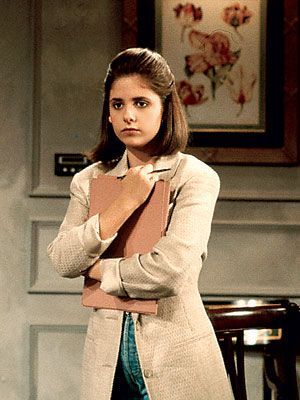
Over the years, the show created incredible characters played by exceptional actors; Sarah Michelle Gellar’s big break came as Kendall on the show; a young actress who not only could hold her own against Susan Lucci but was a villainess you also felt compassion for. She played Kendall, the daughter no one knew Erica had; the product of a rape when she was thirteen that she gave away, and Kendall turned up as a teenager. The scenes between Erica and Kendall, when Erica tried to explain why she could never love her because she would always see Kendall and remember the rape, were incredibly powerful; Sarah Michelle Gellar would win an Emmy for those scenes, and I never understood why Lucci did not. (Lucci, of course, was nominated a billion times and only won once; it became a running joke for Lucci–the irony being she became much more famous for not winning than any of the women who won did; and when she did finally win, it was national news and she was on every magazine cover on the newsstands.)

e55267ed80865a18956f611ddd65fbb8

Kelly Ripa also got her big break on All My Children , as Adam Chandler’s illegitimate daughter Haley.

One of the other things that made the show special was it wasn’t afraid to be funny; it was more than just unrelenting melodrama and sobbing. One moment your heart would be breaking over Donna’s grief over her child dying in a fire and the next you’d be laughing at the antics of Opal Gardner. All My Children never was afraid to be funny. (One of the greatest characters on the show was villainess Janet–“Janet from another planet”–who did horrible things but at the same time was incredibly funny.)

And of course, there was Erica Kane. You can’t talk about All My Children without talking about Erica. When asked once if she would ever leave the show, Susan Lucci replied, “Why would I? Where else would I get to play Scarlett O’Hara every day?” Erica started out as a bitch on the show–a young teen villainess– but in the skillful hands of the perfect actress for the part and a talented writer who showed the character in all of her confusing complexity, Erica became the center of the show, and was always the star. Erica wanted to be loved, but she also wanted to be rich and famous and successful–and didn’t want to get all of those things by marrying a rich man; she wanted to get them herself. And that drive, Erica’s drive, I think, was what made her such a beloved character. She did things the wrong way, she lied and manipulated, but the disaster that was her personal life never stopped her from getting all the things out of life that she wanted–and when her deceptions once again destroyed her personal life, she always wiped away the tears and repeated her mantra: “I can do anything. I’m Erica Kane.”

And of course, Erica had daytime’s first (and one of the few) abortions.

The show always dealt, like it did with abortion and Vietnam, social issues. It had daytime’s first lesbian character, dealt with HIV/AIDS, had a gay character and addressed homophobia, and of course, Erica’s daughter Bianca became daytime’s first main character to be a lesbian…and to have as troubled, dramatic, and fascinating love life as any of the straight characters.

I could probably write an entire book about All My Children . I learned a lot from the show, about writing, how to plot a murder mystery (the show had some of the best murder mysteries on daytime), and how to create a complicated character.

RIP, Ms. Nixon. I’ll talk about One Life to Live tomorrow.

Afternoon Delight

For the first time in maybe a month, I actually had an appointment with Wacky Russian this morning, and you know what? I feel great.I’ve clearly missed the exercise; and I actually feel like I should be going in every morning and doing a bit of stretching and cardio.

Right? Who am I, and what have I done with Gregalicious?

But the rush of endorphins! What a glorious feeling! I actually feel like the lethargy that has engulfed me since prior to Bouchercon has been lifted; the cobwebs in my mind cleared away, and energy, energy, energy. On my walk home from the gym, I actually solved the problem I am having with this stubborn short story I’ve been struggling with for weeks (short stories are ever so much harder for me than novels, really, and yes, I know that means I am completely insane).

And–since we are on a ‘Greg is insane’ run this morning–the problem is I don’t like the title; it doesn’t really fit, and so I have to come up with a better title.

There is great power in names, and I find that I cannot work on anything unless it has a title that I think fits the story; that title might change over the course of writing and rewriting when something better comes to mind, but if it’s not titled, I just can’t write it. I know that doesn’t make any sense, but that also is true about characters. I can’t write about a character unless I know their name.

And this story’s title, while lofty, pretentious and borderline literary (“The Handmaidens of Olympus”) really doesn’t fit the story to me. I’ve played with the title, trying to make that oh-so-pretentious title work in some variation, to no avail. And on the walk home from the gym, I realized that it doesn’t work, it isn’t going to work, and no amount of thinking about it is going to make it work. So, out it goes, and I have to come up with something new.

So, the goal for today is to come up with a new, working title–I have some ideas already–and I suspect the story is going to flow a lot easier for me now.

Weird. I know.


Here’s today’s hunk.

img_1115

Seasons in the Sun

Sunday morning, and I am going to make a Costco run. Sunday mornings, surprisingly enough, are the best time to go; New Orleans is, despite all evidence to the contrary, a city that takes its religion seriously so its always great to run errands during church.

I was on a panel several years ago at Bouchercon in Albany when the venerable Rebecca Chance stated that the most subversive thing a crime writer could do was write a cozy. I’ve thought about that statement a lot in the years since then, and I don’t necessarily agree that writing cozies is actually subversive; although it made for a truly great soundbyte. (I still think about it over three years later, don’I?) I myself have always held that cozies are the bastard redheaded stepchildren of the crime fiction world, and I am not really sure what that is. I do believe there’s an element of by women for women about women about them; nothing seems to earn contempt for books than this reality (the entire romance genre, for example, and Jennifer Weiner for another), despite the fact these books sell consistently well, year in and year out. When I was chair of the newsletter for Mystery Writers of America I wanted to try to come up with definitions for all the various sub-categories of the crime genre; as the official, longest running organization for crime writers, I felt it was kind of our place to define the sub-categories, as they always seem amorphous and fluid and their definitions depend on whomever you are talking to at the moment. The project came to naught, alas, as no one else seemed as interested in coming up with these definitions as I did; which is a shame, but there you have it. I guess that’s why they’ve never really been defined before.

Some cozy writers prefer traditional; and eschew the word cozy. I can certainly understand that, cozy; can be seen as demeaning–I’ve certainly heard it used in a disparaging way more than once.

So, why all this loathing for one of the biggest and most consistently successful subgenres of crime fiction?

I think–and may very well be wrong–think it goes back to the roots of the divide between male and female readers and writers; back in the days when all the women crime writers, no matter how dark and twisted their stories (Armstrong, Millar, etc.) always wound up with those covers with the lovely young girl with flowing hair running away from the spooky house with a light in one of the windows, while men got the covers with the sexy naked woman and a gun. It was in the 1970’s, I think, that women’s work stop being taking as seriously (at least in terms of award recognition) as men’s, coincidentally as the Women’s Movement really began to take hold. When the 1980’s rolled around, Sara Paretsky’s V. I. Warshawski series basically changed the game for all women writers; suddenly, women write hardboiled private eye series with a woman as the private eye. I don’t know if this is true or not, it’s all speculation and I wasn’t really paying much attention to the crime fiction world, but the rise of women authors like Marcia Muller, Sara Paretsky, and Sue Grafton with their hardboiled style of writing and their tough women characters–who didn’t need men, swore, could take a punch as well as throw one–unintentionally relegated the cozies to a place even further in the back of the bus.

And yet, they continue to sell and remain as popular a form of the genre as ever. So, what does that actually mean, in terms of the books and their writers themselves?

If I had a dollar for every time I’ve heard someone dismiss cozies–both men AND women crime writers–well, I’d be typing this on my private beach in the Caribbean as I swill some tropical drink with a lot of liquor in it. I stayed away from reading cozies for a very long time because of this dismissive attitude towards them; yet in the last few years, as I began to recognize (and call out) my own prejudices about reading and book sub-genres, I’ve slowly but surely started reading some of them–and they are actually quite good. Donna Andrews’ Meg Langslow series is quite spectacular; and so is Elaine Viets’ Helen Hawthorne series. I am slowly but surely adding more cozies to my reading, and you know–some of them aren’t to my taste, but I can also say that about pretty much any subgenre of crime writing.

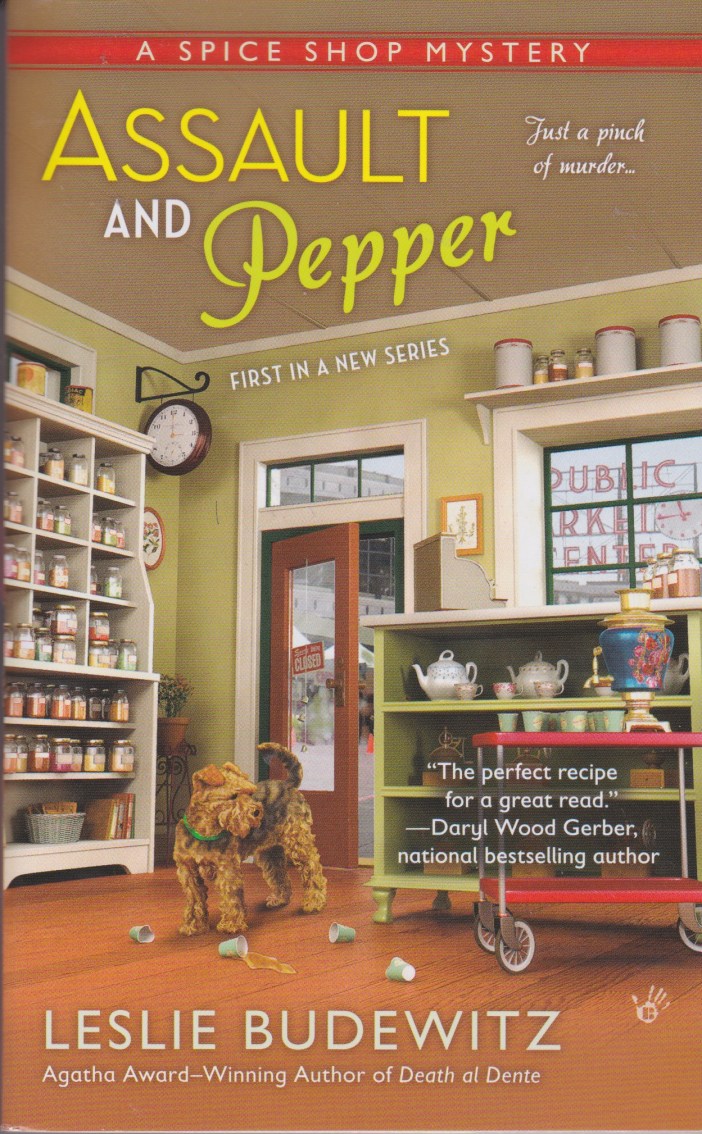
I started reading Leslie Budewitz’ Assault and Pepper yesterday during the embarrassing horror that was the LSU football game, and before I knew it I was halfway through it and really enjoying myself. I met Leslie at Bouchercon this year; she was the outgoing president of Sisters in Crime, and I liked her. So, as always when I meet a writer and like them, even if it’s just in passing and a brief meeting, I thought I would give one of her books a whirl. Leslie has done two series–the first is the Food Village books, and this is the first in her Spice Shop series. And I’m liking it. It’s clever, the main character, Pepper, who owns a spice shop in the Pike Market in Seattle, is likable–smart and on her game, divorced and reinventing herself after losing her job in HR for a law firm–and the stuff about the spice shop is, in and of itself, interesting. (I did know going in how important spices were to world history; European exploration of the world had everything to do with trade and markets, and spices actually played a very large role in that) And the mystery itself is an interesting one.

assault-and-pepper

I’m really enjoying it, and will probably finish reading it today.

I think it’s easy for people who don’t read them to write off cozies; I’m still not entirely sure how you would define them as a subgenre, but I will list off a couple of things that I’ve observed about them:

1. There is a running theme that connects the books. Leslie’s series are the Food Village series and the Spice Shop series; Donna Andrews’ are all connected by bird puns as the titles; Elaine Viets’ are the Dead End jobs series; Miranda James are the Cat in the Stacks books. I’ve seen ones that are based around desserts, house renovations, flower shops, quilting, scrapbooking–you name it. The ones that are based in food often have recipes in the back (there are some in the back of Assault and Pepper); the scrapbook ones have helpful scrapbooking hints and ideas–you get the picture.

2. The main character is a woman. There are exceptions to this, of course–Miranda James’ main character is a man–but without fail, almost always, at least in the first book, the main character is a woman with no romantic entanglements (either single or divorced) and she usually will find a love interest along the way. She is also usually smart, not a wimp but genuinely kind and caring, and while a professional working woman, she is not involved professionally as a crime-solver–cop, private eye, lawyer, reporter–so all of her involvement in murders is usually accidental, or being in the wrong place at the wrong time.

3. Usually, but not always, there’s a pet involved. I’ve often heard cozies dismissed as ‘cat books’–and certainly, Lillian Jackson Braun made a lot of money with her cat detectives, as has Rita Mae Brown. The main character doesn’t have to have a pet (Meg Langslow has a veritable zoo on her farm in Virginia), but it never hurts for them to have a cat or a dog who will inevitably wind up on the cover.

4. The books have a very strong sense of place.Crime novels are, I’ve always felt, very dependent on their setting. V. I. Warshawski’s Chicago, Kinsey Millhone’s Santa Teresa, Lew Archer’s Los Angeles, and Bill Smith/Lydia Chin’s New York loom over the books like another character. Cozies are also very dependent on having a strong sense of place. The Fort Lauderdale of the Helen Hawthorne series is as alive and vibrant as Chandler’s LA. The cozies that are set in fictional small towns also create a sense of community–the books won’t work without capturing that small town essence of everyone-knows-everyone and community ethic. Leslie Budewitz’ <i>Assault and Pepper</I> rings with authenticity; this is a Seattle I’ve visited and can recognize, and it seems very real to me.

I’ve always wanted to write a cozy series, or at least give it a shot. The Scotty series could have easily gone that way, but I chickened out and made Scotty a private eye by Book Three. I think it would be an enormous challenge–and I am all about the challenge.

And now, back to the spice mines.

The Morning After

I got up early this morning (well, early for a Saturday) to take a streetcar named St. Charles down to Audubon Park for the NO/AIDS Walk. I was scheduled to work in the Carevan, our mobile testing unit–and had to wonder, why has it taken me this many years to figure out that clearly the Carevan is the place to work other than the Prevention table? The Carevan is air conditioned. 

It is sad how many years it has taken me to figure this out.

I also took the streetcar home, taking pictures of the beautiful homes on the way home–I don’t know why I didn’t do so on the way there, other than it was early and I’d only had two cups of coffee so my mind wasn’t exactly thinking very clearly–but on both trips, plus the walk through Audubon Park (on the way there, I made a wrong turn at the first lagoon and wound up having to walk all the way around the park–I’d forgotten there was a golf course in the middle of Audubon Park–but didn’t make that mistake on the way back to the streetcar stop) I felt connected to New Orleans again in a way that I haven’t in a while; as ‘touristy’ and ‘cliched’ as the St. Charles streetcar line may be, there’s nothing like taking a leisurely ride on it to make you feel connected to the city again. St. Charles Avenue, and all the houses on it, are so beautiful, and scenic–and all the hidden beauty in Audubon Park, along with the beautiful and massive live oaks everywhere…well, it’s been a while, you know? I love New Orleans so much, but I get so wrapped up in my day-to-day life and existence that I forget sometimes how much I love it here and how grateful I am that I get to live here.

There was, for example, a wedding party having their pictures taken in the park among the live oaks that I stumbled on as I walked back to St. Charles. I didn’t photobomb them–though I thought about it–but they were done and walked back to the Avenue by the time I reached them. There was a portable snowball stand set up on the Avenue, and I took a couple of pictures of the bridal party getting snowballs. It was such a uniquely New Orleans moment.


And riding the streetcar, wandering through the park–despite the heat and the heavy air, I couldn’t help but think about the next Scotty book, and how I need to make it more about New Orleans, how I can add layers and more depth to it as a book, about how to connect the characters in the case itself to the city and make it more New Orleans somehow. I feel like that’s been missing somehow in my work lately, at least in the last few books: that sense of New Orleans that was always there before.  I think I managed to get some of that into Garden District Gothic, but I am never sure. I know that the Chanse books were starting to feel like the setting was generic; they could have been in any city, they just happened to be set in New Orleans. That was, I think, why the series was starting to feel stale to me, and partly why I decided to end it.

I’m worn out now, exhausted from the heat and the humidity and the heavy thoughts. I am going to repair to my easy chair for a lovely relaxing day of college football (GEAUX TIGERS!) and reading Leslie Budewitz’ Assault and Pepper, in preparation for spending the day tomorrow in the spice mines.

The Streak

Laura Lippman always says that one of the most worn-out, tired cliches/tropes of crime fiction is a beautiful woman dies, and a man feels bad.

On our panel at Bouchercon last week, the subject of cultural appropriation came up, and unfortunately, I didn’t get to answer it–which is unfortunate, because my response was going to be, “I appropriate from straight culture all the time. In fact, I used the trope of a beautiful woman dies and a man feels bad in my first novel, only switched it into a beautiful man dies and a man feels bad.

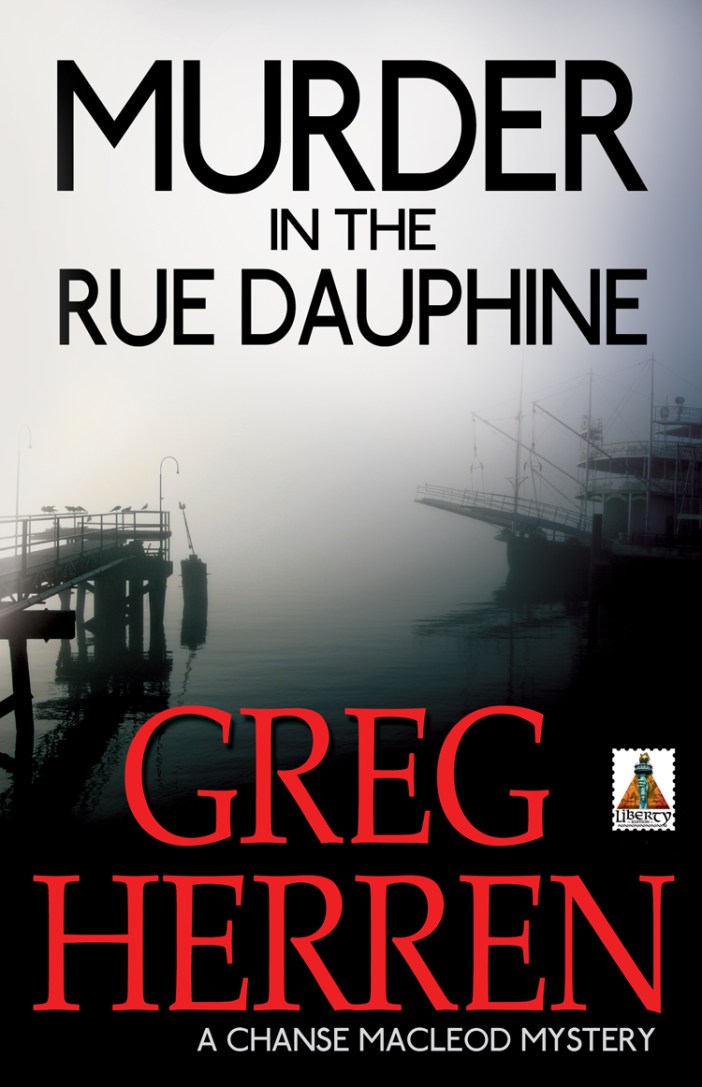
Because really, you can sum up the plot of Murder in the Rue Dauphine that way.

get-attachment-aspxThe funny thing is, I didn’t realize I was subverting, or appropriating, a trope at the time I wrote the book–but I was also trying to write a gay-themed mystery with a gay main character, and so I wound up using one of the tried-and-true crime tropes without even realizing I was doing it.

When I was a senior editor, one of the things I wanted to see was gay novels that flipped the script on straight tropes–where is the gay James Bond? Indiana Jones? Gay romantic suspense? I honestly believed–and still do–that if the books were well-written and the characters well developed,  a gay or lesbian writer could take a trope/cliche from mainstream publishing and breathe fresh life into it. I tried to do this very thing with both Timothy and The Orion Mask, and once I get through these next books I have to write, I am going to try subverting some more writing tropes–like a gay hard-boiled noir, for example; wouldn’t that be fun? I have an idea for two that have been simmering in my head on the back burner for a while: Muscles and Spontaneous Combustion. 

We shall see, I suppose.

And now, I need to get back to the spice mines, otherwise I will never get any of these things done.

The Bitch is Back

I finished rereading Prince of Darkness last night. I really loved the work of Barbara Michaels, even if some of it is now really dated. She made the books very much of their time–Prince of Darkness was written during the 1960’s, so there is very subtle exploration of racism and classism, as well as the student movement of the time–but they still hold up after all this time; which was why Dr. Barbara Mertz, who wrote as both Barbara Michaels and Elizabeth Peters, was such a great writer.

We’ve also been watching the TV series Turn, about Revolutionary War spies, which is apparently based on the nonfiction book Washington’s Spies. It, too, is very well done–in our modern day, which has deified the Revolution and all those involved, turning them all into plaster saints, we have forgotten that they were all just people, who made mistakes, had all the foibles and follies of any of us. I’ve always loved history, and I am very pleased with how accurate to history this show is.

I’ve been thinking a lot lately about character; partly because I did teach the character workshop at SinC Into Great Writing last week, and I’ve done a lot of character workshops over the years. There has also been a lot of talk about the unlikable female protagonist over the last few years, beginning around the time of Gillian Flynn’s monster hit Gone Girl and working its way through The Girl on the Train and any number of other books with female main characters. There seems to be a thirst out there for these types of book (any number of people, I’ve seen, have complained about the Girl books; God save us from any more books with ‘girl’ in the title). I suppose The Girl with the Dragon Tattoo is credited with started The Girl trend–I am not a genre critic/journalist–but it was written by a man; Gone Girl was written by a woman, and that’s why I credit it with starting the trend (technically, Laura Lippman’s The Girl in the Green Raincoat was the first, I suppose–you see what happens when you start splitting the hair?).

The unreliable narrator is not new, nor is the concept of the female unreliable narrator new; Margaret Millar’s Beast in View did a great job with this back in the 1950’s, for example. It is a trend, nothing more; as soon as the bookstores are glutted with books with unreliable female POV’s something else will sell a gazillion copies and the market will be flooded with similar books to it (The DaVinci Code, after all, spawned a million imitators and also the Templar craze).  I asked the question, awhile back, ‘is unlikable a code word for complex?’ And that is something I’ve been pondering ever since; why are complex women characters so easily dismissed as unlikable or as a bitch?

The arch-type of the bitch has long been a staple of melodrama; what would soap operas have done without the lying, manipulative seductresses who basically drove the plots of the shows? Try to imagine All My Children without Erica Kane, One Life to Live without Dorian, Dynasty without Alexis. The characters became enormously popular (the addition of Alexis to the cast of Dynasty took the show from middling ratings on the edge of cancellation to a Top 5 show for almost the entirety of its run), and often their popularity was explained away by ‘they say and do things that people wish they could; they provide some sort of wish fulfillment for the audience.’ I don’t necessarily think that’s true, and the popularity of these ‘unlikable’ women protagonists in crime novels proves me right. I’ve always felt that the ‘bitches’ were popular not only because they were fun to watch, but because they didn’t take any crap from anyone and also because they were vulnerable: Erica Kane just wanted to be loved, but was so used to not getting what she wanted that she often defeated herself because she was used to driving people away; the more husbands/lovers she lost, the more she solidified that persona of independence and strength which made it all the more difficult for her to allow anyone to see her vulnerability and therefore completely trust/give herself to anyone. If the character hadn’t been written and played that way, she would have just been another two-dimensional bitch that the audience would have tired of after a few years and she would have been written out of the show, sent away or killed off.


The best piece of writing advice (well, one of them, at any rate) I got when I was unpublished dealt with a horror short story I wrote called “Fellow Traveler” (it’s never been published, although “A Streetcar Named Death” owes a huge debt to that story), which I’d submitted to a horror magazine whose name I no longer recall. The female protagonist was unlikable; I wrote the story so that the reader would be happy when she got her comeuppance at the end. The note I got back from the editor with the rejection was, very simply, even Hitler loved his dogs. That was, simple as it was, incredibly great feedback; I cannot even begin to tell you how many times over the years I’ve passed that advice along to new writers I am either mentoring or editing. It has also evolved into the villain doesn’t think he/she is the villain.

In other words, your ‘bad characters’ have to be just as three dimensional as your ‘good characters.’ Why is Erica a bitch? What does Alexis really want?

They can’t be bad, and do bad things, simply because you need them to for the sake of the story.

When I was writing Sleeping Angel (spoiler!) I wanted to get inside the head of a bully. It would be incredibly easy to simply write the bully character as an asshole. But I wanted to know, and share with the reader, why this character was a homophobic bully. Bullying was integral to the plot of Sleeping Angel (I do think the book still has some flaws, despite its rave reviews and the awards it won), but it wouldn’t have worked as well as it did had the reader not really understood the bully, if that makes sense.

Okay, back to the spice mines with me.