Gold Dust Woman

My windows are filthy.

Embarrassingly so. It’s always amazing to me how dirty the air in New Orleans must be; because I don’t think I’ve ever lived anywhere before in my life where dust accumulates so quickly.

Anyway. At some point this weekend I shall have to do something about it.

Thanksgiving was a lovely day; the pizza was amazing and we watched two movies, Absolutely Fabulous (which was so bad it was sad) and Neighbors 2, which was actually quite funny. If someone would have told me before watching that the movie I was really looking forward to would be terrible and the one I was watching because I thought it would be terrible would be enjoyable, I would have scoffed in utter disdain. But Rose Byrne is quickly becoming a favorite actress of mine, and this is the first thing I’ve ever seen Zac Efron in, and he played the role of douchey frat bro aging out much better than Rob Lowe did in St. Elmo’s Fire; in fact, I kept thinking as I watched that he would be perfect in the inevitable remake.

I also got further into Elizabeth Little’s wonderful Dear Daughter, which I am also really enjoying. I started off the day watching another documentary series, Secrets of English Castles, and was about halfway through the episode on Dover Castle when Lisa arrived with our pizza, and once I’m finished working today (Paul won’t be home until really late this evening yet again)I am diving back into it. I really am delighted to discover all the documentaries on all of my streaming apps; I see plenty of informational and enjoyable viewing in my future.

We also watched the LSU game last night; GEAUX TIGERS. It’s really quite a shame, as they lost four games by a total of twenty points. Yet another season so close, and yet so far. The coaching situation should be resolved soon; one thing for certain is that LSU football is never dull.

I also can’t believe my vacation is almost over. Where did the time go? I didn’t get nearly as much finished this week as I wanted to, and yet…I can’t really see where I wasted time or goofed off a lot. But the primary purpose of a vacation is to get rested, and I certainly have rested this week and gotten a lot of wonderful sleep. We shall see how that translates into next week when I return to work, won’t we?

And now I suppose I should return to the spice mines.

Here’s a hunk for the day:

I Don’t Want to Know

Thanksgiving Eve, and all is well in the Lost Apartment. I’m up early for Wacky Russian, and I actually woke up a half an hour before the alarm went off, well rested and not tired in the least. There’s something to this vacation thing, or it’s the sleepytime tea I’ve been drinking before I go to bed every night (I started that this week, and so far it’s been pretty effective).

Of course, now that I’ve said that, tonight it won’t work.

Last night I finished reading Falling Angel by William Hjortsberg.

It was Friday the thirteenth and yesterday’s snowstorm lingered in the streets like a leftover curse. The slush outside was ankle-deep. Across Seventh Avenue a treadmill parade of lightbulb headlines marched endlessly around Times Tower’s terra cotta facade…HAWAII IS VOTED INTO UNION AS FIFTIETH STATE: HOUSE GRANTS FINAL APPROVAL 232 TO 89; EISENHOWER’S SIGNATURE OF BILL ASSURED…Hawaii, sweet land of pineapples and Haleloki; ukuleles strumming, sunshine and surf, grass skirts swaying in the tropical breeze.

I spun my chair around and stared out at Times Square. The Camels spectacular on the Claridge puffed fat steam smoke rings out over the snarling traffic. The dapper gentleman on the sign, mouth frozen in a round O of perpetual surprise, was Broadway’s harbinger of spring. Earlier in the week, teams of scaffold-hung painters transformed the smoker’s dark winter homburg and chesterfield overcoat into seersucker and panama straw; not as poetic as Capistrano swallows, but it got the message across. My building was built before the turn of the centuryl a four-story brick pile held together with soot and pigeon dung. An Easter bonnet of billboards flourished on the roof, advertising flights to Miami and various brands of beer. There was a cigar store on the corner, a Polerino parlor, two hot dog stands, and the Rialto Theatre, mid-block. The entrance was tucked between a peep-show bookstore and a novelty place, show windows stacked with whoopee cushions and plaster dog turds.

The book was originally published in 1978 and was an Edgar Award finalist for Best First Novel; it didn’t win, losing to Killed in the Ratings by William L. DeAndrea. It was filmed in the 1980’s as the infamous Angel Heart, starring Mickey Rourke, Charlotte Rampling, Lisa Bonet, and Robert DeNiro. I enjoyed the film very much when I saw it, not knowing it was based on a book; it was another one of those films that drew me to New Orleans and Louisiana. Recently (in the last several months) I came across a listing of great crime novels or the ten noir novels everyone should read or something like that; so I thought, oh, I have to read that and there you go.

The plot of the novel itself was adapted almost perfectly for the film; a private eye named Harry Angel is hired by a strange man named Louis Cyphre to find Johnny Favorite, a singer who was apparently severely injured and left with amnesia during World War II; he owes a debt to Mr. Cyphre and he suspects that Favorite may not be in the hospital he is supposed to be. Angel starts looking for Favorite and discovers that Cyphre is right; Favorite is no longer at the hospital, and soon is drawn into a creepy world of black magic, voodoo, and ritual murder. The primary difference between the novel and the film is that the novel takes place entirely in New York; in the book Favorite’s trail leads Angel to New Orleans.

I guess the filmmakers felt voodoo, black magic, and ritual murders fit better in New Orleans that New York. Whatever; I’m glad they did because again, the film was another step in my journey to New Orleans.

The book is very well done, the pacing is great and as I have said in previous entries, that cynical, hard-boiled noir voice is captured perfectly. I myself have never been able to quite get that style down absolutely right; I do intend to keep trying as I love both hard-boiled and noir styles. Having seen the movie I knew the big surprise twist; I can imagine how surprising and shocking it was back in 1978, or if you haven’t seen the film; the twist was one of the reasons I loved the movie. Even knowing it, I still enjoyed the book tremendously because of the writing.

And now, back to the spice mines.

Songbird

I always say that short stories are much harder for me to write than novels, and I also realize that makes me sound completely insane. But it’s true. I don’t know why I have such a mental block about writing short stories, but the sad thing is I do. I make it much harder than it probably needs to be, most likely. And there’s nothing I admire more than people who write excellent short stories. There’s apparently nothing Stephen King can’t do when it comes to writing; I can name of the top of my head any number of absolutely brilliant short stories he’s written. Daphne du Maurier, Shirley Jackson, William Faulkner–the list goes on and on. I wish I read my short stories, honestly; it makes sense to read short stories when I don’t have a lot of free time to read a novel, or between clients at work, etc. I really want to reread King’s collections Night Shift and Skeleton Crew, and I have anthologies all over my house, as well as back issues of both Ellery Queen’s Mystery Magazine and Alfred Hitchcock’s Mystery Magazine that I should really read.

Music often inspires me; all of my blog titles are song titles, for example, or a lyric from a song, so when I heard about Jim Fusilli’s new anthology Crime Plus Music, crime short stories inspired by music, I had to get a copy.

Thus far, I’ve only read one of the stories, but it’s quite exceptional and may be one of the best short stories I’ve read this year: Alison Gaylin’s “All Ages.”

Gaylin is one of my favorite authors. I’ve loved all her novels (there is one I haven’t read; I’m holding it back because of that weird thing where I always want there to be one more book I haven’t read by a favorite writer), and her What Remains of Me is one of my favorite novels of 2016. Her contribution to my own anthology Blood on the Bayou, “Icon”, was something I was incredibly proud to publish.

But “All Ages”–wow.

We started with the hair. Bret said that was where all adventures started–Great hair, great music, great buzz. And so the first thing we did on the night of the all-ages X show at The Whisky was to lock ourselves in her upstairs bathroom with two cans of Aquanet, three boxes of Midnight Raven temporary dye, and an assortment of pics and combs, gels whose names I can no longer remember but whose colors I do–battery acid green, radioactive yellow…Each of them with anepoxy-like consistency and a sickly chemical smell. We teased the mercy out of each other’s hair and took swigs from a bottle of peach schnapps we’d found at the back of her parents’ liquor cabinet and we played X albums–Under the Big Black Sun, Los Angeles, some bootleg tape recorded live at one of their local shows. Bret’s trifecta in action. And it was working. Exene’s steely voice grew more and more beautiful with each gulp of schnapps, John Doe’s growl a cloud I could float on. My hair turned stiff and black and defiant and before long I was a star, a punk rock star. I felt like dancing.

Gaylin captures the 80’s beautifully, and what it was like to be a kid during that time (she also does this in What Remains of Me). The story, also like the novel, flashes back in time from the present to the 80’s, as the main character remembers what happened the night of the X concert, and how she and Bret hadn’t been friends for years, now that she is attending Bret’s funeral. It’s a lovely story, about friendship and loss, the complicated relationships between girls…and there’s a twist that will knock you out of your chair.

The book is worth the price for this story alone, and it has an amazingly stellar line-up of top crime writers in addition to Gaylin as well: Craig Johnson, Val McDermid, and Gary Phillips, just to name a few.

I’m looking forward to reading the rest.

And now back to the spice mines.

Go Your Own Way

I had planned, all week, to take yesterday as a day off. I am going to have to write and edit like a madman all of my vacation (woo-hoo! I’m on vacation!) and decided that yesterday, and Thanksgiving day itself, would be my days to do nothing but putter around the house and read and so forth. I also somehow wound up in Facebook jail for posting a photo of a guy in a bikini three years ago that someone somehow decided yesterday ‘violated their community standards of nudity’–who knew that a man in a bikini was naked? Puritans. So I went to Costco and cleaned up around the house and spent the day finishing reading Owen Laukkanen’s The Watcher in the Wall, and once I was finished with that, I started reading William Hjortsberg’s Falling Angel, around essays from Barbara Tuchman’s Practicing History.

Damn, I do love to read.

We also started getting caught up on the shows we watch last night.

It was time.

Adrian Miller had planned to wait, a few more days, another week, maybe. Hell, when he woke up for school that morning, before school, he wasn’t even sure he would do it anymore. He’d thought about his mom and dad and sister, about Lucas, and wondered what kind of monster would want to hurt them the way he was planning. He’d hugged his parents goodbye and walked out the front door, and it was a beautiful fall morning, crisp and bracing and clear, and he’d decided, not yet. Maybe not ever.

But then he showed up at school, and it all started again.

Lucas wouldn’t talk to him. Lucas never talked to him, not in public, anyway. Lucas avoided his eyes in the hallway, wouldn’t eat lunch with him, made him wait until the final bell rang and they could go to the park, or to Lucas’ dad’s basement, somewhere far away from school and Lucas’ real friends.

I really, really loved this book.

Take this opening. Laukkanen perfectly captures the experience of what it feels like to be that kid; the one who has no friends, the one who counts the minutes until the final bell rings, who dreads going to gym class or the cafeteria for lunch and going to school every morning; who dreads going to bed every night because it means when you wake up you have to go to school again; what it feels like to wish you would die in your sleep so it would all be over; to wonder if you would ever have the nerve to kill yourself.

I was that kid once.

When I bought the book (because I wanted to read one of Owen’s books) I didn’t realize it was a book in a series, but to be honest, I didn’t realize it was a series until I was well into it, and by then I couldn’t stop reading even if I had wanted to; and it didn’t matter at all. Maybe the reading experience would have been heightened by having read the series in its proper order (I’m a bit obsessive about this sort of thing) but I didn’t feel like I missed anything. It worked perfectly well as an introduction to the series (which I am now going to go back and read), and that’s truly not an easy thing to do. (I don’t think, for example, my series can be read out of order.)

The series characters are Kirk Stevens and Carla Windermere, who work on a joint FBI-BCA violent crime task force. They get involved in this particular case when Stevens’ daughter–distraught about her classmate Adrian Miller’s suicide–asks them to do something about it. There isn’t much they can do at first, but as a courtesy they start looking into it, and soon discover an ugly world on-line of suicide groups and chatboards…and disturbed individuals who encourage the suicidal to go through with it. Adrian was the victim of one such person, and as they start to dig into this subculture more, they soon realize that there will be more kids talked into killing themselves while this person watches via webcam.

What makes the book so brilliant, though, is that Laukkanen takes us into the mind of the psychopath as well; how he became this person who enjoys watching young people kill themselves, how much he enjoys playing the game, and how he has turned it into a for-profit business. And while it is a slithery, creepy, horrifying place to be–at the same time you can’t help but feel some empathy for this awful, horrible person you want to be caught; since you know the backstory of how he came to be this monster. This fleshes him out, makes him more real–and all the more terrifying, as it is easy to see how such a psychopath is created.

Laukkanen also shows us the point of view of his new target, a sad lonely girl who hates her life, lured in by an Internet boyfriend she meets on one of the suicide chat boards and comes to know through Facebook and other social media (he uses the pictures of an attractive boy who committed suicide already to create this fake presence, and we learn how he does this and how easy teenagers are prey to this sort of thing–which is also terrifying), and finally she decides to go meet him, taking a bus from Tampa to Louisville…and the race is on for Stevens and Windermere to save her.

The pacing is amazing; you never want to put the book down. The writing is superb, and Laukkanen’s characters are all very real.

Oddly enough, once I finished reading this I realized I actually already had the first book in the series, The Professionals, in my TBR pile.

Looking forward to reading some more of Owen Laukkanen.

Don’t Stop (Thinking About Tomorrow)

One more day to get through and then it’s vacation. Woo-hoo!

I have literally been riveted by Owen Laukkanen’s The Watcher in the Wall; I hated having to put it down and go to bed last night. I’m about halfway finished; Paul won’t be home until late tonight so I am hoping I’ll be able to finish it tonight. I’m probably going to read Michael Thomas Ford’s Lily tomorrow; the LSU game is on early and after that I am probably going to do a lot of cleaning and organizing and reading. (I’ve decided to take Saturday off from all projects, in order to recharge my batteries.) There’s no Saints game on Sunday, so I am debating whether I should attempt Costco before the LSU game tomorrow, or just go Sunday while everyone’s at church.

Decisions, decisions.

Of course, while I juggle these multiple projects, I’ve been thinking a lot about a couple of short stories I’ve been working on for years, “The Ditch” and “Fireflies”; this was triggered, I think, by reading the Lisa Unger novel. I’ve been also thinking about a y/a novel I’ve wanted to write for years called Ruins; rereading the two Barbara Michaels novels in October started me down that path, and the Unger kicked it into overdrive. The problem with Ruins is that I borrowed some of it for Lake Thirteen; if I am going to write Ruins I’ll have to come up with some new things to say, and replace the scenes I borrowed. The problem with Ruins, of course, is that it’s a Civil War ghost story, and you can’t write that kind of book without addressing the elephant in the room: slavery and racism. I originally wrote it as a short story a long time ago (correction: make that a really bad short story; I think it was one of the stories I wrote in the 1980’s when I was trying to emulate Stephen King. I didn’t address any of those issues in the short story; I blissfully pretended, as so many others have done, that none of that mattered. God, the naivete. I think this is why I have so much trouble with trying to write about Alabama. Is there anything more annoying than a progressive white person trying to address race issues? I loved To Kill a Mockingbird when I read it as a kid; I reread it again recently and, while still thinking it was a moving story that was beautifully written, recognized several problems with it. I have copies of the Colson Whitehead novel that just won the National Book Award and the controversial book Ben Winters published earlier this year; I also found a copy of William Bradford Huie’s The Klansman, about the civil rights struggle in Alabama in the 1960’s, on ebay that I want to reread. (I read it when I was young; I’d like to give it a reread as an adult.)

Maybe after I read Lily. The time has never been more ripe for reading about racism, and studying America’s history of it. I also have Philip Roth’s alternate history The Plot Against America.

Hmmmm.

Of course, actually writing Ruins is a long way away; I have so much to do before the end of the year…

But it’s lovely feeling creative again. I am making lots of notes. The book is coming along rather well, too. I may even get all these things done when I am supposed to

Scary. Who am I?

And on that note, I should probably head back to the spice mines.

Here’s a hottie for today:

14542384_10210729441256939_5592957175501939966_o

Never Going Back Again

Tonight is my biweekly late night, and tomorrow is my last day in the office before I go on vacation, which is so fucking lovely I cannot wait. I have to do some things today –grocery store and get the oil changed in the car–before I head to work, and I also need to edit and write. I have some laundry going right now, and I also have to do the dishes.

I’m so fascinating.

I am reading Owen Laukkanen’s amazing The Watcher in the Walls, and I think I may take Saturday as a day off so I can watch the LSU-Florida game and relax and finish reading it. One of the lovely consequences of recent events has me avoiding wasting time on social media when I get home from work and actually either watching something on television–last night I watched the season finale of American Horror Story, which was incredibly awful and a complete waste of time, just as the entire season was–or reading; I’m really enjoying the reading, frankly, and there are so many books I need to read. Just that extra hour or so of reading every day is getting me through the TBR file ever so much faster and it’s absolutely lovely. I love reading so much.

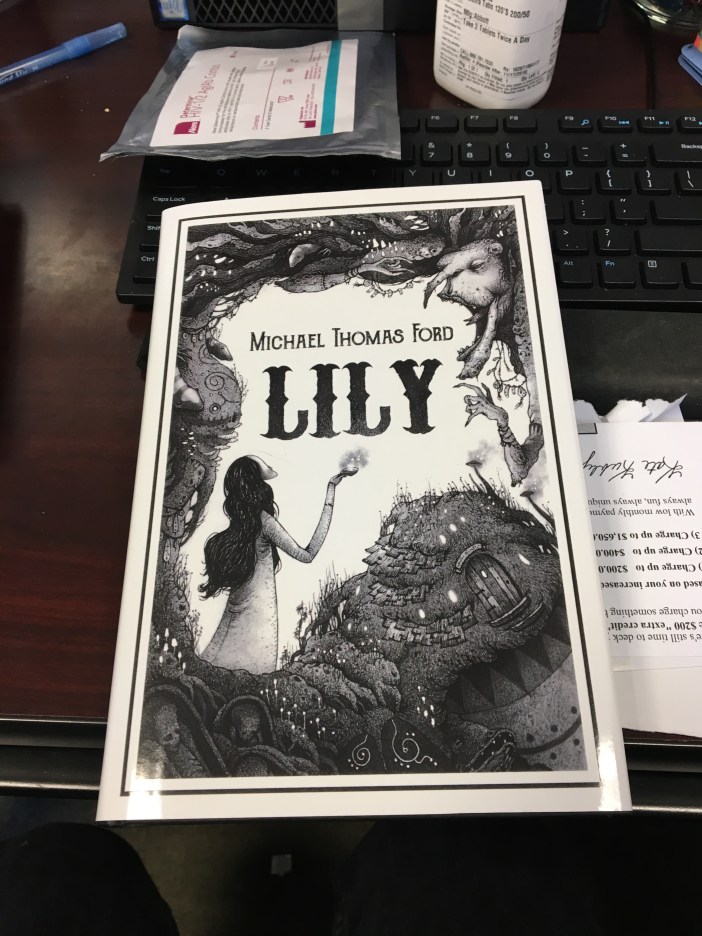
I also got some lovely new books in the mail yesterday, not the least of which is Michael Thomas Ford’s Lily, which I am hoping to read very soon.

img_0974

I also got Lara Parker’s latest Dark Shadows novel, Heiress of Collinwood; I think I might indulge myself and read those novels during Christmas.

I’m also feeling a bit discombobulated this morning; I am going to have to get out my list and make sure I am getting everything done today that I need to get done.

And on that note–back to the spice mines.

Dreams

I just remembered I am going to be on vacation next week.

It’s not a ‘vacation’ in the sense that I am going anywhere; I simply took the week off from work and am staying home. I have a lot to get done (as always) but rather than being stressed or worried about it, I feel pretty good about it. Odd, I know; who am I and what have I done with Gregalicious? It will be nice, though; I’ll also be able to sleep in and go to the gym; perhaps do some cardio (I can dream, can’t I?) and maybe finally reorganize and clean the kitchen the way I want it to be done.

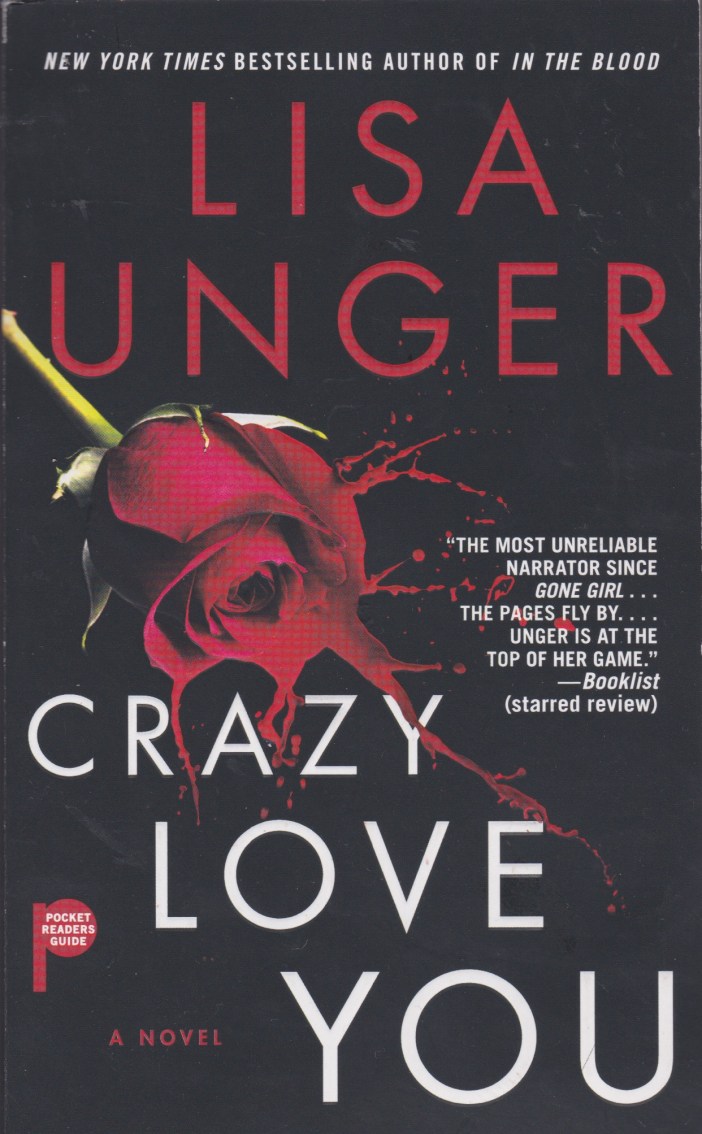
I finished reading Lisa Unger’s superb Crazy Love You last night, and started reading Owen Laukkanen’s The Watcher in the Wall (which is also superb).

crazy-love-you

As I pulled up the long driveway, deep potholes and crunching gravel beneath my wheels, towering pines above me, I was neither moved by the natural beauty nor stilled inside by the quietude I did not marvel at the fingers of light spearing through the canopy, dappling the ground. I did not admire the frolicking larks or the scampering squirrels for their carefree existence. No. In fact, it all made me sick. There was a scream of protest lodged at the base of my throat, and it had been sitting there for the better part of a year. When it finally escaped–and I wasn’t sure when that might be–I knew it would be a roar to shake the world to its core.

I always say the best writers inspire me; when I read their work, I get ideas for stories of my own and how to improve my own writing. I am now adding Lisa Unger to the list of writers who have that effect on me when I read their books.

Crazy Love You is a rollercoaster ride where you don’t ever know what is real, what is going on, and it’s deeply unsettling to read. But the main character is so well done, you can’t stop reading, you can’t stop caring for him–even when he may (or may not) be doing something truly terrible; you can’t help but hope that it’s not him.

Our hero is Ian Paine, and the story is told in his first person point of view. Ian is the successful artist/writer of a series of semi-autobiographical graphic novels called Fatboy and Priss. Ian grew up in a small town north of New York City called The Hollows, and was fat and unpopular and bullied as a kid. There was a horrible family tragedy when he was young, and that’s when he discovered his friend Priss, a beautiful little girl who lived somewhere in the woods near his own house. Throughout Ian’s life, Priss has taken care of him, when things have gotten bad for him or someone has treated him badly. As the book flashes back and forth in time between the present–where Ian is in love, and engaged to, an almost perfect young woman named Megan and trying to dissociate himself from Priss–to his childhood when Priss stepped in to intervene in his life in some way, we slowly begin to wonder precisely what’s going on. Does Priss really exist, or is she some imaginary friend he’s conjured up to help him deal with his own anger issues? Is she some kind of supernatural creature? Does he have dissociative identity disorder? Is this all some kind of drug-induced hallucination?

This was fascinating to read, and a little heartbreaking; I was bullied when I was young and so of course I can completely empathize with Ian and his absorption into comic books and then graphic novels. And Unger is great at not only her use of language but in building tension, mood, suspense and atmosphere.

I’ll definitely be reading more of her work.

And now back to the spice mines.

Second Hand News

I finished reading Gore Vidal’s Thieves Fall Out between bursts of writing on Saturday, and then during the LSU-Arkansas game Saturday night I started reading Lisa Unger’s Crazy Love You, which is just extraordinary. I often say that the best writers and their work are inspirational to me; they give me ideas and make me want to work harder at my own writing and just be a better writer.

So far, the Unger novel is doing just that–and that’s my hallmark for someone being a truly spectacular writer. I just wish I had the time to just sit down and read it through.

That said, as Constant Reader is undoubtedly aware, I’ve been in a writing malaise lately. I don’t know why this happens, nor do I know how to stave it off, but it’s been the reality. I’ve been struggling to write, and even getting 1000 words out in one day has been absolutely like pulling teeth in the Middle Ages. And yet…yesterday I sat down and in less than two hours I wrote over 3000 words. I think–and I am deadly serious–that reading the Unger novel kicked me past it. I also managed to get a lot done over the weekend on top of the writing as well; organizing and cleaning and so forth. So I think I may be past the malaise this time. Here’s hoping.

I wasn’t crazy about the Vidal novel, to be perfectly honest. It seemed like it could be something truly special; international intrigue in 1950’s Egypt, with after effects from the war and all the intrigue from that, as well as some stuff about the antiquities black market. It was one of the many novels Vidal published under a pseudonym in the 1950’s, after publishing The City and the Pillar basically killed his career for a while. I’ve read other works by Vidal and greatly enjoyed them; I am slowly working my way through his epic Empire (one of the multiple books I am currently reading) and so I thought this noirish thriller would be better than it actually was. Don’t get me wrong, I’m not sorry I read it, mind you–I just don’t think it warrants more of a discussion on here.

Although my creativity continues to rage out of control. I had some ideas on how to fix some short stories this weekend, and wish that I could work on them right now–I also got the idea for another novel. Heavy heaving sigh. It really never relents!

Okay, I am going to dive back into the spice mines. Here’s a beefcake shot of Ryan Phillippe, a bonus from 54:

ryan-phillippe-54

Bella Donna

I’ve been, over the course of the last week, rereading Les Liaisons Dangereuses by Choderlos de Laclos; originally published in 1782 as the sun set on the absolute Bourbon monarchy. My interest and curiosity in the novel had been piqued by watching the two competing film versions of the same story that had come out in the same time period; the more famous Dangerous Liaisons and the overshadowed Valmont. The book had been adapted into a quite successful play; the play was the basis for the former film while the book served as the template for the latter–the director, Milos Forman, had been intrigued by the play but the rights had already gone; the book, however was in the public domain and he was determined to film his story. Even now, I wonder about the wisdom of his decision and his financial backers. Dangerous Liaisons wound up being an enormous hit and was nominated for a boatload of Oscars; his film came out second and was mostly overlooked. I preferred Valmont at the time, for reasons I shall explain; but on reviewing the films it is clearly the inferior of the two.

dangerous-liaisons

I also thought it was interesting that publishers associated the book in print with the first film…

The story itself has always, always, fascinated me; it is incredibly dark, and rather on the noir side. Madame de Merteuil, a widow (her title is actually Marquise), is angry because her lover, the Comte de Gercourt, has left her to become affianced to her young cousin Cecile Volanges; a fifteen year old innocent who has been living and being educated in a convent. It is this innocence that Gercourt is attracted to; and as an affianced husband he no longer requires a mistress. The Marquise’ jealousy is, of course, primarily motivated by ego; men do not leave her. So she concocts a scheme to despoil the innocence of young Cecile, and wants to enlist her dear friend, the Vicomte de Valmont, to seduce the girl and turn her into a wanton so that on her wedding night Gercourt would not only be disappointed but humiliated; she also thinks Valmont will help her because in the past, Gercourt had seduced a mistress of Valmont’s. But seducing a virgin isn’t the kind of challenge a practiced roué as Valmont; his interest lies in seducing Madame de Tourvel, a deeply religious and devoted wife whose husband is away on business, nor does he particularly feel the need for revenge against Gercourt. So the Marquise instead has to find another method of having the young girl seduced, and the story goes from there.

glenn-close-and-john-malk-001

I love the book. It’s extraordinary; and it is an epistolary novel, told and advanced through the letters of everyone involved in this game of seduction and the corruption of innocence and virtue. The reader is thus able to engage with each player, and Laclos is able to create each character and their voice distinctly. It’s also a fascinating character study; as the Vicomte and the Marquise explain to each other each step in their game–eventually leading to a bet between the two; if Valmont is somehow able to accomplish his seduction of Tourvel, the Marquise will be his for one night. But also, we see Tourvel’s letters to the Vicomte as she tries to resist him; her letters to friends where she talks about the struggle in her own soul between virtue and sin. We see Cecile’s letters to her friend Sophie, back in the convent, as her own innocence and childhood is slowly taken away from her as she is first excited and scared at the thought of her impending marriage; her innocent, almost childlike love for her music instructor, the Chevalier Danceny (whom the Marquise, having failed at getting Valmont to seduce Cecile, targets to be Cecile’s despoiler), and then her ultimate education into sensuality by Valmont (who finally does seduce Cecile and take her as his mistress to revenge himself on her mother, who has written disparagingly about him to Tourvel and thus hindered his seduction of her). The letters between the Marquise and Valmont also reveal how they became the way they are; their own brief affair which ended when they recognized in each other another such as themselves and decided to be friends and allies instead, and the ultimate game they are actually playing with each other.

The original film, with Glenn Close and John Malkovich in the leads, with Michelle Pfeiffer as Tourvel, Uma Thurman as Cecile, Keanu Reeves as Danceny, and Swoosie Kurtz as Cecile’s mother Madame de Volanges, was very sumptuously filmed; gorgeous sets and costumes and cinematography. But I was repelled by it when I watched it; I couldn’t really believe either Close or Malkovich as these master seducers–although I readily believed them as manipulators. The film itself seemed incredibly cold and dark to me. I much preferred Valmont; with Colin Firth and Annette Bening in the roles, with Meg Tilly as Tourvel, Fairuza Balk as Cecile, Henry Thomas (from E.T. now a young man) as Danceny, and the amazing Sian Phillips as Cecile’s mother. The backstory is set up better–we see Gercourt dumping the Marquise brutally, for example, and Bening and Firth are just so luminously beautiful it was easier to believe they’d be able to seduce pretty much anyone.

tumblr_l89but6kut1qzu6rfo1_1280I read the book after seeing the films; I’ve reread it several times, and after rereading it this last time and rewatching the movies, I am not ashamed to say that I was wrong originally. <I>Dangerous Liaisons</I> is more true to the book as it was written; that coldness, the dark viciousness at the heart of the novel drives that movie far more than it does <I>Valmont</i>; the main characters aren’t quite as dark and nasty and chilling in the second version; she’s simply a woman scorned and he’s just kind of a dick. That sense of evil entitlement that Close and Malkovich embraced and played to the hilt; that seductive sleaziness just isn’t there.

And I now prefer the first film.

It was adapted yet again in the late 1990’s as Cruel Intentions and updated to the world of a modern day prep school and filthy rich kids, with beautiful Ryan Philippe and Sarah Michelle Gellar in the leads as step-siblings, Reese Witherspoon in the Tourvel role as a young girl who’s kind of became the spokesperson for modern virtue and virginity pledges, and Selma Blair as Cecile; whom Catherine’s latest boyfriend has left her for. It takes place over the summer between semesters–and the motivation for Gellar as Catherine to have Cecile seduced, and the reason her boyfriend leaves her for Cecile, doesn’t really play as well. (In an interesting aside, Swoosie Kurtz appears early in the movie as Sebastian’s–the modern day Vicomte–therapist whose daughter he seduces. The darkness at the heart of the story is there in this adaptation, making it even darker as it is about cynical teenagers/high school students. I intend to watch it again; I’ll probably talk about it here once I do.


MSDCRIN EC012

And now back to the spice mines.

No Questions Asked

Monday morning. Heavy heaving sigh. Another week, a lot to do, and probably not nearly enough time in which to try to do it all. I am going to do my level best <b>not</b> to allow this to create a sense of helplessness/impossibility which will lead me to distraction and not even trying, which only makes things worse.

Yes, I’ve been here before, if you couldn’t tell.

I must not panic I must not panic I must not panic I must not panic.

And I won’t. I just have to buckle down and get it done and I know I can.

FOCUS.

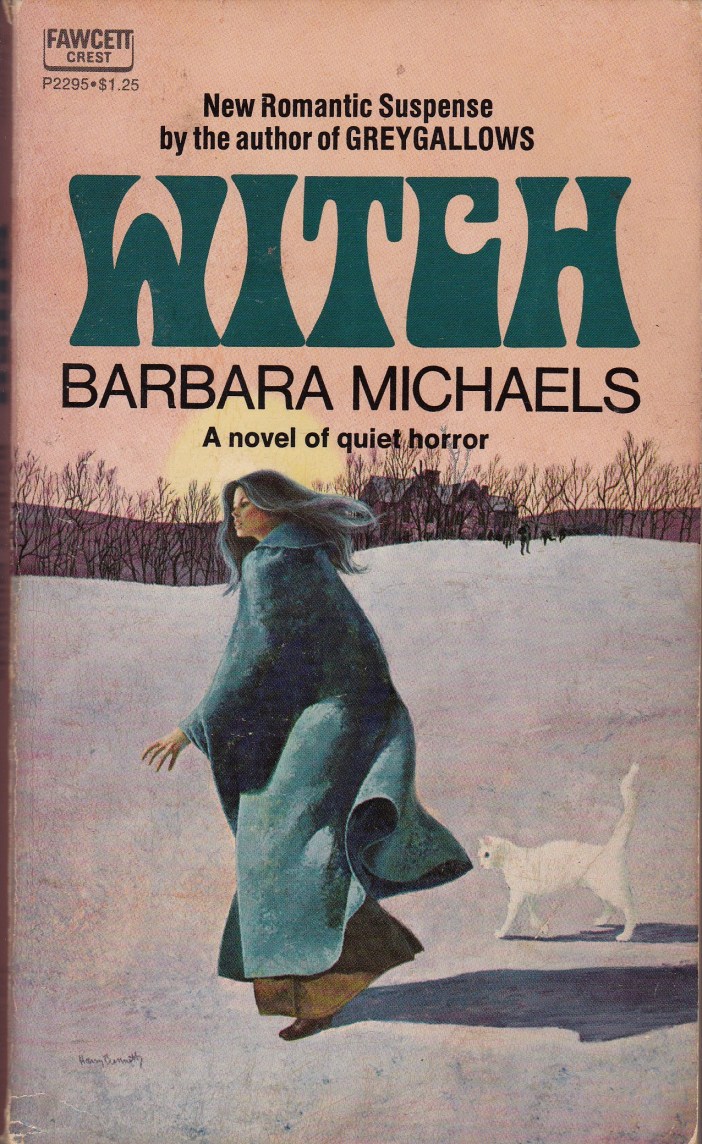
Over the weekend, after finishing Triad, I reread another favorite Barbara Michaels novel, Witch, which I had not read in a long time. (I am now reading Gore Vidal’s Thieves Fall Out, originally published under a pseudonym and now reprinted under his actual name by Hard Case Crime.)

witch

According to the directions Ellen had received from the real estate agent, the house was in a clearing in the woods. Gently perspiring in the the hot office, Ellen had thought wistfully of cool forest glades. April in Virginia is unpredictable; this particular day might have been borrowed from July, and the small-town office was not air-conditioned.

An hour later, after bumping down rutted lanes so narrow that tree branches pushed in through the car windows, Ellen was inclined to consider “clearing” a wild exaggeration. She started perspiring again as soon as she turned off the highway. No breeze could penetrate the tangled growth of these untamed forests; moisture weighted the air.

At any rate, this must be the house, though it more resembled a pile of worn logs overgrown by honeysuckle and other vines.

Barbara Michaels, as I have said any number of times, is one of my favorite writers of all time. Witch is one of her better books, definitely in my top tiers of her novels under that name. It tells the tale of Ellen March, divorced, who has been living with her brother-in-law helping him raise his three sons (her dead sister’s) and her own daughter, but now all are leaving for college or private schools, the brother-in-law’s job with the state department is taking him overseas, and all of a sudden, she is at loose ends. As the house in one of the suburbs of DC is to be sold, Ellen decides to buy a nice place out in the country. And she finds one, spends the next few months getting it fixed up, and moves in.

But all is not what it seems in the country.

First off, Ellen has a very bizarre reaction to the house when she first sets foot in it–an exultation, kind of ecstatic joy. And then there are the stories about the house–it was originally built in the seventeenth century, and it was the home of a woman many of the local considered to be a witch–who tended the wild animals in the woods and then “committed suicide.”

And then weird things start happening–she starts seeing a white cat in the woods (the witch had a white cat); sometimes she sees shadows out of the corner of her eye in her bedroom that vanish when she looks; she occasionally hears laughter inside the house; and then she tells, as a joke, fortunes for some teenagers who hang out in the general store in the nearby village of Chew’s Corners…and the fortunes start coming true.

The town, which is dominated by a horrific fundamentalist church called the Earthly Atonement of the Wrath of God, which is even worse than it sounds. So, of course, the “good” people of Chew’s Corners think she is either a witch herself, or being possessed by the ghost of the witch.

It’s a good story–although I would disagree with the cover’s depiction of it as “a story of quiet horror”–it’s still, more than anything else, a suspense novel with some paranormal elements thrown into it for good measure. It’s a great read, and the big reveal is just as shocking on a reread as it was on the original read.

And now, back to the spice mines. This stuff ain’t going to get done on its own.