I always say my first identity is reader; I was a voracious reader long before I realized that loving to read and loving books predestined me to become an author, a teller of tales. Certainly author is my primary, preferred identity; sometimes I worry that my identity is entirely too wrapped up in being an author. But trying not to worry and be anxious about anything and everything in my life is my new mantra.
Anyway, I had the great pleasure of meeting S. A. (Shawn) Cosby at Bouchercon in St. Petersburg. I don’t really remember much of the weekend–I met a lot of people and I drank way too much–but I know I met and liked him enough to get a copy of his debut novel, My Darkest Prayer. I loved the book, and saw in its pages an incredible talent, for character and place and dialogue and language, and when I reviewed it on here I predicted an incredibly bright future for him as a crime writer.
I was right,
Titus woke up five minutes before his alarm went off at 7:00 A. M. and made himself a cup of coffee in the Keurig Darlene had gotten him last Christmas. At the time she’d given it he’d thought it was an expensive gift for a relationship that was barely four months old. These days, Titus had to admit it was a damn good gift he was grateful to have.
He’d gotten her a bottle of perfume.
He almost winced thinking back on it If knowing your lover was a competition, Darlene was a gold medalist. Titus didn’t even qualify for the bronze. Over the last ten months he’d forced himself to get exponentially better in the gift-giving department.
Titus sipped his coffee.
His last girlfriend before Darlene has said he was a great boyfriend but was awful at relationships. He didn’t dispute that assessment.
Titus took another sip.
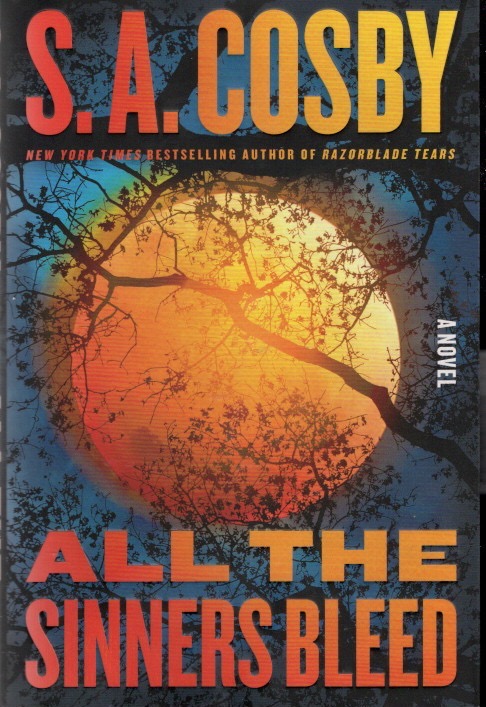
All the Sinners Bleed is Shawn’s fourth novel (as a solo author–he also co-wrote a book with Questlove). In the wake of My Darkest Prayer, he released two novels to extraordinary success and acclaim, Blacktop Wasteland and Razorblade Tears. Both were amazing, and somehow each book is somehow better than the preceding one–which is really saying something; I’d happily retire if I ever reached anything comparable to those two with any two of my own.
But they were just warm-up acts for this incredible new novel.
Something that has always interested me over the years is the integration of American police forces on every level. How do, for example, Black and/or Latinx/Hispanic cops feel when their fellow officers commit racially driven police brutality? How does it feel to be a part of a police force–particularly in the deep South, but also in places like Los Angeles–that has always been historically racist and oppressive to non-whites? For that matter, how does it feel to be a queer police officer?
All the Sinners Bleed takes on that question with our main character, Titus Crown, the recently elected first-ever Black sheriff in a pretty racist little corner of southeastern Virginia. Titus was born and raised there; his father and brother live there, and he returns to his hometown after a stint with the FBI. He ran for sheriff not expecting to win, but to try to break the stranglehold of power always held by money and white supremacy there. (I have another essay or entry to write about small Southern counties/parishes, and how they all too frequently are run like corrupt authoritarian dictatorships with the power being passed down within a few families, sometimes only one. Exhibit A: the Murtaughs in the South Carolina low country.) As the first Black sheriff of Charon County, he has to uphold the law–which he intends to do to the best of his abilities.
The book opens with a shooting at the local high school; this was hard for me to read and part of the reason it took me so long to get into it; I thought this was going to be a school shooting novel and I wasn’t sure if I wanted to read that. But I was wrong; yes, there was a shooting at the school and yes, that shooting was pivotal to the plot, but it wasn’t a mass shooting: a young Black man goes to the school and murders one of the teachers, and on his way out he is shot and killed by the cops when he won’t drop his weapon. Why would Latrell Macdonald shoot Mr. Spearman, a very popular teacher? As Titus starts looking into the strange shooting, he discovers another level of horror going on in Charon County, and once the story gets moving, it’s hard to put the book down.
Over the course of this all-too-short novel, Cosby tackles a lot of issues without either being preachy or over-the-top. Confederate monuments, the Daughters of the Confederacy, racism, white supremacy, the cruelty of poverty, police brutality, and the hard, cruel kind of Christianity practiced in poor, remote rural regions of the South. But the most powerful aspect of the book is how it handles grief; the three Crown men dealing with the loss of wife and mother, a wound that never heals–and the guilt that comes with moving on from such a loss. Cosby had a lot to say in just over three hundred pages; the fact that he said it all, and powerfully, by using character, place and story to get his messages across is testament to his great skil.
And this book is bound to piss off white supremacists. It will make a great Christmas gift for any in your family.
 Queer and Loathing in America