It is impossible for me to express how much books have always meant to me, and how grateful I am, to this day, to my parents and grandmother for encouraging me to read. We’ve always been a reading family–but no one ever has read as much, or as often, as I did. One of my aunts called me “the readingest child I’ve ever seen”–and she was a librarian. Books made sense to me; the worlds I escaped into whenever I opened a book made sense to me, and none of the worries or cares of my childhood bothered me when I was lost in a book. I also loved history, and thus read a lot of it when I was a kid; the basic overview history classes I had were pretty easy for me because I already knew the history in greater depth than the textbook provided.
The Scholastic Book Fairs were always my favorite day every month, and I was always so delighted when my mom would let me order a few–never all the ones I wanted, because I really wanted them all–and it was even more exciting when I found one that was also set in a period of American history. Johnny Tremain remains, to this day, one of my all-time favorites, and when I was a kid, I wanted to write both a mystery series (like the Hardy Boys and Nancy Drew) as well as historical fiction.
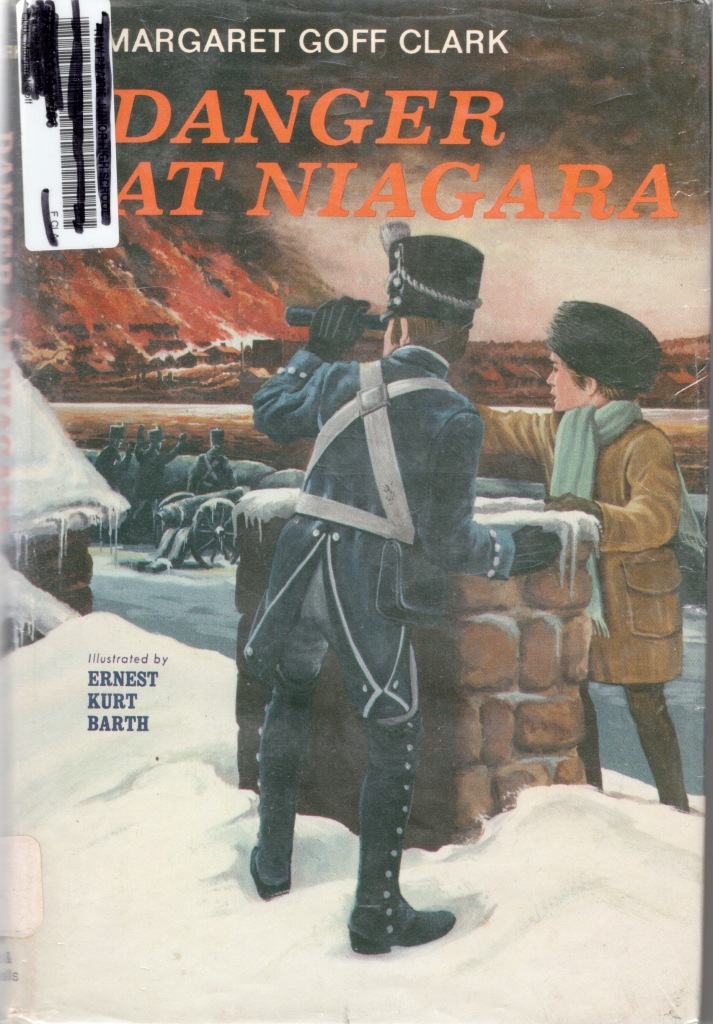
One such book that stuck with me over the years–and didn’t have as big an impact on culture as Johnny Tremain, which won awards and was filmed by Disney–was Margaret Goff Clark’s Danger at Niagara, which was set on the US/Canadian border during the War of 1812 (which few people write about and is mostly forgotten today). A few years ago I was looking for the original hardcover of Johnny Tremain I had read as a child, when a copy of Danger at Niagara was recommended to me by the eBay algorithm. It wasn’t expensive, it was a library remainder, and I thought, what the hell and shelled out the less than five dollars including postage, and the other day while they worked on the ceiling, I reread its 120 pages.
Exhausted from a day of fruitless hunting, Homan Reed ate a cold supper of cornbread and milk. Hastily he banked the fire and then fell into bed, forgetting his loneliness and the ever-present danger from across the river.
He awoke at dawn, shivering under the heavy quilts, awakened as much by the silence as the cold. He lay still, listening. Gray morning light had come through the small panes of glass Uncle Oliver had carried all the way from Connecticut. A sound that usually penetrated the log walls of the cabin was missing–a sound that was part of the background of his life in this lonely frontier clearing in western New York State.
His hear began to beat too fast, and he sat up in bed, reaching for the buckskin breeches he had laid on top of the quilts. Homan was a good-looking boy, rather small for his almost fifteen years.
There really isn’t much to the story, really. Homan wakes up to realize he has slept through a raid on his little family farm, and their livestock is gone. His uncle brought Homan and his brother up here after their parents died, and his brother is off fighting in the American army in the War of 1812. The Reed place is right across the river from Canada–and of course, at that time Canada was the enemy. Putting myself into Homan’s place was exciting; trying to imagine what it was like to know that not only was the British army capable of crossing the river at any time, their Mohawk allies were also out and about and a constant threat. Shortly after the opening of the book, the American army burns a Canadian town and turns out women, children, the sick and the elderly out into the cold with no shelter or food; to the author’s credit, she makes it clear this is horrible and a war crime; Homan, who witnesses this from inside Fort Niagara (he’s gone looking for his brother and to try to enlist), is horrified and ashamed Americans could do something so heinous–and everyone on the American side of the river knows there will be retaliation and retribution.
As I reread this short book, I paid very close attention to what we now would call propaganda for American supremacy–and there was some, but not as much as I would have thought, and there was less problematic language than I would have expected for the time (it was published in 1967 originally). Yes, Clark refers to the Tuscarora and Mohawk peoples as “Indians,” as do the characters (which is what they would have said at the time, so historically accurate, if offensive) but she treats the natives with respect–no references to them not being human beings, or being savages or uncivilized or anything like that; Homan even has a friend his age from the Tuscarora people. The Mohawks are referred to as the enemy, but in the same way the British are. There are a few mentions of pro-American exceptionalism propaganda–things like “we are a growing power the world needs to respect”, that sort of thing that Americans have always believed and never questioned until the last few decades or so. But Homan is likable enough, and the story itself, of worrying about your safety and losing your home and so forth, resonates still, even if technically Homan and his family were colonizers.
I really do need to reread Johnny Tremain…
 Queer and Loathing in America