Torn between Two Lovers

The other show that Agnes Nixon created was One Life to Live, set in the Philadelphia suburb of Llanview. The show never really got quite the attention that it’s sister shows on ABC did, airing for most of its run between the better known All My Children and General Hospital, and it did veer into the weird from time to time. But when it was on its game,One Life to Live was without question one of the best shows on television.

oltl92

I can remember watching from a very early age, with our babysitter and my grandmother. The lead character was–and always remained–Victoria Lord. The show followed the classic soap set-up of two contrasting families–one rich, one poorer–but Agnes Nixon gave that classic set-up a twist. Usually, the families were large–the Hortons on Days of Our Lives being a prime example–and very WASP-y; with names like Hughes and Lowell and Matthews. The “poorer” family wasn’t really poor; it usually was more upper-middle class, with doctors and lawyers; money was never a concern. What Nixon did with One Life to Live was very different than anything else on the air. Of course, there were the Lords, filthy rich with their mansion and publishing empire–but she deliberately made the second family not only working class but ethnic–the Polish-American Woleks.

And even more shocking, one of her initial storylines was about Carla…who turned out to be a light-skinned black woman passing for white, engaged to a white man, and struggling to deal with whether she should embrace who she was or continue living a lie. For the 1960’s, this was shocking–particularly since she was engaged to a white doctor. The big reveal when the audience found out that Carla was actually black was one of the biggest plot twists ever on a daytime drama–and needless to say, didn’t play well in the deep South.

The show always took chances–some of them paid off, others didn’t. The underground city of Eterna story, the time travel story that sent Clint Buchanan back to the 1880’s–these were the things that made one roll one’s eyes.

But like I said, when the show was on, it was fucking on.

Take the character of Tina Clayton, for example. She was originally brought on as the teenaged daughter of Viki’s best friend from college, and a little loose with her morals. She left the show, only to return in the mid 1980’s older, trashier, and with a secret–she was actually Viki’s half-sister, because her mother had had an affair with VIki’s father!

andrea_evans

Now, one of the original big stories on the show was Viki’s mental illness–she had DID (dissociative identity disorder), or what was then called a ‘split personality.’ She would become another woman, Niki Smith. This illness was originally ‘cured’ and Viki moved on. Tina’s return, and the claims about Viki’s father, brought Niki Smith back out yet again. Tina was front and center on the show for several years, superbly played by Andrea Evans, until she left the show. The part was recast a couple of times, but Evans was so definitive it was hard for the other actresses to make the part their own.

But Erika Slezak was fantastic as Viki. She won six Emmys for the part–in no small part because of her stunning performances during the DID episodes, when she was completely believable as someone else.

slezak4-thumb-250x274-21937-e1384105464226

She also had amazing chemistry with another amazing actress, Robin Strasser, who played her arch-enemy and stepmother, Dorian Lord.

mti4odiynda0ntc4mzg0mzuw

The scenes when Dorian finally confronts Viki with the knowledge she’d always thought Viki knew herself–that Victor Lord had sexually abused her as a child–were stunning; they are on Youtube, if you want to take a look. That was when Viki’s mind shattered into several different characters; at least six. Amazing acting and writing.

In the early 1990’s, One Life to Live was absolutely must-watch television, at least for me, as the show took on homophobia and HIV. Viki’s youngest son Joey’s best friend Billy Douglas, played by Ryan Philippe, was thrown out by his parents for being gay.

ea9f5a12fba50e9d1875e383bf864b37

At the same time, a local girl named Marty Saybrooke was obsessed with Father Andrew Carpenter, an Episcopalian priest who was trying to help Billy. When Andrew rejected her advances, Marty started telling people that Andrew had actually molested Billy and that was why he was gay. Andrew’s older brother had actually BEEN gay, and died from AIDS without reconciling with their homophobic father. It was riveting to watch, as characters whom I’d watched and loved for years had to struggle with their own homophobia and biases, as well as their fear of AIDS. Watching Sloan Carpenter come to terms with the knowledge that his own fears and biases had cost him his son was powerful, and of course, in the end all was well and the truth came out and Sloan convinced Billy’s parents that loving their son–and not losing him as he had lost his own son–was most important. The storyline wrapped up with a visit to the AIDS Quilt, where the Carpenters added a panel for their lost son.

As a gay man in a homophobic world, you can only imagine how powerful that was to watch. That they actually showed the quilt was one of the most amazing things in the world to me.

But the show wasn’t done quite yet with powerful stories. Next came the gang rape of Marty Saybrooke, at a fraternity party. SPurning the advances of Todd Manning and pretty much loathed and despised by everyone in Llanview as a liar, Marty got drunk at a fraternity party–and Todd, along with two of his buddies, including a cousin of Viki’s–gang raped her in one of the fraternity dorm rooms. The rape was actually shot through an aquarium; so you could see vague movements and blurred violence, but you could hear it happening. It was incredibly horrifying, and extraordinary television and storytelling; because who would believe notorious liar Marty? Especially because she included Viki’s oldest son, Kevin, in her accusation because she was drunk–and later recanted, which threw her entire story into question.

todd_kev_powell_zach

Susan Haskell won an Emmy for her portrayal of Marty–she would later win another for reprising the role fifteen years later.

And the show created the most terrifying villain of all in ringleader Todd Manning, superbly played by Roger Howarth (who also won an Emmy). The character was so popular they had to somehow find a way to keep him on the show–which meant rehabilitating a rapist (problematic, but that’s a subject for another time). Eventually, Todd turned out to be Viki’s half-brother, product of the continued liaison between her friend Irene and her father.

For those two stories alone–the homophobia and the gang rape–the show should never be forgotten.

It was brave and daring for its time, and incredible storytelling.

And I didn’t even mention Judith Light’s brilliance as housewife hooker Karen Wolek.

S thank you, Agnes Nixon. You were an amazing writer, and a creative genius, and your creations were some of the best television ever.

Angie Baby

Agnes Nixon died yesterday. For those of you who don’t know who she was, she created the long-running soaps One Life to Live and All My Children, among others, and worked on numerous others as well. She created two of the greatest female characters in television history–Victoria Lord on One Life to Live and Erica Kane on All My Children, both of whom made daytime legends of the actresses who played them, Erika Slezak and Susan Lucci.

I loved soaps, and it wasn’t until the late 1990’s that I stopped watching them because i needed the time to write. When I was a kid, both of my parents worked so during the summers a lady down the street watched my sister and I during the day–and she was an avid fan of General Hospital, One Life to Live, and Dark Shadows. My grandmother also worked the evening shift at American Can Company back then, and so she also watched the shows, so on days when she watched us we watched them all together. It was hard sometimes catching up, since we weren’t able to watch them during the school year (other than Dark Shadows, which we could run home from school to catch the last twenty minutes or so of), but watch them we did…and when All My Children debuted, we started watching that one because it was new–we could know everything from the very beginning. The thing that was amazing about All My Children as well, was that it had young characters featured front and center; the romantic lives of teenagers was just as important as that of its older characters. Tara, Phil, Chuck and Erica were all high school students when the show started, and there was something else odd about the adults in Pine Valley, as well. They didn’t just sit around and talk about what was going on with their lives, they also talked about the Vietnam War, protests, and opposing it. The show was actually relevant; while other soaps were insular, where nothing mattered except what was going on in the town as though the rest of the world didn’t exist, the people in Pine Valley were very aware. And both Phil and Chuck–and their families–worried they’d be drafted when they got out of high school.

amcbook

Phil eventually did wind up going to Vietnam, and was reported dead there.

The show was incredibly popular with young people–all of my friends watched it, and as the years passed, the show continued its commitment to young love. Pine Valley also had something else that most other soaps didn’t have–people of color. In the early 1980’s, there were two parallel star-crossed love stories featuring teens–Greg and Jenny, who were white, and Jesse and Angie, who were black. Both stories got equal air time, were equally important, and the young actors were incredibly compelling. There was also a teen villainess, Liza Colby, played by Marcy Walker, who was also fantastic.

Greg and Jenny:
imgres

Angie and Jesse:

imgres-1

The despicable Liza:

imgres-2

Kim Delaney, who would go on to prime time success, left the show shortly after she and Greg were finally, after years of heartbreak, obstacles, and separation, married; the show decided not to recast but to kill her off.

It was devastating.

In college, everyone would gather around television sets in the lounges to watch All My Children ; when Jenny flatlined I remember everyone in the lounge gasped in disbelief; some people actually started crying. Years later, I mentioned to a friend “if someone ever tells you they used to watch All My Children , and you ask them when they stopped watching, they will tell you they stopped watching when Jenny died.”

The show did eventually recover from killing off Jenny, but it took a while.

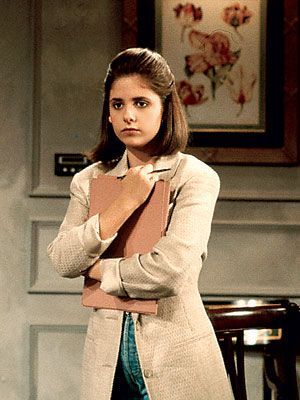
Over the years, the show created incredible characters played by exceptional actors; Sarah Michelle Gellar’s big break came as Kendall on the show; a young actress who not only could hold her own against Susan Lucci but was a villainess you also felt compassion for. She played Kendall, the daughter no one knew Erica had; the product of a rape when she was thirteen that she gave away, and Kendall turned up as a teenager. The scenes between Erica and Kendall, when Erica tried to explain why she could never love her because she would always see Kendall and remember the rape, were incredibly powerful; Sarah Michelle Gellar would win an Emmy for those scenes, and I never understood why Lucci did not. (Lucci, of course, was nominated a billion times and only won once; it became a running joke for Lucci–the irony being she became much more famous for not winning than any of the women who won did; and when she did finally win, it was national news and she was on every magazine cover on the newsstands.)

e55267ed80865a18956f611ddd65fbb8

Kelly Ripa also got her big break on All My Children , as Adam Chandler’s illegitimate daughter Haley.

One of the other things that made the show special was it wasn’t afraid to be funny; it was more than just unrelenting melodrama and sobbing. One moment your heart would be breaking over Donna’s grief over her child dying in a fire and the next you’d be laughing at the antics of Opal Gardner. All My Children never was afraid to be funny. (One of the greatest characters on the show was villainess Janet–“Janet from another planet”–who did horrible things but at the same time was incredibly funny.)

And of course, there was Erica Kane. You can’t talk about All My Children without talking about Erica. When asked once if she would ever leave the show, Susan Lucci replied, “Why would I? Where else would I get to play Scarlett O’Hara every day?” Erica started out as a bitch on the show–a young teen villainess– but in the skillful hands of the perfect actress for the part and a talented writer who showed the character in all of her confusing complexity, Erica became the center of the show, and was always the star. Erica wanted to be loved, but she also wanted to be rich and famous and successful–and didn’t want to get all of those things by marrying a rich man; she wanted to get them herself. And that drive, Erica’s drive, I think, was what made her such a beloved character. She did things the wrong way, she lied and manipulated, but the disaster that was her personal life never stopped her from getting all the things out of life that she wanted–and when her deceptions once again destroyed her personal life, she always wiped away the tears and repeated her mantra: “I can do anything. I’m Erica Kane.”

And of course, Erica had daytime’s first (and one of the few) abortions.

The show always dealt, like it did with abortion and Vietnam, social issues. It had daytime’s first lesbian character, dealt with HIV/AIDS, had a gay character and addressed homophobia, and of course, Erica’s daughter Bianca became daytime’s first main character to be a lesbian…and to have as troubled, dramatic, and fascinating love life as any of the straight characters.

I could probably write an entire book about All My Children . I learned a lot from the show, about writing, how to plot a murder mystery (the show had some of the best murder mysteries on daytime), and how to create a complicated character.

RIP, Ms. Nixon. I’ll talk about One Life to Live tomorrow.