The Morning After

I got up early this morning (well, early for a Saturday) to take a streetcar named St. Charles down to Audubon Park for the NO/AIDS Walk. I was scheduled to work in the Carevan, our mobile testing unit–and had to wonder, why has it taken me this many years to figure out that clearly the Carevan is the place to work other than the Prevention table? The Carevan is air conditioned. 

It is sad how many years it has taken me to figure this out.

I also took the streetcar home, taking pictures of the beautiful homes on the way home–I don’t know why I didn’t do so on the way there, other than it was early and I’d only had two cups of coffee so my mind wasn’t exactly thinking very clearly–but on both trips, plus the walk through Audubon Park (on the way there, I made a wrong turn at the first lagoon and wound up having to walk all the way around the park–I’d forgotten there was a golf course in the middle of Audubon Park–but didn’t make that mistake on the way back to the streetcar stop) I felt connected to New Orleans again in a way that I haven’t in a while; as ‘touristy’ and ‘cliched’ as the St. Charles streetcar line may be, there’s nothing like taking a leisurely ride on it to make you feel connected to the city again. St. Charles Avenue, and all the houses on it, are so beautiful, and scenic–and all the hidden beauty in Audubon Park, along with the beautiful and massive live oaks everywhere…well, it’s been a while, you know? I love New Orleans so much, but I get so wrapped up in my day-to-day life and existence that I forget sometimes how much I love it here and how grateful I am that I get to live here.

There was, for example, a wedding party having their pictures taken in the park among the live oaks that I stumbled on as I walked back to St. Charles. I didn’t photobomb them–though I thought about it–but they were done and walked back to the Avenue by the time I reached them. There was a portable snowball stand set up on the Avenue, and I took a couple of pictures of the bridal party getting snowballs. It was such a uniquely New Orleans moment.


And riding the streetcar, wandering through the park–despite the heat and the heavy air, I couldn’t help but think about the next Scotty book, and how I need to make it more about New Orleans, how I can add layers and more depth to it as a book, about how to connect the characters in the case itself to the city and make it more New Orleans somehow. I feel like that’s been missing somehow in my work lately, at least in the last few books: that sense of New Orleans that was always there before.  I think I managed to get some of that into Garden District Gothic, but I am never sure. I know that the Chanse books were starting to feel like the setting was generic; they could have been in any city, they just happened to be set in New Orleans. That was, I think, why the series was starting to feel stale to me, and partly why I decided to end it.

I’m worn out now, exhausted from the heat and the humidity and the heavy thoughts. I am going to repair to my easy chair for a lovely relaxing day of college football (GEAUX TIGERS!) and reading Leslie Budewitz’ Assault and Pepper, in preparation for spending the day tomorrow in the spice mines.
The Streak

Laura Lippman always says that one of the most worn-out, tired cliches/tropes of crime fiction is a beautiful woman dies, and a man feels bad.

On our panel at Bouchercon last week, the subject of cultural appropriation came up, and unfortunately, I didn’t get to answer it–which is unfortunate, because my response was going to be, “I appropriate from straight culture all the time. In fact, I used the trope of a beautiful woman dies and a man feels bad in my first novel, only switched it into a beautiful man dies and a man feels bad.”

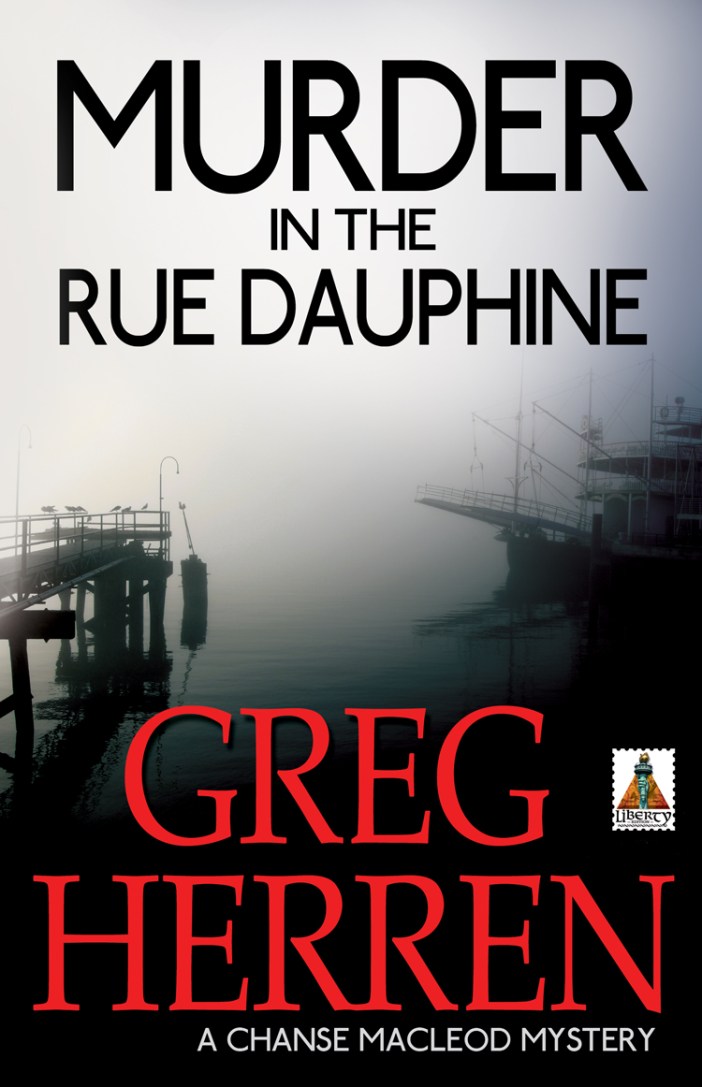
Because really, you can sum up the plot of Murder in the Rue Dauphine that way.

get-attachment-aspxThe funny thing is, I didn’t realize I was subverting, or appropriating, a trope at the time I wrote the book–but I was also trying to write a gay-themed mystery with a gay main character, and so I wound up using one of the tried-and-true crime tropes without even realizing I was doing it.

When I was a senior editor, one of the things I wanted to see was gay novels that flipped the script on straight tropes–where is the gay James Bond? Indiana Jones? Gay romantic suspense? I honestly believed–and still do–that if the books were well-written and the characters well developed,  a gay or lesbian writer could take a trope/cliche from mainstream publishing and breathe fresh life into it. I tried to do this very thing with both Timothy and The Orion Mask, and once I get through these next books I have to write, I am going to try subverting some more writing tropes–like a gay hard-boiled noir, for example; wouldn’t that be fun? I have an idea for two that have been simmering in my head on the back burner for a while: Muscles and Spontaneous Combustion. 

We shall see, I suppose.

And now, I need to get back to the spice mines, otherwise I will never get any of these things done.

The Bitch is Back

I finished rereading Prince of Darkness last night. I really loved the work of Barbara Michaels, even if some of it is now really dated. She made the books very much of their time–Prince of Darkness was written during the 1960’s, so there is very subtle exploration of racism and classism, as well as the student movement of the time–but they still hold up after all this time; which was why Dr. Barbara Mertz, who wrote as both Barbara Michaels and Elizabeth Peters, was such a great writer.

We’ve also been watching the TV series Turn, about Revolutionary War spies, which is apparently based on the nonfiction book Washington’s Spies. It, too, is very well done–in our modern day, which has deified the Revolution and all those involved, turning them all into plaster saints, we have forgotten that they were all just people, who made mistakes, had all the foibles and follies of any of us. I’ve always loved history, and I am very pleased with how accurate to history this show is.

I’ve been thinking a lot lately about character; partly because I did teach the character workshop at SinC Into Great Writing last week, and I’ve done a lot of character workshops over the years. There has also been a lot of talk about the unlikable female protagonist over the last few years, beginning around the time of Gillian Flynn’s monster hit Gone Girl and working its way through The Girl on the Train and any number of other books with female main characters. There seems to be a thirst out there for these types of book (any number of people, I’ve seen, have complained about the Girl books; God save us from any more books with ‘girl’ in the title). I suppose The Girl with the Dragon Tattoo is credited with started The Girl trend–I am not a genre critic/journalist–but it was written by a man; Gone Girl was written by a woman, and that’s why I credit it with starting the trend (technically, Laura Lippman’s The Girl in the Green Raincoat was the first, I suppose–you see what happens when you start splitting the hair?).

The unreliable narrator is not new, nor is the concept of the female unreliable narrator new; Margaret Millar’s Beast in View did a great job with this back in the 1950’s, for example. It is a trend, nothing more; as soon as the bookstores are glutted with books with unreliable female POV’s something else will sell a gazillion copies and the market will be flooded with similar books to it (The DaVinci Code, after all, spawned a million imitators and also the Templar craze).  I asked the question, awhile back, ‘is unlikable a code word for complex?’ And that is something I’ve been pondering ever since; why are complex women characters so easily dismissed as unlikable or as a bitch?

The arch-type of the bitch has long been a staple of melodrama; what would soap operas have done without the lying, manipulative seductresses who basically drove the plots of the shows? Try to imagine All My Children without Erica Kane, One Life to Live without Dorian, Dynasty without Alexis. The characters became enormously popular (the addition of Alexis to the cast of Dynasty took the show from middling ratings on the edge of cancellation to a Top 5 show for almost the entirety of its run), and often their popularity was explained away by ‘they say and do things that people wish they could; they provide some sort of wish fulfillment for the audience.’ I don’t necessarily think that’s true, and the popularity of these ‘unlikable’ women protagonists in crime novels proves me right. I’ve always felt that the ‘bitches’ were popular not only because they were fun to watch, but because they didn’t take any crap from anyone and also because they were vulnerable: Erica Kane just wanted to be loved, but was so used to not getting what she wanted that she often defeated herself because she was used to driving people away; the more husbands/lovers she lost, the more she solidified that persona of independence and strength which made it all the more difficult for her to allow anyone to see her vulnerability and therefore completely trust/give herself to anyone. If the character hadn’t been written and played that way, she would have just been another two-dimensional bitch that the audience would have tired of after a few years and she would have been written out of the show, sent away or killed off.


The best piece of writing advice (well, one of them, at any rate) I got when I was unpublished dealt with a horror short story I wrote called “Fellow Traveler” (it’s never been published, although “A Streetcar Named Death” owes a huge debt to that story), which I’d submitted to a horror magazine whose name I no longer recall. The female protagonist was unlikable; I wrote the story so that the reader would be happy when she got her comeuppance at the end. The note I got back from the editor with the rejection was, very simply, even Hitler loved his dogs. That was, simple as it was, incredibly great feedback; I cannot even begin to tell you how many times over the years I’ve passed that advice along to new writers I am either mentoring or editing. It has also evolved into the villain doesn’t think he/she is the villain.

In other words, your ‘bad characters’ have to be just as three dimensional as your ‘good characters.’ Why is Erica a bitch? What does Alexis really want?

They can’t be bad, and do bad things, simply because you need them to for the sake of the story.

When I was writing Sleeping Angel (spoiler!) I wanted to get inside the head of a bully. It would be incredibly easy to simply write the bully character as an asshole. But I wanted to know, and share with the reader, why this character was a homophobic bully. Bullying was integral to the plot of Sleeping Angel (I do think the book still has some flaws, despite its rave reviews and the awards it won), but it wouldn’t have worked as well as it did had the reader not really understood the bully, if that makes sense.

Okay, back to the spice mines with me.