Paul Tremblay has managed to turn himself into one of my favorite authors currently writing horror; I can’t think of a single novel of his that hasn’t been utterly fantastic, or that I haven’t enjoyed. He manages to make his characters absolutely real–with flaws and hang-ups; so much that sometimes you want to shake some sense into them–and the situations they find themselves in, while certainly horrific, are realistic. That, of course, is what makes the so horrible and terrifying; it’s easy to see yourself in his characters and stories. I also love his writing style; there’s something lyrical and poetic about his sentence construction and word choices, creating rhythms that make the words kind of sing in your head.
I wasn’t sure if I should, in that case, listen to one of his novels as an audiobook–would that musical sense of language carry over?
I needn’t have worried.
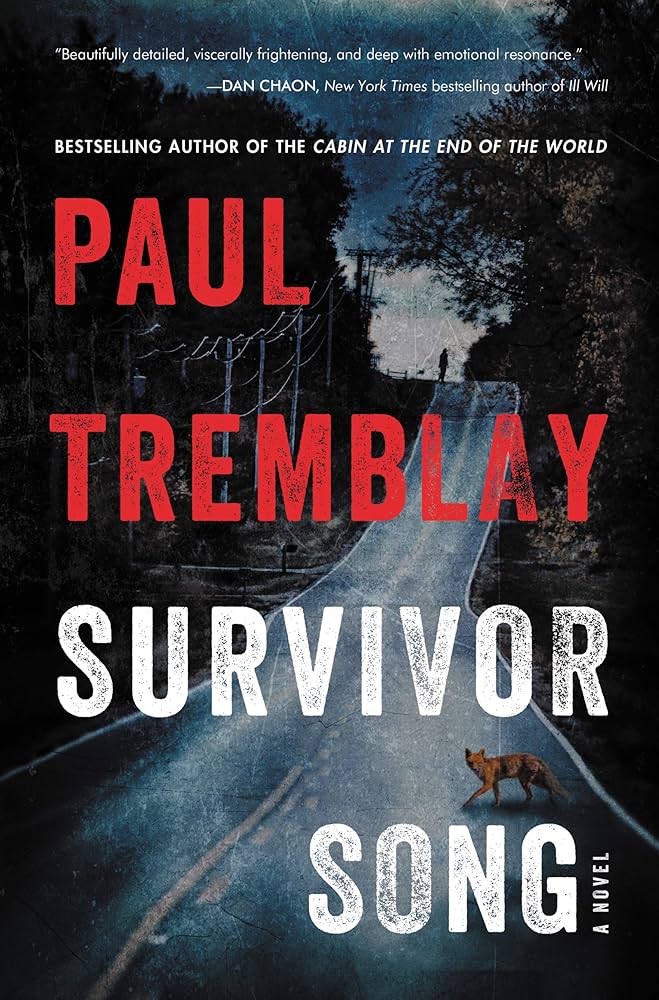
This is not a fairy tale. Certainly it is not one that has been sanitized, homogenized, or Disneyfied. bloodless in every possible sense of the word, beasts and human monsters defanged and claws clipped, the children safe and the children saved, the hard truths harvested from hard lives if not lost than obscured, and purposefully so.
Last night there was confusion as to whether turning off the lights was a recommendation or if it was a requirement in accordance with the government mandated curfew. After her husband, Paul, was asleep, Natalie relied on her cell phone’s flashlight in the bathroom as a guide instead of lighting a candle. She has been getting clumsier by the day and didn’t trust herself to casually carry fir through the house.
It’s quarter past 11 a.m. and yes, she is in the bathroom again. Before Paul left three hours ago, she joked she should set up a cot and an office in here. It’s first-floor window overlooks the semi-private backyard and the sun-bleached, needs-a-cost-of-stain picket fence. The grass is dead, having months prior surrendered to the withering heat of yet another record-breaking summer.
The heat will be blamed for the outbreak. There will be scores of other villains, some heroes too. It will be years before the virus’ full phylogenetic tree is mapped, and even then, there will continue to be doubters, naysayers, and the most cynical political opportunists. The truth will go unheeded by some, as it invariably does.
To wit, Natalie can’t stop reading the fourteen-day-old Facebook post on her town’s “Stoughton Enthusiasts” page. There are currently 2,312 comments. Natalie has read them all.
This was a book I didn’t want to read at the time of its release; and I am kind of glad I waited to get into it for a few years; while I was certainly reading a lot of plague fiction in the summer of 2020, when this book was released, the thought of reading something new about a plague whilst in the midst of one seemed–I don’t know, too real for me? The older stuff I revisited, both fiction and non, were things I had already read at some point in my life and therefore couldn’t be applied to the quarantine situation we were experiencing at that time. Of course, four years later, my own time-line is kind of fuzzy and off; it was a disorienting time, and it clearly broke the brains of a lot of people. Reading (listening) to the book four years later–without access of any kind to the pub date of the book, which I couldn’t remember in the car–I thought, wow, he really captured the insanity of the quarantine AND how people would react to it, so you can imagine my surprise to see it actually was written and already moving through the publishing pipeline for release before the pandemic began, which is frightening how eerily prescient Tremblay’s book actually is/was. (Although, imagining the right launching into conspiracy theories and blowing off quarantines and safety precautions and arming themselves–is it that prescient?)
The pandemic/plague in Tremblay’s book is a highly infectious, rapid onset variant of the rabies virus–so animals get it and become dangerous, and the infections can spread to humans. Once bitten or exposed, the human doesn’t have long before the virus takes over and leads, after a mad frenzy of attacking anyone or anything, to a painful death. Natalie and her husband Paul are coping with the quarantines, the breakdown in supply chains, the shortage of necessary supplies; a trip to the grocery store, never more than an hour to and from, including the shopping, can now take up to or more than four hours, as she is finding out that morning as she waits for him to come home. She’s in her ninth month of pregnancy, and that’s what she primarily focuses on, like most normal people do. Unfortunately shortly after Paul comes home, an infected man breaks into their house, kills Paul, and manages to bite her in the arm before she can finally kill him and escape. Natalie calls her best friend and college roommate–a doctor named Ramola–for help.
Ramola comes to pick up her friend, and the rest of the novel is the two women desperately trying to get to a hospital to try to get her treatment as well as a c-section to deliver the baby in case the treatments don’t work. It’s a race against time, and the suspense ratchets up to a unbearable level, as the two women–and everyone they encounter–encounter difficulties and roadblocks, not sure who they can trust and who they can’t, as they try to save both mother and child. Tremblay also takes the opportunity, whenever it arises, to chastise the anti-science movement in this country (which was saw in force that summer of 2020) for it’s radical views and beliefs that endanger everyone because of their own selfishness; again, was that prescience or simply the obvious conclusion to make? Even Ramola and Natalie, in their desperation, sometimes act in an incredibly selfish manner to achieve their own ends that makes me want to shake them both–which is another terrific insight on human behavior; we will always put our own individual needs ahead of the abstract “group” needs.1
It’s a very good book, and like the best fiction, it make me think. A lot, not just about American privilege and selfishness, but about dystopian fiction and disaster-type novels like this–which will inevitably become a Substack essay at some point.
Definitely recommended.
- This is something that often irritates me in these types of novels; leaders in these books will inevitably always put their own selfish needs ahead of those of the group (looking at you, Cell). ↩︎
 Queer and Loathing in America