The 2023 football season is very different from every season that has come before it.
College football has gone through a reboot of sorts, in which the old pretenses of amateur athletics in exchange for an education have finally been stripped away to turn the game into a semi-pro NFL feeder system with payers getting paid ridiculous amounts of money, by the college and by booster collectives and being able to cash in on their name-likeness-image (NIL) by doing advertising for businesses.
College football is very different from the era I grew up watching, and so I’ve seen the changes first hand. Back in the early 1900’s, when college football truly began, college was for rich kids or poor kids who were super-smart and worked hard and put themselves through with scholarships, financial aid, and jobs. College was only for the elites; working class people and most middle class kids couldn’t afford it and it was out of the question: you needed family money or a lot of intelligence or athletic ability. The rags-to-riches story of kids from farms or very poor families who got to go to college and change their lives became a cliché in film and books and sports columns; Americans always love an underdog in their entertainment (while never examining in their own lives and behaviors how they treat underdogs–which is usually with the same condescending contempt that the elites show to underdogs in college sports movies and novels). In some cases it was true, especially during the Depression. (Watching the ESPN documentary Saturdays Down South, about the rise and history of the Southeastern Conference, you hear that same story over and over again with the older guys, or the phantoms from the past.)
When I was a kid, there was no national championship in college football’s highest level. Originally, the Rose Bowl was kind of seen as a “national championship” game as the only postseason game, but eventually other bowls began popping up for those excellent teams passed over by the Rose Bowl, which led to the creation of the Cotton, Sugar, and Orange bowls, which were the original big four bowl games. The national championship was decided by polls that didn’t always agree, so almost every year there was no consensus champion, and often more than one. Most lists of college football national champions only counts one or two polls, usually the AP (sports writers) and UPI (coaches poll). Needless to say, this didn’t solve anything and led to a lot of controversy and bad feeling. The writers and the coaches were frequently biased, which led to a situation where a “brand” name school–your Oklahomas, Ohio States, Notre Dames, Alabamas, and USC’s, among others–were always taken more seriously than non-brand name schools; it wasn’t easy for any team who wasn’t one of those (or Michigan, or Texas) to be picked over a name brand school; and it was always obvious that an undefeated Notre Dame would always win the polls over any other undefeated team. The bowls gradually tied themselves to conferences, which made the national championship race even more tangles. The Southwest champion always went to the Cotton Bowl, SEC has the Sugar, the Big Eight had the Orange, and the Rose was the Big Ten champion against the Pac-9 champion. The money also wasn’t there; ABC had an exclusive contract to televise NCAA games, and so every weekend there was usually a game of national import to watch as well as something local. We were from the South but lived in the Midwest when I was a kid, which meant we rarely got to see any SEC games unless Alabama was doing really well.
The break-up of that monopoly held by NCAA over television rights for college football fell in the early 1980s, ESPN launched, and suddenly the landscape of college football had changed forever. The need for a consensus champion led to several attempts to solve the problem, but the question of the top two teams to play for it every year became controversial as inevitably, someone was left out. The debacle of the 2003 season, which saw LSU win on the field and USC win in a poll, led to some more tweaking of the system. But…when they expanded the field to four I said “there will be controversy when you have six teams with the same record so two are left out (which happened last year, with Georgia and Florida State) and now this year…there’s a twelve team playoff so the season doesn’t matter quite as much; there will be teams left out again, the players are getting paid, and the conference realignments all went into effect this year, changing everything. I’m not used to seeing Texas and Oklahoma being SEC teams, or USC and Washington being in the Big Ten.
It’s fucking weird.
It always surprises people that I love college football. Gay men aren’t, apparently, supposed to care about sports and especially not “sportsball”1; but for many of my straight guy friends, football is something we can talk about outside of writing or reading or anything publishing related; it also helps me feel more comfortable talking to straight men as many of them are football fans. There’s no better icebreaker than talking about football. I also am not one of those fans who mock and taunt fans of a team I don’t care for. And I know a lot about college football from decades of watching it; I have relatives who’ve played at the Division I level, and whenever my family gathers for any kind of event in the fall on a Saturday, we usually gather around the television to watch whatever games are airing.
I generally try not to read a lot of books about college football. My reading time is too consumed with reading fiction and history that I generally can’t spare a lot of time for reading about something I just enjoy, and it can never count in my fevered brain as research, as I most likely will not ever write anything about college football, although I suppose I could write about being a fan, and what that is like, and how fun it is to follow LSU (and the Saints) as a fan here in Louisiana. But with the pandemic and all the insane daily news of the last four (or ten) years, I didn’t follow the behind-the-scenes machinations of how everything was coming together for the realignments and the play-offs–and what all went on in the boardrooms; why some conferences grew and became super conferences, how some others rebuilt, and others died on the vine. The Southwest Conference died in the early 1990’s, so it’s not like conferences haven’t died before, but seeing the events of the last few years was kind of crazy.
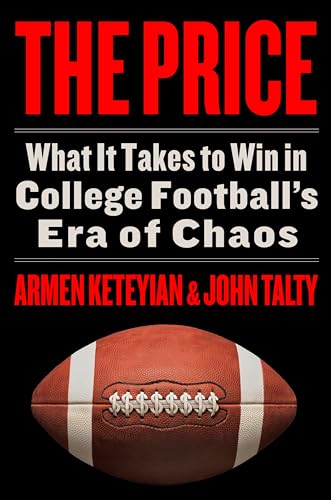
So I bought a copy of The Price: What It Takes to Win in College Football’s Era of Chaos, and left it on the coffee table next to my easy chair. The lovely thing about the book is each chapter is written like a stand-alone in-depth piece of journalism, and provides a lot of background on all the politics and backstabbing and money involved in rebooting all of college football for a new era, and how much the big money involved drove almost everything. It’s also a terrific in-depth look at the 2023 season, from the pre-season media days all the way to the championship game with Michigan once again ascending the throne of college football.
As for me, it’s an adjustment to the new world of college football, but at the same time, the only thing constant in anything is change. Is it better or worse than it was before? I am not going to stand on my lawn shouting at clouds about it, and am willing to give it a wait-and-see attitude; you can get used to almost anything, and I imagine at some point we’ll get so used to the new system we’ll look back at the old worlds (as we have already done) and wonder, “why did we do it like that when it doesn’t make much sense?”
Que sera, sera.
And if you do enjoy college football, this is a terrific read.
- For the record, gay men who call it that aren’t clever or amusing, but incredibly offensive. I actually cringe a little bit for them. Not being a part of something that’s enjoyed by the vast majority of people doesn’t make you any edgier or cooler. It’s actually infantile and makes me think less of you. “oooh, is today the sportsball?” You can also not say any-fucking-thing. And remember that the next time someone mocks you for, I don’t know, liking show tunes and red carpets. ↩︎
 Queer and Loathing in America