I became a fan of Patricia Highsmith in the late 1990’s, although I’d been a fan for a lot longer–I didn’t know she’d written the book that Hitchcock’s magnificent Strangers on a Train was based on. It was the release of the Anthony Minghella film version of The Talented Mr. Ripley that finally got me to start reading Highsmith; I read the book on which it was based and I became a big fan of Ripley, the queerness of the story, but the film never really resonated with me the way the book did…and I think it was acting and directorial choices. Damon also played Ripley as a nerdy, socially awkward type desperate for friendship and for love, and while I think Highsmith definitely created him as a striver, his striving had a lot more to do with sociopathy than unrequited love. It never made sense to me in the movie that he started impersonating Dickie on his way to Italy. Why would he do this? Was he trying to transform into Dickie before he even met him? (Whether Tom actually did know Dickie before the Greenleafs hire him to go to Italy isn’t clear in any adaptation of the story, including the novel–which I’ve not read in a while, so my memories of the book aren’t to be trusted. I should probably read it again sometime this year, to help me with my essay on Saltburn... and I should also read Brideshead Revisited.)
As a Highsmith fan fascinated by her mind and talent as well as someone who’s been interested in her Tom Ripley character–I never read the four other books in the Ripley series; I wasn’t terribly interested in seeing how things went for him after the first book ended–primarily because of the potential queer undertones in the relationship with Dickie. In the Minghella film, Tom does make a move on Dickie–and this is where, in the movie, Dickie completely changes his attitude toward Tom and just wants to get rid of him. I think this particular scene is where the audience’s sympathies are now fully with Tom going forward; we’ve all been rejected by someone we loved, and many of us have been rejected as cruelly and nastily as Dickie turns on Tom, and poor heartbroken Tom who has now had all of the rugs pulled out from underneath him…we are fully on board with him from hereon out; I certainly wasn’t sorry when Tom snaps and kills him in the boat. This motivation, I think, is a failure in the script; Tom is a sociopath incapable of feeling, so it never made sense to me in the movie. (I do not remember how this played out in the book, which is yet another reason I need to go back and read it again.)
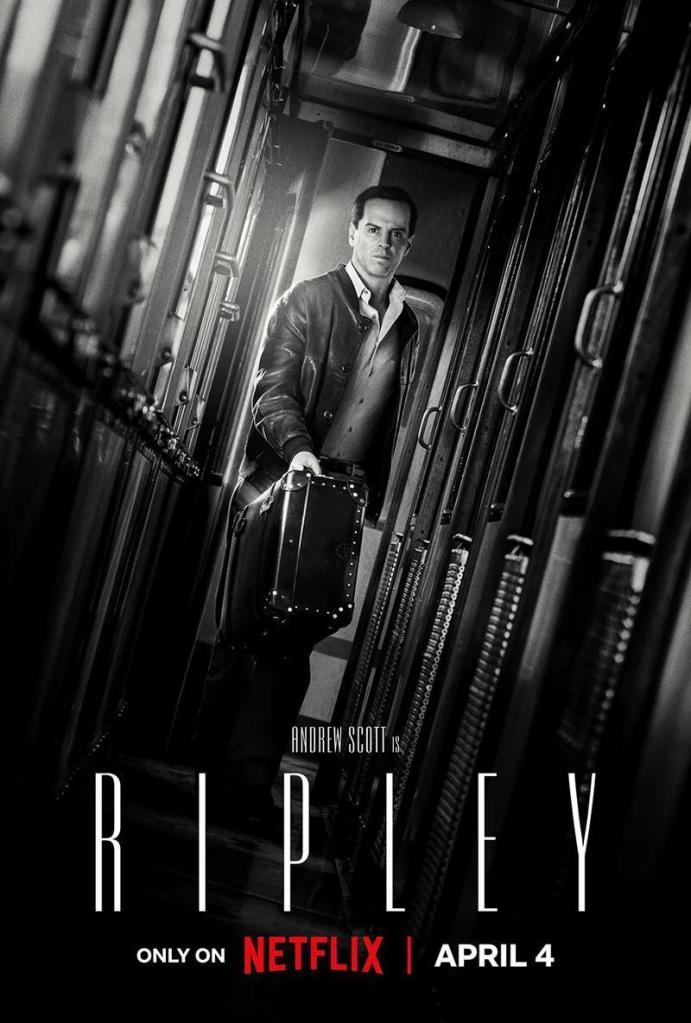
I had already been thinking about Ripley a lot lately; since watching Saltburn and trying to see the inspirations there to compare the two. I’d been looking forward to the Netflix adaptation–which I think is going to go further into the Ripley series, beyond the first book–since it was announced; one can never go wrong with Andrew Scott in a lead role.
But the series is an entirely different animal than the Anthony Minghella film from the late 1980’s, and I realized, while watching the series, that I had always viewed the novel through the lens of that movie….and now I need to read it again.
It’s fun, though, when an adaptation can give you another reading of a book; every time I’ve read The Talented Mr. Ripley I’ve viewed it a new way–but always through that Minghella lens; the only other book I’ve read differently on a reread (every reread, really) is Rebecca.
High praise indeed.
The queer undertones from the original story are still there in this mini-series, but Andrew Scott plays Tom as older and as an already career criminal, committing check fraud and insurance fraud on a very small scale. He lives in a shitty place, barely has the money to live decently, and these little frauds he perpetrates aren’t big time enough to ever earn him a big score. (It also reminded me of how, in pre-Internet and cell phone and computer days, how easy it was to swindle people.) When he gets the chance to travel to Europe to try to persuade DIckie to come home, it’s just another step, another con, a new opportunity to begin life anew in another country and get to know Dickie and perhaps infiltrate his life. As he’s so well established already as a con man and small-time crook, his pretending to be Dickie on the cruise ship makes more sense, and takes on a more sinister tone. The black-and-white cinematography was beautiful, languid, and breathtaking. The pacing of the series is tantalizingly slow, which seemed at first to be a slow-burn and a major risk; I do remember thinking how are we ever going to sit through eight hours of this? But as the story progresses and Tom’s cons and crimes become more complex and clever, it all makes sense. It makes sense that he would kill Dickie and take his place when Dickie tried to get rid of him (in the series, why Dickie would go out to sea alone on a boat with someone he’s trying to get rid of and thinks could be dangerous struck me at first as insanely stupid–but it was all of a piece with Dickie and his arrogance. He’s a rich white American, no one would ever dare harm HIM, right?), and the rest of series seems to fly by as Tom continues fooling everyone by never letting anyone who knows him as Dickie meet Tom, and the people who know him as Tom never see Dickie. Superb, and Andrew Scott was fantastic as Ripley; I felt like this was the version of Ripley Hitchcock would have given us.
At one point, Paul turned to me and said, “It’s funny how you root for the sociopathic killer,” and I replied, “because the rich people are horrible, and you want to see them suffer.”
And that’s the true genius of Highsmith; she doesn’t make Tom sympathetic, but by putting us into his mindset and seeing everything from his point of view…you start rooting for the sociopath because he’s the most sympathetic character in the book.
Which is a view of the rich I can certainly get behind.
Highly recommended, and I am looking forward to the next season.
 Queer and Loathing in America