I don’t know if I have enough words to describe how much I love Ted Lasso.

I also am not sure I’ll ever get over the show coming to an end. Okay, that’s extreme. I will miss the show a lot though; the show was topnotch from top to bottom. There was never a bad performance from anyone in the cast; the writing was stellar; the videography terrific; and the story was just wonderful. There haven’t been many ensemble casts this large where everyone had the opportunity to truly dig in and develop identities as their characters; the chemistry between the cast members was astonishing (well done, casting director and production team!). With the exception of Sudeikis and Anthony Head (as the villain of the piece, Rupert), I didn’t recognize anyone in the cast…although you can probably imagine my delight to discover that Hannah Waddingham, so sublime as Rebecca Welton, was the goddamned Shame Nun on Game of Thrones, and the star swimmer’s mother on Sex Education! I thought she was gorgeous in Sex Education, but that didn’t prepare me for the knockout she turned out to be on Ted Lasso (and my God how I hated the Shame Nun and cheered at her final comeuppance).

I literally knew nothing about the show when it first dropped on Apple Plus. It was during the pandemic–perhaps even while we in the midst of the shutdown (forgive me, those years are blurry to me). I’d seen some bits about it on social media, and I remembered the character from the ESPN commercials (which I’d hated and thought were stupid) and it really didn’t seem like anything I’d enjoy. It was a fish-out-of-water comedy, and that is a trope that has been worked to death since the beginning of time…and it just seemed kind of silly, stupid and definitely lowbrow. I was bemoaning the end of Schitt’s Creek on Twitter, and my friend Alafair replied to my tweet, you need to watch Ted Lasso. There’s a lot more to it than you’d think. I like Jason Sudeikis (so does Paul; the movie We’re the Millers, for whatever reason, is a vastly underrated comedy film), and so one night we tuned in.
And by the end of that first episode, we were believers. (Sorry, couldn’t resist.) When the credits rolled I looked at Paul and said, “I quite enjoyed that, did you?” and he agreed, and we went on a binge. How wonderful was that first season? Getting to meet the characters and how they interacted with each other–when Ted first met Keely; when Trent Crimm stood up and started asking asshole-ish reporter questions at Ted’s first press conference; the development of the relationship/friendship between Keely and Rebecca; and of course, that corny, stock, trope of a set-up: Rebecca, having been cheated on and publicly humiliated by her ex-husband, got majority ownership of the AFC Richmond soccer team, and hurt and angry beyond belief, she’s decided that since the only thing Rupert cares about is his soccer team, she’s going to take it and run it into the ground for revenge. We’ve all seen this set-up before, right? How many rom-coms or movies have used this similar insane kind of trope to build around? As I was watching, I kept thinking, okay, Ted is going to win her over and they’re going to become friends and then he’s going to find out what she was up to and be hurt and betrayed and…but the cast was appealing enough for me to care enough to keep watching. There was Jamie Tartt, the cocky young self-absorbed narcissistic star of the team; Sam, the new shy player from Nigeria; Nate, the sweet and shy and timid kit manager, constantly bullied by the players; and of course, Roy Kent (he’s here, he’s there, he’s every fucking where) the aging star who isn’t as fast as he used to be and is slightly resentful of the younger players coming up and taking over. The only people who are genuinely kind and friendly to Ted and his buddy Coach Beard are Keely–they hit it off immediately (I wondered if there was a romance budding there that first season), Nate, and Higgins, Rebecca’s assistant who kept Rupert’s affairs a secret from her and covered for him for years–so she is torturing him.
(And the song playing over the opening credits is a banger.)
And of course, Ted know nothing about soccer. He coached football (the American kind) at Wichita State, and the victory celebration video after they won the national title is what got Rebecca’s attention. But why would Ted accept a job on the other side of the world from his home, away from his wife and son, doing something he knows absolutely nothing about? The offer, as it turns out, came at a time when Ted gradually was becoming aware that his wife was unhappy and wanted out of the marriage. To try to save it, Ted accepted the job so he could give her space–half a planet’s worth. It’s still a bit of a stretch, but as we get to know Ted and Michelle and the rest of the cast through each episode, it becomes obvious that this is exactly the kind of thing Ted would do. His kindness, politeness, and friendliness–often mocked and made fun of by the more cynical characters in the cast–his uncanny gift for compassion, even when he doesn’t really understand, comes from a place of caring but we also learn it’s all a coping mechanism for him as well. His father committed suicide when Ted was a teen, and he’s never really come to grips with the loss, the grief and the pain. Now with his own family unit at risk of breaking up, of course he would do whatever he had to in order to keep the family together and sparing his son the same kind of pain he experienced when his father died.
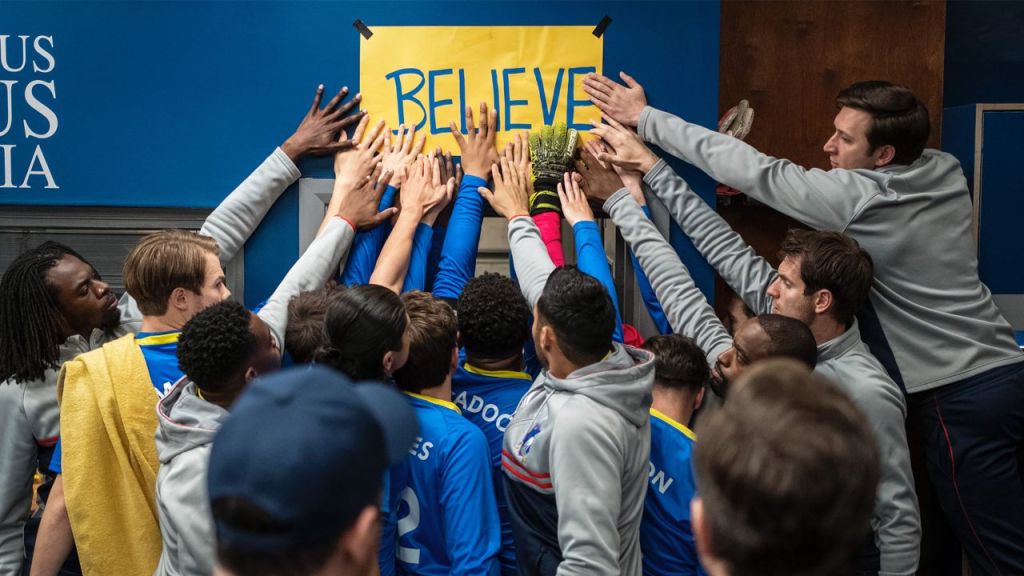
That’s kind of deep for a comedy. But…Ted Lasso wasn’t just a comedy. It had a lot more layers and depth than I would have ever imagined.
Ted seems almost gimmicky at first. He’s always looking for the best in every person and every situation and has that “aw shucks” kind of cornball Dad humor. But his empathy for others, his ability to see things from their perspective removed from any personal bias, has an overwhelming effect on other people, begins making them rethink their own attitudes and biases and behaviors–encouraging them to be better versions of themselves. At one point in Season 1, Ted explains his entire philosophy of coaching (for want of a better word, it’s holistic) to Trent Crimm…a cynical, skeptical journalist trying to get to the root of who this man is and if he is for real…and spending time with Ted turns Trent himself into a believer. But the empathy, the kindness, the total giving of himself to the betterment of others is actually his coping mechanism. As long as he is helping other people work on themselves, Ted doesn’t have to confront his own demons and issues and problems. This ignoring his own needs for self-care and mental health is damaging him. It damaged his marriage to the point of it breaking. Ted cannot help himself the way he helps others…and as the show progresses he slowly learns and comes to understand that he needs help from others, and that his own vulnerability isn’t a weakness.
And had anyone told me in Season 1 that Season 3 Jamie Tartt would steal my heart, I would have laughed in your face.

Oh my God, what a character arc.
When we first meet Jamie, he’s someone we’ve seen before. Handsome, hot, and an amazing player, he is incredibly full of himself and doesn’t give a shit about anyone else but himself. Somehow he has managed to land Keely Fucking Jones (she will always be that to me, thank you, Roy Kent) as a girlfriend, which I never quite understood; why would Keely put up with this (albeit very hot) man boy? She eventually dumps him mid-season, and he gets sent back to his regular team–he was on loan, something I never really quite understood. He is, in fact, the one who wins the big game for the other team that sees Richmond undergo the humiliation of relegation, by doing something Ted coached him to do that he flatly refused to do when playing for him; making an extra pass to an open teammate rather than scoring himself…and it is in that episode, the finale of Season One, where we discover the key to Jamie’s personality and why he is the way he is (alluded to in an earlier episode, the one about ridding the stadium of ghosts); his alcoholic and highly abusive father–who never gave a shit about Jamie or his mother until he showed prowess at soccer–shows up, and Ted witnesses the abuse in person. Between season one and two, Jamie went a bit haywire, leaving his team to go on Love Island and getting voted off early. No team wants him because of the way he bailed on the team and because he’s a diva, so he has to beg Ted and the team to let him come back to Richmond. And he has to earn it, which he does, by humbling himself and being more of a team player. Watching Jamie grow–and played expertly by Phil Dunster, who deserves an Emmy for Season 3–was an absolute pleasure. He was a standout in Season 3, and it was weird how proud I was of a fictional character.
The scene where he teaches Roy to ride a bike was an absolute joy.
I loved all of these characters, and the talents that played them so beautifully. I could write entire essays about Sam, Roy, Phoebe, Higgins and any number of other characters on the show; I’d be hard pressed to pick a favorite. But I am going to close–since it’s Pride Month, and they gave us such an amazing gift in the finale, which aired on Day One of June.
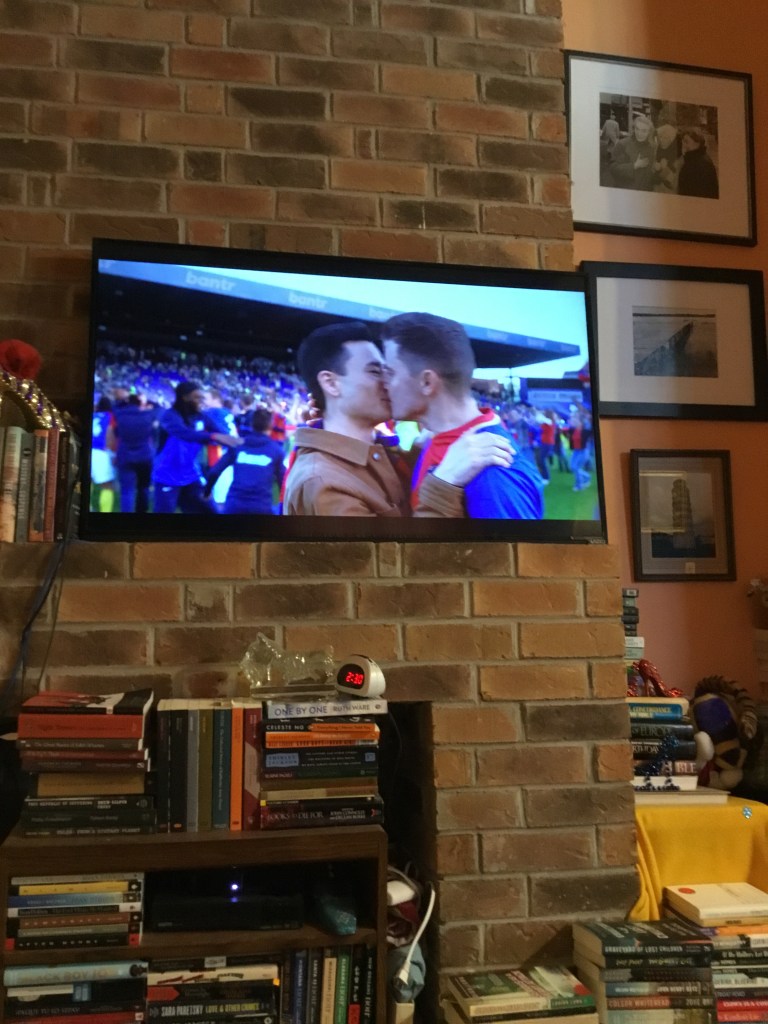
The last thing I expected to find in Season 3 of Ted Lasso was the story of a closeted gay player on the Richmond team. Colin Hewes, who was just adorable and got a line here and there–often funny ones–got his chance to shine as an actor in the third season. When the team’s sponsor switches from Dubai Air to Bantr in the second season, Keely is telling the team about them and she talks about how it’s spelled…and Colin pipes up with, “oh, like Grindr.” There was a bit of an awkward silence and then the scene moved forward. A throwaway, a little nothing, and I literally was amused by it and promptly forgot it. But there was a pay-off for that little line, as we discover in Season 3 that Colin is gay and deeply closeted, as well as deeply conflicted about keeping the secret from his teammates–who are both friend and family to him. I’ve already written about the beautiful scene in Amsterdam when Trent not only tells Colin that he knows, but comes out to him as well…becoming a kind of mentor for him. The fact that the scene between Colin and Trent was filmed in front of the monument to all the gay lives lost in the Holocaust (our history! No longer being ignored! Oh my heart!)? Bravo, Apple TV and everyone involved with this show. Bravo.
And finally…his best friend on the team finds out and stops speaking to him. Finally, in one of my favorite episodes ever of any television series, Colin finally has to come clean…and is welcomed by one and all. Ted’s speech about them caring about his being gay because they care about him, and how he never has to go through anything alone anymore, was just beautiful and I had tears running out of my eyes.
Hell, just writing about it is making me tear up again.
Representation matters. And having it on one of the most critically acclaimed and award-winning comedy series of the decade?
And the scene above? It’s also a callback to the conversation between Colin and Trent. Colin says he doesn’t want to be a spokesperson, doesn’t want any fuss, just wants to live his life and “be able to kiss my guy after a win, like the other fellas do with their gals.” And after the biggest win in the history of the team, he gets to do just that.
I would have cried had I not already been crying.
Because yes, the final game Ted coached for Richmond was epic. At one point during the game I realized I was just as tense as I get during big LSU games, marveling at the power of the show. The game was a fiction. It wasn’t real. But it mattered to me. I wanted them to win. I wanted my team, my little family of players on a fictional television series, to win because I wanted to see their joy. I wanted them to celebrate, and I wanted to see it. (I’ve watched the game segment several times now.)
And as much as I hate to say it, it is time to say adieu to one of my favorite shows. Thank you for the joy you’ve brought me the last three seasons. Thank you to the cast, the writers, and the crew.
And a big thank you to Alafair Burke, without whom I may have never watched in the first place.
 Queer and Loathing in America