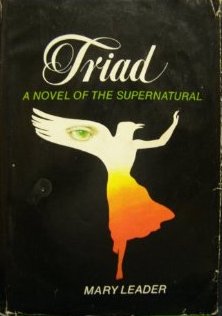
I first read Mary Leader’s novel Triad when I was either eleven or twelve. I was creepy, and I really enjoyed it; but I had trouble pronouncing one of the character names: Rhiannon. It was a Welsh name, of course, and I’d never heard it before, so I was pronouncing it RYE-uh-none. I actually thought it was an ugly name. Flash forward a few years, and I heard a song unlike any other I’d ever heard before on the radio–KCMO AM out of Kansas City, I think it was–and after it was finished playing, the deejay said it was “Ree-ANN-un” by Fleetwood Mac (a band I’d never heard of). The next time I was at a record store, I looked for it in the 45’s rack, and there it was: RHIANNON (Will You Ever Win” by Fleetwood Mac.

Oh, THAT’S how you say it, I thought to myself, and bought it. I eventually bought the entire album–one of the first albums I’d ever owned that I could listen to from beginning to end–and have been a Fleetwood Mac fan ever since.
A few years ago, I either read an interview with her, or saw her talking about the song on television somewhere, and Stevie Nicks said she’d read a book where she came across the name, and the book actually inspired the song. It was one of those moments where you feel a connection with an artist you love (“Oh my God, I read that book too!”)
Recently, and I don’t remember where or how or why; it may have been my October blogging, but as I said, I don’t remember how, but I remembered the book again. I hadn’t read it in over forty years, and I remembered that the author had written another book I’d enjoyed–Salem’s Children–and so I went on-line and ordered copies of both.
And I reread Triad this past week.
It didn’t start all of a sudden. As I think back now, there were so many little unexplained incidents that I shoved aside and forgot about until later. There began to be those gaps in my life, little ones at first, but then longer and longer as time went on. I would wonder if my memory was failing me and I worried about the headaches to which I’d become prone, but my doctor told me that it was probably shock due to the baby’s death.
That has been so unexpected. I put him to bed one night, all rosy and dimpled with health. He looked at me with those big bright eyes, as he lay fingering the handle of his rattle, then drowsiness drew down his lids and he flipped over on his stomach as he always did and went to sleep with his fist curled around the rattle. The next morning I awakened to the sound of children on their way to school and the disposal truck grinding garbage under our apartment window. Alan was away on one of his projects, so I must have slept right through breakfast. I started to stretch lazily in those moments of waking when one lies between forgetting and remembering, and then sat up with a jerk. Timmy has missed his four o’clock feeding! Had he called and I hadn’t heard him? That wasn’t possible. I always woke at the slightest sound he made. I hurried to the crib and there he was, just as I had left him, but his little body was cold.
“Unexplained crib death” was what the doctor wrote on the death certificate after the autopsy, which meant that Timmy went to sleep a normal child and just stopped breathing for no apparent reason.
Branwen is our young point of view heroine, and the sudden, unexpected death of her child has obviously had a terrible effect on her; I cannot even imagine what it must be like to lose a child, let alone a baby. In an effort to get her over the tragedy, she and her husband, Alan–a civil engineer who is thus away for work most of the time–leave their Chicago apartment behind and buy a beautiful old Victorian house in a small town north of the city on the lake shore.
And then the weird things start happening.
Branwen has guarded a secret most of her life, you see. When she was a little girl she had an older cousin, Rhiannon–their parents were two sets of identical twins–who was jealous and cruel to her, and as such, Branwen hated her. After Rhiannon killed a kitten of Branwen’s–and made it look like it was Branwen’s fault–during a game of hide-and-seek, Rhiannon was inside an old freezer, and Branwen closed the lid on her.
Unfortunately, the handle broke and she wasn’t able to get her out. She went for help, but by the time she was able to get help, Rhiannon was dead.
And now, in the big empty house, with its speaking tubes and old-fashioned stylings, she can hear Rhiannon whispering to her…and strange things start happening.
Has Rhiannon come back? Is the house haunted? Has the loss of her child driven her mad? Is she being possessed?
The atmosphere of the book is terrifying and creepy–those speaking tubes! One of the things I remembered before the reread, over forty years later, was the speaking tubes and the hollow voices coming out of them.
In tone and voice and atmosphere, it’s very similar to Thomas Tryon’s The Other as well as something Shirley Jackson might have written.
Long out of print, it’s a shame. The book is a gem of a read, and short–less than 200 pages–and it’s also a shame Leader only wrote two books.
And as you read it, you can see echoes of the Stevie Nicks song in its pages, and you can see how it inspired her to write the song.
It’s a haunting book–like I said, I’ve never forgotten it–and I’m glad I got the chance to reread it.
 Queer and Loathing in America